

The zero space is demonstrated in Figure 4, where the connected components
where the Laplacian changes sign are labeled. From the figure, it is apparent that the
cell nuclei can be enclosed well by the blobs.
The number of differential invariants increases with the increase of the image
dimensions. However, the theory can be extended along similar lines. A very useful
development in this direction is geometric algebra and calculus, which provide a
dimension invariant representation of the geometrical structures.
The so-introduced geometric image features can be used as building blocks for
advanced machine learning strategies for interactive segmentation and classification. This strategy was implemented in two segmentation platforms based on
ImageJ/Fiji. The Trainable Weka Segmentation (TWS) [10] and the Active Segmentation [11] have recently presented new opportunities for analyzing complex
datasets. Specifically, the active segmentation uses the scale-space-based filters
presented here.
5. Scale-space theory
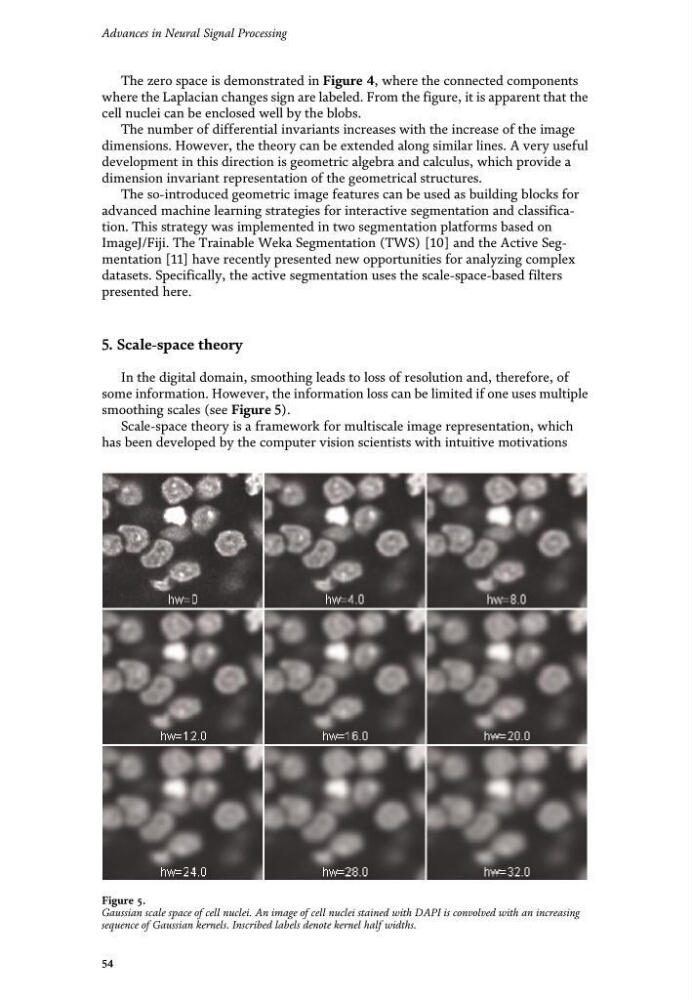
In the digital domain, smoothing leads to loss of resolution and, therefore, of
some information. However, the information loss can be limited if one uses multiple
smoothing scales (see Figure 5).
Scale-space theory is a framework for multiscale image representation, which
has been developed by the computer vision scientists with intuitive motivations
Figure 5.
Gaussian scale space of cell nuclei. An image of cell nuclei stained with DAPI is convolved with an increasing
sequence of Gaussian kernels. Inscribed labels denote kernel half widths.
54
Advances in Neural Signal Processing
where the Laplacian changes sign are labeled. From the figure, it is apparent that the
cell nuclei can be enclosed well by the blobs.
The number of differential invariants increases with the increase of the image
dimensions. However, the theory can be extended along similar lines. A very useful
development in this direction is geometric algebra and calculus, which provide a
dimension invariant representation of the geometrical structures.
The so-introduced geometric image features can be used as building blocks for
advanced machine learning strategies for interactive segmentation and classification. This strategy was implemented in two segmentation platforms based on
ImageJ/Fiji. The Trainable Weka Segmentation (TWS) [10] and the Active Segmentation [11] have recently presented new opportunities for analyzing complex
datasets. Specifically, the active segmentation uses the scale-space-based filters
presented here.
5. Scale-space theory
In the digital domain, smoothing leads to loss of resolution and, therefore, of
some information. However, the information loss can be limited if one uses multiple
smoothing scales (see Figure 5).
Scale-space theory is a framework for multiscale image representation, which
has been developed by the computer vision scientists with intuitive motivations
Figure 5.
Gaussian scale space of cell nuclei. An image of cell nuclei stained with DAPI is convolved with an increasing
sequence of Gaussian kernels. Inscribed labels denote kernel half widths.
54
Advances in Neural Signal Processing