

Advances in Neural Signal Processing
14
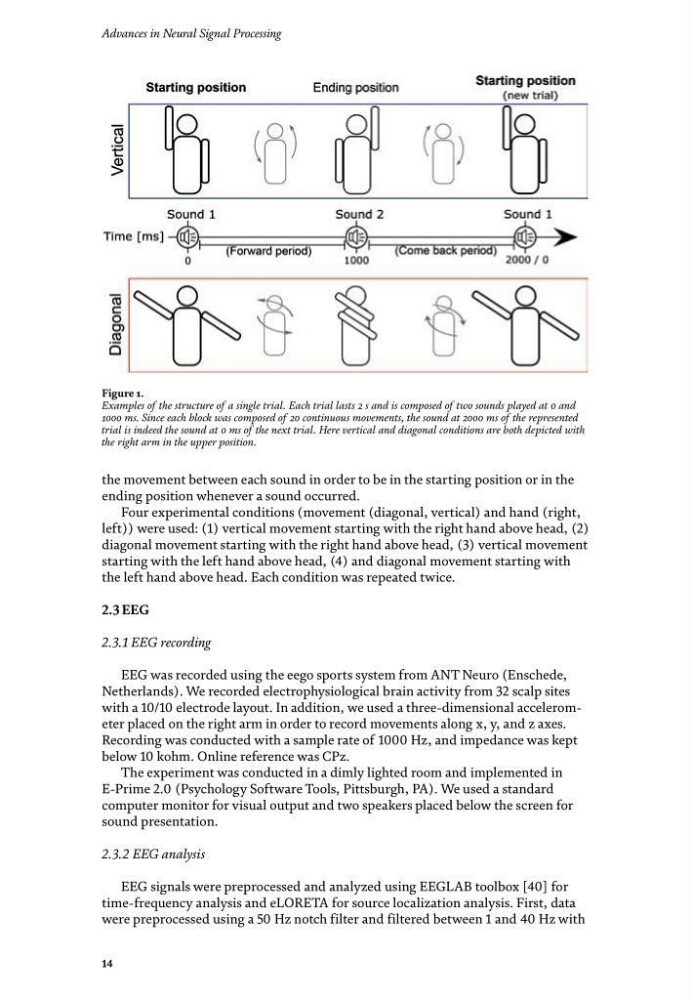
the movement between each sound in order to be in the starting position or in the
ending position whenever a sound occurred.
Four experimental conditions (movement (diagonal, vertical) and hand (right,
left)) were used: (1) vertical movement starting with the right hand above head, (2)
diagonal movement starting with the right hand above head, (3) vertical movement
starting with the left hand above head, (4) and diagonal movement starting with
the left hand above head. Each condition was repeated twice.
2.3 EEG
2.3.1 EEG recording
EEG was recorded using the eego sports system from ANT Neuro (Enschede,
Netherlands). We recorded electrophysiological brain activity from 32 scalp sites
with a 10/10 electrode layout. In addition, we used a three-dimensional accelerometer placed on the right arm in order to record movements along x, y, and z axes.
Recording was conducted with a sample rate of 1000 Hz, and impedance was kept
below 10 kohm. Online reference was CPz.
The experiment was conducted in a dimly lighted room and implemented in
E-Prime 2.0 (Psychology Software Tools, Pittsburgh, PA). We used a standard
computer monitor for visual output and two speakers placed below the screen for
sound presentation.
2.3.2 EEG analysis
EEG signals were preprocessed and analyzed using EEGLAB toolbox [40] for
time-frequency analysis and eLORETA for source localization analysis. First, data
were preprocessed using a 50 Hz notch filter and filtered between 1 and 40 Hz with
Figure 1.
Examples of the structure of a single trial. Each trial lasts 2 s and is composed of two sounds played at 0 and
1000 ms. Since each block was composed of 20 continuous movements, the sound at 2000 ms of the represented
trial is indeed the sound at 0 ms of the next trial. Here vertical and diagonal conditions are both depicted with
the right arm in the upper position.
14
the movement between each sound in order to be in the starting position or in the
ending position whenever a sound occurred.
Four experimental conditions (movement (diagonal, vertical) and hand (right,
left)) were used: (1) vertical movement starting with the right hand above head, (2)
diagonal movement starting with the right hand above head, (3) vertical movement
starting with the left hand above head, (4) and diagonal movement starting with
the left hand above head. Each condition was repeated twice.
2.3 EEG
2.3.1 EEG recording
EEG was recorded using the eego sports system from ANT Neuro (Enschede,
Netherlands). We recorded electrophysiological brain activity from 32 scalp sites
with a 10/10 electrode layout. In addition, we used a three-dimensional accelerometer placed on the right arm in order to record movements along x, y, and z axes.
Recording was conducted with a sample rate of 1000 Hz, and impedance was kept
below 10 kohm. Online reference was CPz.
The experiment was conducted in a dimly lighted room and implemented in
E-Prime 2.0 (Psychology Software Tools, Pittsburgh, PA). We used a standard
computer monitor for visual output and two speakers placed below the screen for
sound presentation.
2.3.2 EEG analysis
EEG signals were preprocessed and analyzed using EEGLAB toolbox [40] for
time-frequency analysis and eLORETA for source localization analysis. First, data
were preprocessed using a 50 Hz notch filter and filtered between 1 and 40 Hz with
Figure 1.
Examples of the structure of a single trial. Each trial lasts 2 s and is composed of two sounds played at 0 and
1000 ms. Since each block was composed of 20 continuous movements, the sound at 2000 ms of the represented
trial is indeed the sound at 0 ms of the next trial. Here vertical and diagonal conditions are both depicted with
the right arm in the upper position.