

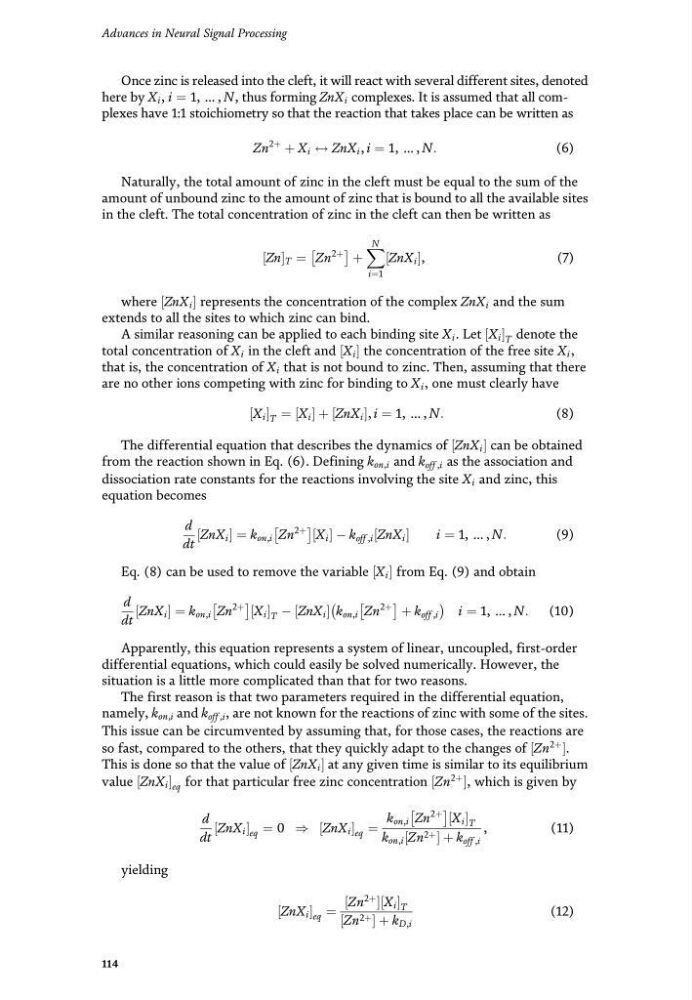
Once zinc is released into the cleft, it will react with several different sites, denoted
here by X i , i ¼ 1, … , N, thus forming ZnX i complexes. It is assumed that all complexes have 1:1 stoichiometry so that the reaction that takes place can be written as
Zn
2þ þ X i $ ZnX i , i ¼ 1, … , N:
(6)
Naturally, the total amount of zinc in the cleft must be equal to the sum of the
amount of unbound zinc to the amount of zinc that is bound to all the available sites
in the cleft. The total concentration of zinc in the cleft can then be written as
Zn
½� T ¼ Zn
2þ
��
þ
X N
i¼1
ZnX i
½� ,
(7)
where ZnX i
½� represents the concentration of the complex ZnX i and the sum
extends to all the sites to which zinc can bind.
A similar reasoning can be applied to each binding site X i . Let X i
½� T denote the
total concentration of X i in the cleft and X i
½� the concentration of the free site X i ,
that is, the concentration of X i that is not bound to zinc. Then, assuming that there
are no other ions competing with zinc for binding to X i , one must clearly have
X i
½� T ¼ X i
½ �þ ZnX i
½� , i ¼ 1, … , N:
(8)
The differential equation that describes the dynamics of ZnX i
½� can be obtained
from the reaction shown in Eq. (6). Defining k on,i and k off ,i as the association and
dissociation rate constants for the reactions involving the site X i and zinc, this
equation becomes
d
dt
ZnX i
½
�¼k on,i Zn
2þ
��
X i
½ ��k off ,i ZnX i
½�i ¼ 1, … , N:
(9)
Eq. (8) can be used to remove the variable X i
½� from Eq. (9) and obtain
d
dt
ZnX i
½
�¼k on,i Zn
2þ
��
X i
½� T � ZnX i
½� k on,i Zn
2þ
��
þ k off ,i
��
i ¼ 1, … , N: (10)
Apparently, this equation represents a system of linear, uncoupled, first-order
differential equations, which could easily be solved numerically. However, the
situation is a little more complicated than that for two reasons.
The first reason is that two parameters required in the differential equation,
namely, k on,i and k off ,i , are not known for the reactions of zinc with some of the sites.
This issue can be circumvented by assuming that, for those cases, the reactions are
so fast, compared to the others, that they quickly adapt to the changes of Zn
2þ
½� .
This is done so that the value of ZnX i
½� at any given time is similar to its equilibrium
value ZnX i
½� eq for that particular free zinc concentration Zn
2þ
½� , which is given by
d
dt
ZnX i
½� eq ¼ 0 ) ZnX i
½� eq ¼
k on,i Zn
2þ
��
X i
½� T
k on,i Zn 2þ
½
�þk off ,i
,
(11)
yielding
ZnX i
½� eq ¼
Zn
2þ
½� X i
½� T
Zn 2þ
½
�þk D,i
(12)
114
Advances in Neural Signal Processing
here by X i , i ¼ 1, … , N, thus forming ZnX i complexes. It is assumed that all complexes have 1:1 stoichiometry so that the reaction that takes place can be written as
Zn
2þ þ X i $ ZnX i , i ¼ 1, … , N:
(6)
Naturally, the total amount of zinc in the cleft must be equal to the sum of the
amount of unbound zinc to the amount of zinc that is bound to all the available sites
in the cleft. The total concentration of zinc in the cleft can then be written as
Zn
½� T ¼ Zn
2þ
��
þ
X N
i¼1
ZnX i
½� ,
(7)
where ZnX i
½� represents the concentration of the complex ZnX i and the sum
extends to all the sites to which zinc can bind.
A similar reasoning can be applied to each binding site X i . Let X i
½� T denote the
total concentration of X i in the cleft and X i
½� the concentration of the free site X i ,
that is, the concentration of X i that is not bound to zinc. Then, assuming that there
are no other ions competing with zinc for binding to X i , one must clearly have
X i
½� T ¼ X i
½ �þ ZnX i
½� , i ¼ 1, … , N:
(8)
The differential equation that describes the dynamics of ZnX i
½� can be obtained
from the reaction shown in Eq. (6). Defining k on,i and k off ,i as the association and
dissociation rate constants for the reactions involving the site X i and zinc, this
equation becomes
d
dt
ZnX i
½
�¼k on,i Zn
2þ
��
X i
½ ��k off ,i ZnX i
½�i ¼ 1, … , N:
(9)
Eq. (8) can be used to remove the variable X i
½� from Eq. (9) and obtain
d
dt
ZnX i
½
�¼k on,i Zn
2þ
��
X i
½� T � ZnX i
½� k on,i Zn
2þ
��
þ k off ,i
��
i ¼ 1, … , N: (10)
Apparently, this equation represents a system of linear, uncoupled, first-order
differential equations, which could easily be solved numerically. However, the
situation is a little more complicated than that for two reasons.
The first reason is that two parameters required in the differential equation,
namely, k on,i and k off ,i , are not known for the reactions of zinc with some of the sites.
This issue can be circumvented by assuming that, for those cases, the reactions are
so fast, compared to the others, that they quickly adapt to the changes of Zn
2þ
½� .
This is done so that the value of ZnX i
½� at any given time is similar to its equilibrium
value ZnX i
½� eq for that particular free zinc concentration Zn
2þ
½� , which is given by
d
dt
ZnX i
½� eq ¼ 0 ) ZnX i
½� eq ¼
k on,i Zn
2þ
��
X i
½� T
k on,i Zn 2þ
½
�þk off ,i
,
(11)
yielding
ZnX i
½� eq ¼
Zn
2þ
½� X i
½� T
Zn 2þ
½
�þk D,i
(12)
114
Advances in Neural Signal Processing