

depending degradation profiles supports the conclusions of earlier studies
(as outlined earlier in Chap. 2).
10.2.3 Other Chlorinated Pesticides
Besides chiral PCBs and α-HCH, some other chiral chlorinated pesticides have been
described to show various enantioselective toxicity. Some of the most notorious
chiral chlorinated pesticides reported as environmental pollutants include chlordane
and cyclodiene derivatives like heptachlor, 2-chloroheptachlor, heptachlor exoepoxide and related compounds. Miyazaki et al. (1978) reported the enantioselective
toxicity of cyclodiene derivatives and heptachlor exo-epoxide on male adults of
German cockroach (Blattella germanica). A sample of the enantiomers and their
racemic mixture was given to 10–20 bugs per dose. The toxicity was shown as
the percentage of mortality per 24 h after the use of the samples. It was concluded
that (–)-chlordiene epoxide, (+)-chlordiene and (+)- heptachlor exo-epoxide
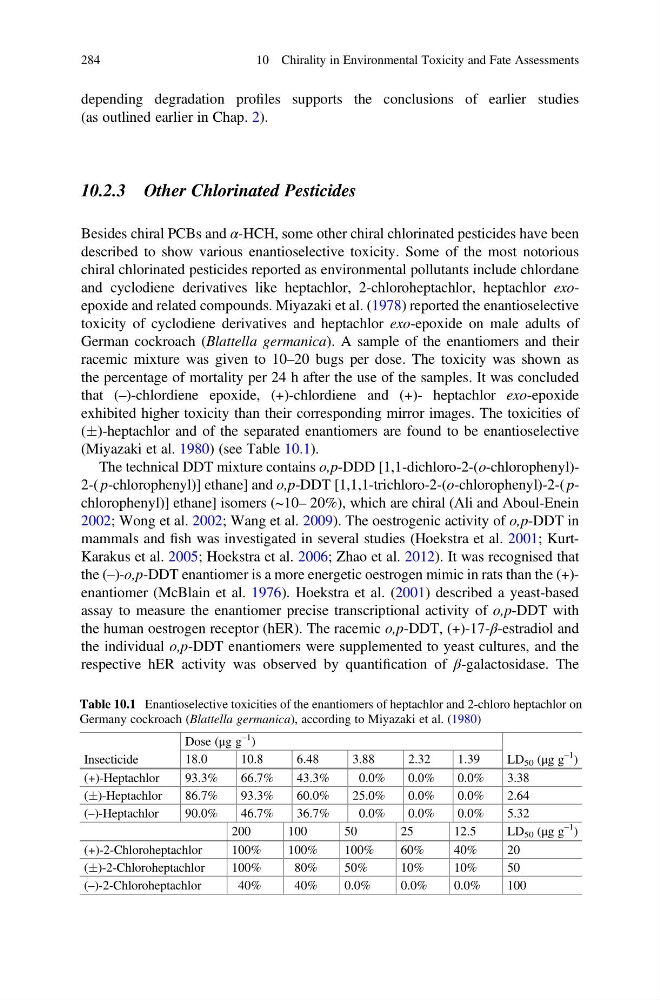
exhibited higher toxicity than their corresponding mirror images. The toxicities of
(Æ)-heptachlor and of the separated enantiomers are found to be enantioselective
(Miyazaki et al. 1980) (see Table 10.1).
The technical DDT mixture contains o,p-DDD [1,1-dichloro-2-(o-chlorophenyl)2-( p-chlorophenyl)] ethane] and o,p-DDT [1,1,1-trichloro-2-(o-chlorophenyl)-2-( pchlorophenyl)] ethane] isomers (~10– 20%), which are chiral (Ali and Aboul-Enein
2002; Wong et al. 2002; Wang et al. 2009). The oestrogenic activity of o,p-DDT in
mammals and fish was investigated in several studies (Hoekstra et al. 2001; KurtKarakus et al. 2005; Hoekstra et al. 2006; Zhao et al. 2012). It was recognised that
the (–)-o,p-DDT enantiomer is a more energetic oestrogen mimic in rats than the (+)enantiomer (McBlain et al. 1976). Hoekstra et al. (2001) described a yeast-based
assay to measure the enantiomer precise transcriptional activity of o,p-DDT with
the human oestrogen receptor (hER). The racemic o,p-DDT, (+)-17-β-estradiol and
the individual o,p-DDT enantiomers were supplemented to yeast cultures, and the
respective hER activity was observed by quantification of β-galactosidase. The
Table 10.1 Enantioselective toxicities of the enantiomers of heptachlor and 2-chloro heptachlor on
Germany cockroach (Blattella germanica), according to Miyazaki et al. (1980)
Insecticide
Dose (μg g
–1
)
LD 50 (μg g
–1
)
18.0
10.8
6.48
3.88
2.32
1.39
(+)-Heptachlor
93.3%
66.7%
43.3%
0.0%
0.0%
0.0%
3.38
(Æ)-Heptachlor
86.7%
93.3%
60.0%
25.0%
0.0%
0.0%
2.64
(–)-Heptachlor
90.0%
46.7%
36.7%
0.0%
0.0%
0.0%
5.32
200
100
50
25
12.5
LD 50 (μg g
–1
)
(+)-2-Chloroheptachlor
100%
100%
100%
60%
40%
20
(Æ)-2-Chloroheptachlor
100%
80%
50%
10%
10%
50
(–)-2-Chloroheptachlor
40%
40%
0.0%
0.0%
0.0%
100
284
10 Chirality in Environmental Toxicity and Fate Assessments
(as outlined earlier in Chap. 2).
10.2.3 Other Chlorinated Pesticides
Besides chiral PCBs and α-HCH, some other chiral chlorinated pesticides have been
described to show various enantioselective toxicity. Some of the most notorious
chiral chlorinated pesticides reported as environmental pollutants include chlordane
and cyclodiene derivatives like heptachlor, 2-chloroheptachlor, heptachlor exoepoxide and related compounds. Miyazaki et al. (1978) reported the enantioselective
toxicity of cyclodiene derivatives and heptachlor exo-epoxide on male adults of
German cockroach (Blattella germanica). A sample of the enantiomers and their
racemic mixture was given to 10–20 bugs per dose. The toxicity was shown as
the percentage of mortality per 24 h after the use of the samples. It was concluded
that (–)-chlordiene epoxide, (+)-chlordiene and (+)- heptachlor exo-epoxide
exhibited higher toxicity than their corresponding mirror images. The toxicities of
(Æ)-heptachlor and of the separated enantiomers are found to be enantioselective
(Miyazaki et al. 1980) (see Table 10.1).
The technical DDT mixture contains o,p-DDD [1,1-dichloro-2-(o-chlorophenyl)2-( p-chlorophenyl)] ethane] and o,p-DDT [1,1,1-trichloro-2-(o-chlorophenyl)-2-( pchlorophenyl)] ethane] isomers (~10– 20%), which are chiral (Ali and Aboul-Enein
2002; Wong et al. 2002; Wang et al. 2009). The oestrogenic activity of o,p-DDT in
mammals and fish was investigated in several studies (Hoekstra et al. 2001; KurtKarakus et al. 2005; Hoekstra et al. 2006; Zhao et al. 2012). It was recognised that
the (–)-o,p-DDT enantiomer is a more energetic oestrogen mimic in rats than the (+)enantiomer (McBlain et al. 1976). Hoekstra et al. (2001) described a yeast-based
assay to measure the enantiomer precise transcriptional activity of o,p-DDT with
the human oestrogen receptor (hER). The racemic o,p-DDT, (+)-17-β-estradiol and
the individual o,p-DDT enantiomers were supplemented to yeast cultures, and the
respective hER activity was observed by quantification of β-galactosidase. The
Table 10.1 Enantioselective toxicities of the enantiomers of heptachlor and 2-chloro heptachlor on
Germany cockroach (Blattella germanica), according to Miyazaki et al. (1980)
Insecticide
Dose (μg g
–1
)
LD 50 (μg g
–1
)
18.0
10.8
6.48
3.88
2.32
1.39
(+)-Heptachlor
93.3%
66.7%
43.3%
0.0%
0.0%
0.0%
3.38
(Æ)-Heptachlor
86.7%
93.3%
60.0%
25.0%
0.0%
0.0%
2.64
(–)-Heptachlor
90.0%
46.7%
36.7%
0.0%
0.0%
0.0%
5.32
200
100
50
25
12.5
LD 50 (μg g
–1
)
(+)-2-Chloroheptachlor
100%
100%
100%
60%
40%
20
(Æ)-2-Chloroheptachlor
100%
80%
50%
10%
10%
50
(–)-2-Chloroheptachlor
40%
40%
0.0%
0.0%
0.0%
100
284
10 Chirality in Environmental Toxicity and Fate Assessments