

9.9 Endocrine-Disrupting Chemicals
The endocrine-disrupting chemicals (EDCs) are very notorious molecules disturbing
our endocrine system. The contamination effects of endocrine-disrupting chemicals
are gaining great attention worldwide (Furlong, Water Environment Research Foundation, et al. 2010; Klein 2012; Lippmann and Leikauf 2020). EDCs are exogenous
agents interfering with the synthesis, secretion, transport, binding action or elimination of natural hormones in the body. The EDC group is partially covering already
mentioned substance groups such as organochlorine pesticides, additives,
polychlorinated biphenyl phenolic compounds and selected PPCPs (Khetan 2014;
Spellman 2014). The endocrine system of an organism (hormone interactions) is
accountable for the maintenance of homeostasis, reproduction, development or
behaviour. Interacting EDCs in an organism can, thus, cause difficulties in cell,
organ, individual, and population levels by disturbing the endocrine balance. The
most investigated EDCs are pesticides, PAH, PCBs, natural and synthetic steroid
hormones and some drugs. The most notorious chiral molecules are o,p
0 -DDT,
hexachlorocyclohexanes (i.e. α-HCH), bifenthrin, permethrin, fenvalerate,
naproxen, metoprolol and others. The sources of their pollution are the same as
discussed in various classes as above.
9.10 Conclusion
The identification of sources of pollution is a very important aspect in controlling the
pollution of the environment. There are two important sources of pollution, that is,
point and non-point sources. The point sources include industrial production, industrial effluents and emissions, hospitals, pharmacies, clinics, stores, municipal wastewater discharge run-off, rural and urban sewage sludge, wastewater treatment plants,
landfills and thermal processes. Contrarily, the non-point sources are agricultural and
forestry run-off, vapourisation, spray drift, combustion of fossil fuels, automobile
engine exhausts, forest and prairie fires, incineration of municipal waste and
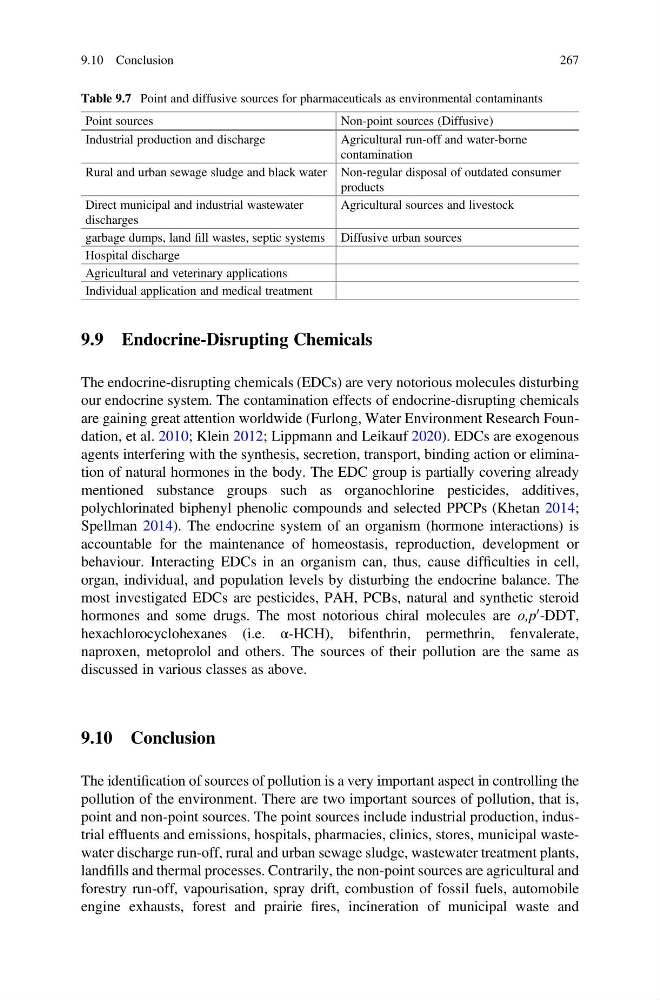
Table 9.7 Point and diffusive sources for pharmaceuticals as environmental contaminants
Point sources
Non-point sources (Diffusive)
Industrial production and discharge
Agricultural run-off and water-borne
contamination
Rural and urban sewage sludge and black water Non-regular disposal of outdated consumer
products
Direct municipal and industrial wastewater
discharges
Agricultural sources and livestock
garbage dumps, land fill wastes, septic systems Diffusive urban sources
Hospital discharge
Agricultural and veterinary applications
Individual application and medical treatment
9.10 Conclusion
267
The endocrine-disrupting chemicals (EDCs) are very notorious molecules disturbing
our endocrine system. The contamination effects of endocrine-disrupting chemicals
are gaining great attention worldwide (Furlong, Water Environment Research Foundation, et al. 2010; Klein 2012; Lippmann and Leikauf 2020). EDCs are exogenous
agents interfering with the synthesis, secretion, transport, binding action or elimination of natural hormones in the body. The EDC group is partially covering already
mentioned substance groups such as organochlorine pesticides, additives,
polychlorinated biphenyl phenolic compounds and selected PPCPs (Khetan 2014;
Spellman 2014). The endocrine system of an organism (hormone interactions) is
accountable for the maintenance of homeostasis, reproduction, development or
behaviour. Interacting EDCs in an organism can, thus, cause difficulties in cell,
organ, individual, and population levels by disturbing the endocrine balance. The
most investigated EDCs are pesticides, PAH, PCBs, natural and synthetic steroid
hormones and some drugs. The most notorious chiral molecules are o,p
0 -DDT,
hexachlorocyclohexanes (i.e. α-HCH), bifenthrin, permethrin, fenvalerate,
naproxen, metoprolol and others. The sources of their pollution are the same as
discussed in various classes as above.
9.10 Conclusion
The identification of sources of pollution is a very important aspect in controlling the
pollution of the environment. There are two important sources of pollution, that is,
point and non-point sources. The point sources include industrial production, industrial effluents and emissions, hospitals, pharmacies, clinics, stores, municipal wastewater discharge run-off, rural and urban sewage sludge, wastewater treatment plants,
landfills and thermal processes. Contrarily, the non-point sources are agricultural and
forestry run-off, vapourisation, spray drift, combustion of fossil fuels, automobile
engine exhausts, forest and prairie fires, incineration of municipal waste and
Table 9.7 Point and diffusive sources for pharmaceuticals as environmental contaminants
Point sources
Non-point sources (Diffusive)
Industrial production and discharge
Agricultural run-off and water-borne
contamination
Rural and urban sewage sludge and black water Non-regular disposal of outdated consumer
products
Direct municipal and industrial wastewater
discharges
Agricultural sources and livestock
garbage dumps, land fill wastes, septic systems Diffusive urban sources
Hospital discharge
Agricultural and veterinary applications
Individual application and medical treatment
9.10 Conclusion
267