

8.2.5.4 The Transformation Products of HHCB
A comprehensive risk assessment study should also include the metabolites of the
respective xenobiotics. In the case of the polycyclic musks, publications by Biselli
et al. (Biselli 2001; Gatermann et al. 2002a, b) and Franke et al. (1999) presented first
results on HHCB metabolites, including their syntheses and their enantioselective
gas chromatographic separations.
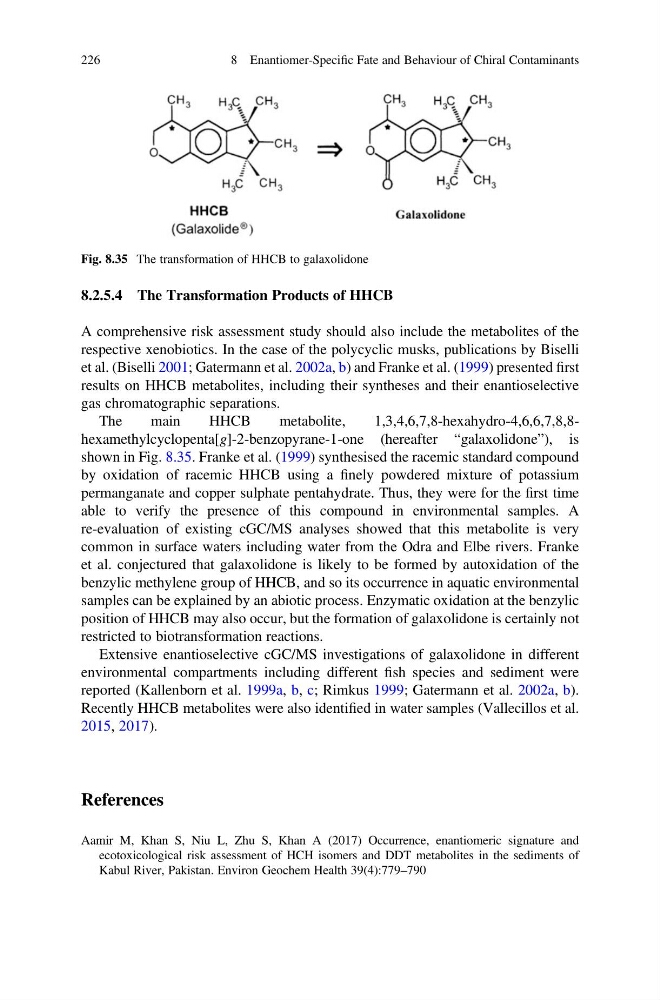
The
main
HHCB
metabolite,
1,3,4,6,7,8-hexahydro-4,6,6,7,8,8hexamethylcyclopenta[g]-2-benzopyrane-1-one (hereafter “galaxolidone”), is
shown in Fig. 8.35. Franke et al. (1999) synthesised the racemic standard compound
by oxidation of racemic HHCB using a finely powdered mixture of potassium
permanganate and copper sulphate pentahydrate. Thus, they were for the first time
able to verify the presence of this compound in environmental samples. A
re-evaluation of existing cGC/MS analyses showed that this metabolite is very
common in surface waters including water from the Odra and Elbe rivers. Franke
et al. conjectured that galaxolidone is likely to be formed by autoxidation of the
benzylic methylene group of HHCB, and so its occurrence in aquatic environmental
samples can be explained by an abiotic process. Enzymatic oxidation at the benzylic
position of HHCB may also occur, but the formation of galaxolidone is certainly not
restricted to biotransformation reactions.
Extensive enantioselective cGC/MS investigations of galaxolidone in different
environmental compartments including different fish species and sediment were
reported (Kallenborn et al. 1999a, b, c; Rimkus 1999; Gatermann et al. 2002a, b).
Recently HHCB metabolites were also identified in water samples (Vallecillos et al.
2015, 2017).
References
Aamir M, Khan S, Niu L, Zhu S, Khan A (2017) Occurrence, enantiomeric signature and
ecotoxicological risk assessment of HCH isomers and DDT metabolites in the sediments of
Kabul River, Pakistan. Environ Geochem Health 39(4):779–790
Fig. 8.35 The transformation of HHCB to galaxolidone
226
8 Enantiomer-Specific Fate and Behaviour of Chiral Contaminants
A comprehensive risk assessment study should also include the metabolites of the
respective xenobiotics. In the case of the polycyclic musks, publications by Biselli
et al. (Biselli 2001; Gatermann et al. 2002a, b) and Franke et al. (1999) presented first
results on HHCB metabolites, including their syntheses and their enantioselective
gas chromatographic separations.
The
main
HHCB
metabolite,
1,3,4,6,7,8-hexahydro-4,6,6,7,8,8hexamethylcyclopenta[g]-2-benzopyrane-1-one (hereafter “galaxolidone”), is
shown in Fig. 8.35. Franke et al. (1999) synthesised the racemic standard compound
by oxidation of racemic HHCB using a finely powdered mixture of potassium
permanganate and copper sulphate pentahydrate. Thus, they were for the first time
able to verify the presence of this compound in environmental samples. A
re-evaluation of existing cGC/MS analyses showed that this metabolite is very
common in surface waters including water from the Odra and Elbe rivers. Franke
et al. conjectured that galaxolidone is likely to be formed by autoxidation of the
benzylic methylene group of HHCB, and so its occurrence in aquatic environmental
samples can be explained by an abiotic process. Enzymatic oxidation at the benzylic
position of HHCB may also occur, but the formation of galaxolidone is certainly not
restricted to biotransformation reactions.
Extensive enantioselective cGC/MS investigations of galaxolidone in different
environmental compartments including different fish species and sediment were
reported (Kallenborn et al. 1999a, b, c; Rimkus 1999; Gatermann et al. 2002a, b).
Recently HHCB metabolites were also identified in water samples (Vallecillos et al.
2015, 2017).
References
Aamir M, Khan S, Niu L, Zhu S, Khan A (2017) Occurrence, enantiomeric signature and
ecotoxicological risk assessment of HCH isomers and DDT metabolites in the sediments of
Kabul River, Pakistan. Environ Geochem Health 39(4):779–790
Fig. 8.35 The transformation of HHCB to galaxolidone
226
8 Enantiomer-Specific Fate and Behaviour of Chiral Contaminants