

8.2.5.3 Comparison of Tench and Crucian Carp Samples
In order to support the conclusion that the lower concentrations encountered in
crucian carps are caused by enantioselective transformation, theoretical concentrations for passive bioconcentration were calculated by Gatermann et al. (2002a, b) on
the following basis: It was tentatively assumed that only one enantiomer is being
transformed and that the prevailing enantiomer represents 50% of a “theoretical
concentration” without metabolisation. In the case of trans-ATII, an ER of 0.8
(found in the water samples) instead of a racemic distribution was used as basic
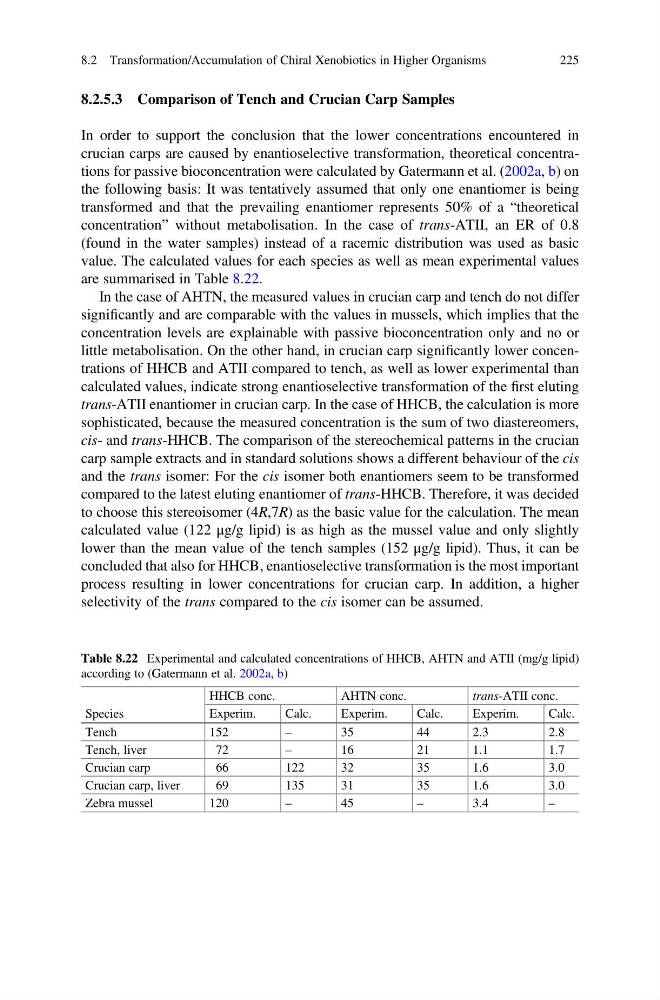
value. The calculated values for each species as well as mean experimental values
are summarised in Table 8.22.
In the case of AHTN, the measured values in crucian carp and tench do not differ
significantly and are comparable with the values in mussels, which implies that the
concentration levels are explainable with passive bioconcentration only and no or
little metabolisation. On the other hand, in crucian carp significantly lower concentrations of HHCB and ATII compared to tench, as well as lower experimental than
calculated values, indicate strong enantioselective transformation of the first eluting
trans-ATII enantiomer in crucian carp. In the case of HHCB, the calculation is more
sophisticated, because the measured concentration is the sum of two diastereomers,
cis- and trans-HHCB. The comparison of the stereochemical patterns in the crucian
carp sample extracts and in standard solutions shows a different behaviour of the cis
and the trans isomer: For the cis isomer both enantiomers seem to be transformed
compared to the latest eluting enantiomer of trans-HHCB. Therefore, it was decided
to choose this stereoisomer (4R,7R) as the basic value for the calculation. The mean
calculated value (122 μg/g lipid) is as high as the mussel value and only slightly
lower than the mean value of the tench samples (152 μg/g lipid). Thus, it can be
concluded that also for HHCB, enantioselective transformation is the most important
process resulting in lower concentrations for crucian carp. In addition, a higher
selectivity of the trans compared to the cis isomer can be assumed.
Table 8.22 Experimental and calculated concentrations of HHCB, AHTN and ATII (mg/g lipid)
according to (Gatermann et al. 2002a, b)
Species
HHCB conc.
AHTN conc.
trans-ATII conc.
Experim.
Calc.
Experim.
Calc.
Experim.
Calc.
Tench
152
–
35
44
2.3
2.8
Tench, liver
72
–
16
21
1.1
1.7
Crucian carp
66
122
32
35
1.6
3.0
Crucian carp, liver
69
135
31
35
1.6
3.0
Zebra mussel
120
–
45
–
3.4
–
8.2 Transformation/Accumulation of Chiral Xenobiotics in Higher Organisms
225
In order to support the conclusion that the lower concentrations encountered in
crucian carps are caused by enantioselective transformation, theoretical concentrations for passive bioconcentration were calculated by Gatermann et al. (2002a, b) on
the following basis: It was tentatively assumed that only one enantiomer is being
transformed and that the prevailing enantiomer represents 50% of a “theoretical
concentration” without metabolisation. In the case of trans-ATII, an ER of 0.8
(found in the water samples) instead of a racemic distribution was used as basic
value. The calculated values for each species as well as mean experimental values
are summarised in Table 8.22.
In the case of AHTN, the measured values in crucian carp and tench do not differ
significantly and are comparable with the values in mussels, which implies that the
concentration levels are explainable with passive bioconcentration only and no or
little metabolisation. On the other hand, in crucian carp significantly lower concentrations of HHCB and ATII compared to tench, as well as lower experimental than
calculated values, indicate strong enantioselective transformation of the first eluting
trans-ATII enantiomer in crucian carp. In the case of HHCB, the calculation is more
sophisticated, because the measured concentration is the sum of two diastereomers,
cis- and trans-HHCB. The comparison of the stereochemical patterns in the crucian
carp sample extracts and in standard solutions shows a different behaviour of the cis
and the trans isomer: For the cis isomer both enantiomers seem to be transformed
compared to the latest eluting enantiomer of trans-HHCB. Therefore, it was decided
to choose this stereoisomer (4R,7R) as the basic value for the calculation. The mean
calculated value (122 μg/g lipid) is as high as the mussel value and only slightly
lower than the mean value of the tench samples (152 μg/g lipid). Thus, it can be
concluded that also for HHCB, enantioselective transformation is the most important
process resulting in lower concentrations for crucian carp. In addition, a higher
selectivity of the trans compared to the cis isomer can be assumed.
Table 8.22 Experimental and calculated concentrations of HHCB, AHTN and ATII (mg/g lipid)
according to (Gatermann et al. 2002a, b)
Species
HHCB conc.
AHTN conc.
trans-ATII conc.
Experim.
Calc.
Experim.
Calc.
Experim.
Calc.
Tench
152
–
35
44
2.3
2.8
Tench, liver
72
–
16
21
1.1
1.7
Crucian carp
66
122
32
35
1.6
3.0
Crucian carp, liver
69
135
31
35
1.6
3.0
Zebra mussel
120
–
45
–
3.4
–
8.2 Transformation/Accumulation of Chiral Xenobiotics in Higher Organisms
225