

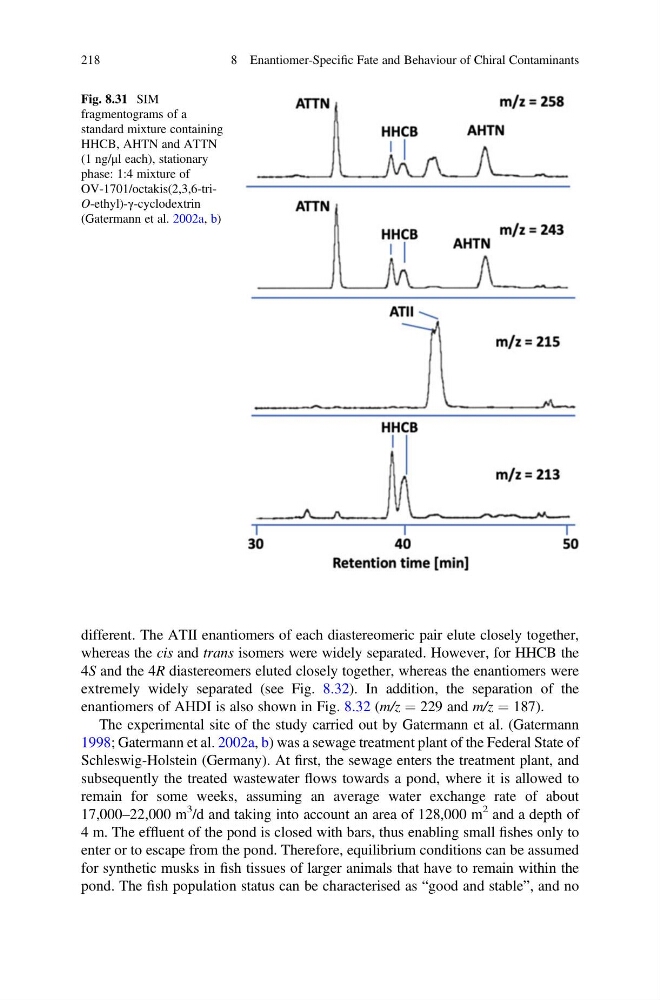
different. The ATII enantiomers of each diastereomeric pair elute closely together,
whereas the cis and trans isomers were widely separated. However, for HHCB the
4S and the 4R diastereomers eluted closely together, whereas the enantiomers were
extremely widely separated (see Fig. 8.32). In addition, the separation of the
enantiomers of AHDI is also shown in Fig. 8.32 (m/z ¼ 229 and m/z ¼ 187).
The experimental site of the study carried out by Gatermann et al. (Gatermann
1998; Gatermann et al. 2002a, b) was a sewage treatment plant of the Federal State of
Schleswig-Holstein (Germany). At first, the sewage enters the treatment plant, and
subsequently the treated wastewater flows towards a pond, where it is allowed to
remain for some weeks, assuming an average water exchange rate of about
17,000–22,000 m
3 /d and taking into account an area of 128,000 m
2 and a depth of
4 m. The effluent of the pond is closed with bars, thus enabling small fishes only to
enter or to escape from the pond. Therefore, equilibrium conditions can be assumed
for synthetic musks in fish tissues of larger animals that have to remain within the
pond. The fish population status can be characterised as “good and stable”, and no
Fig. 8.31 SIM
fragmentograms of a
standard mixture containing
HHCB, AHTN and ATTN
(1 ng/μl each), stationary
phase: 1:4 mixture of
OV-1701/octakis(2,3,6-triO-ethyl)-γ-cyclodextrin
(Gatermann et al. 2002a, b)
218
8 Enantiomer-Specific Fate and Behaviour of Chiral Contaminants
whereas the cis and trans isomers were widely separated. However, for HHCB the
4S and the 4R diastereomers eluted closely together, whereas the enantiomers were
extremely widely separated (see Fig. 8.32). In addition, the separation of the
enantiomers of AHDI is also shown in Fig. 8.32 (m/z ¼ 229 and m/z ¼ 187).
The experimental site of the study carried out by Gatermann et al. (Gatermann
1998; Gatermann et al. 2002a, b) was a sewage treatment plant of the Federal State of
Schleswig-Holstein (Germany). At first, the sewage enters the treatment plant, and
subsequently the treated wastewater flows towards a pond, where it is allowed to
remain for some weeks, assuming an average water exchange rate of about
17,000–22,000 m
3 /d and taking into account an area of 128,000 m
2 and a depth of
4 m. The effluent of the pond is closed with bars, thus enabling small fishes only to
enter or to escape from the pond. Therefore, equilibrium conditions can be assumed
for synthetic musks in fish tissues of larger animals that have to remain within the
pond. The fish population status can be characterised as “good and stable”, and no
Fig. 8.31 SIM
fragmentograms of a
standard mixture containing
HHCB, AHTN and ATTN
(1 ng/μl each), stationary
phase: 1:4 mixture of
OV-1701/octakis(2,3,6-triO-ethyl)-γ-cyclodextrin
(Gatermann et al. 2002a, b)
218
8 Enantiomer-Specific Fate and Behaviour of Chiral Contaminants