

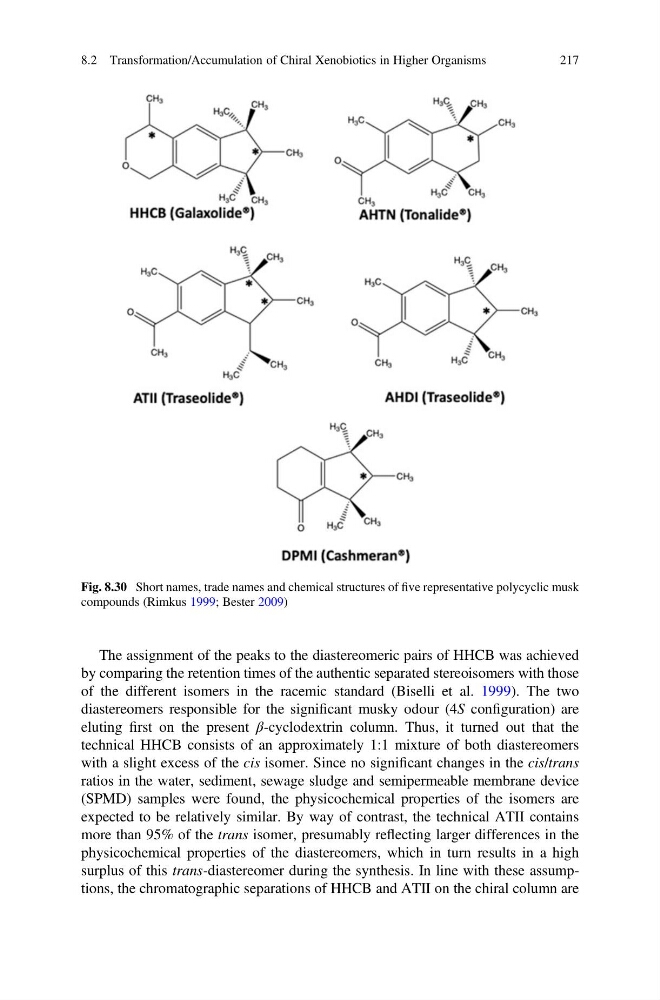
The assignment of the peaks to the diastereomeric pairs of HHCB was achieved
by comparing the retention times of the authentic separated stereoisomers with those
of the different isomers in the racemic standard (Biselli et al. 1999). The two
diastereomers responsible for the significant musky odour (4S configuration) are
eluting first on the present β-cyclodextrin column. Thus, it turned out that the
technical HHCB consists of an approximately 1:1 mixture of both diastereomers
with a slight excess of the cis isomer. Since no significant changes in the cis/trans
ratios in the water, sediment, sewage sludge and semipermeable membrane device
(SPMD) samples were found, the physicochemical properties of the isomers are
expected to be relatively similar. By way of contrast, the technical ATII contains
more than 95% of the trans isomer, presumably reflecting larger differences in the
physicochemical properties of the diastereomers, which in turn results in a high
surplus of this trans-diastereomer during the synthesis. In line with these assumptions, the chromatographic separations of HHCB and ATII on the chiral column are
Fig. 8.30 Short names, trade names and chemical structures of five representative polycyclic musk
compounds (Rimkus 1999; Bester 2009)
8.2 Transformation/Accumulation of Chiral Xenobiotics in Higher Organisms
217
by comparing the retention times of the authentic separated stereoisomers with those
of the different isomers in the racemic standard (Biselli et al. 1999). The two
diastereomers responsible for the significant musky odour (4S configuration) are
eluting first on the present β-cyclodextrin column. Thus, it turned out that the
technical HHCB consists of an approximately 1:1 mixture of both diastereomers
with a slight excess of the cis isomer. Since no significant changes in the cis/trans
ratios in the water, sediment, sewage sludge and semipermeable membrane device
(SPMD) samples were found, the physicochemical properties of the isomers are
expected to be relatively similar. By way of contrast, the technical ATII contains
more than 95% of the trans isomer, presumably reflecting larger differences in the
physicochemical properties of the diastereomers, which in turn results in a high
surplus of this trans-diastereomer during the synthesis. In line with these assumptions, the chromatographic separations of HHCB and ATII on the chiral column are
Fig. 8.30 Short names, trade names and chemical structures of five representative polycyclic musk
compounds (Rimkus 1999; Bester 2009)
8.2 Transformation/Accumulation of Chiral Xenobiotics in Higher Organisms
217