

6 months for dichlorprop. Lewis et al. used a strange way of summarising their
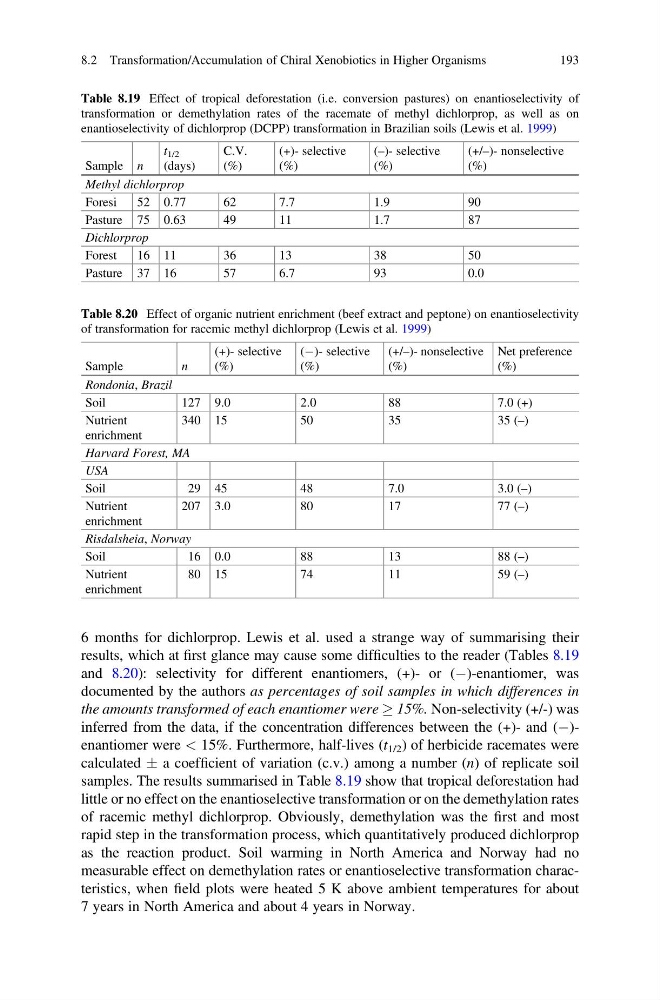
results, which at first glance may cause some difficulties to the reader (Tables 8.19
and 8.20): selectivity for different enantiomers, (+)- or (À)-enantiomer, was
documented by the authors as percentages of soil samples in which differences in
the amounts transformed of each enantiomer were ! 15%. Non-selectivity (+/-) was
inferred from the data, if the concentration differences between the (+)- and (À)enantiomer were < 15%. Furthermore, half-lives (t 1/2 ) of herbicide racemates were
calculated Æ a coefficient of variation (c.v.) among a number (n) of replicate soil
samples. The results summarised in Table 8.19 show that tropical deforestation had
little or no effect on the enantioselective transformation or on the demethylation rates
of racemic methyl dichlorprop. Obviously, demethylation was the first and most
rapid step in the transformation process, which quantitatively produced dichlorprop
as the reaction product. Soil warming in North America and Norway had no
measurable effect on demethylation rates or enantioselective transformation characteristics, when field plots were heated 5 K above ambient temperatures for about
7 years in North America and about 4 years in Norway.
Table 8.19 Effect of tropical deforestation (i.e. conversion pastures) on enantioselectivity of
transformation or demethylation rates of the racemate of methyl dichlorprop, as well as on
enantioselectivity of dichlorprop (DCPP) transformation in Brazilian soils (Lewis et al. 1999)
Sample n
t 1/2
(days)
C.V.
(%)
(+)- selective
(%)
(–)- selective
(%)
(+/–)- nonselective
(%)
Methyl dichlorprop
Foresi
52 0.77
62
7.7
1.9
90
Pasture 75 0.63
49
11
1.7
87
Dichlorprop
Forest
16 11
36
13
38
50
Pasture 37 16
57
6.7
93
0.0
Table 8.20 Effect of organic nutrient enrichment (beef extract and peptone) on enantioselectivity
of transformation for racemic methyl dichlorprop (Lewis et al. 1999)
Sample
n
(+)- selective
(%)
(À)- selective
(%)
(+/–)- nonselective
(%)
Net preference
(%)
Rondonia, Brazil
Soil
127 9.0
2.0
88
7.0 (+)
Nutrient
enrichment
340 15
50
35
35 (–)
Harvard Forest, MA
USA
Soil
29 45
48
7.0
3.0 (–)
Nutrient
enrichment
207 3.0
80
17
77 (–)
Risdalsheia, Norway
Soil
16 0.0
88
13
88 (–)
Nutrient
enrichment
80 15
74
11
59 (–)
8.2 Transformation/Accumulation of Chiral Xenobiotics in Higher Organisms
193
results, which at first glance may cause some difficulties to the reader (Tables 8.19
and 8.20): selectivity for different enantiomers, (+)- or (À)-enantiomer, was
documented by the authors as percentages of soil samples in which differences in
the amounts transformed of each enantiomer were ! 15%. Non-selectivity (+/-) was
inferred from the data, if the concentration differences between the (+)- and (À)enantiomer were < 15%. Furthermore, half-lives (t 1/2 ) of herbicide racemates were
calculated Æ a coefficient of variation (c.v.) among a number (n) of replicate soil
samples. The results summarised in Table 8.19 show that tropical deforestation had
little or no effect on the enantioselective transformation or on the demethylation rates
of racemic methyl dichlorprop. Obviously, demethylation was the first and most
rapid step in the transformation process, which quantitatively produced dichlorprop
as the reaction product. Soil warming in North America and Norway had no
measurable effect on demethylation rates or enantioselective transformation characteristics, when field plots were heated 5 K above ambient temperatures for about
7 years in North America and about 4 years in Norway.
Table 8.19 Effect of tropical deforestation (i.e. conversion pastures) on enantioselectivity of
transformation or demethylation rates of the racemate of methyl dichlorprop, as well as on
enantioselectivity of dichlorprop (DCPP) transformation in Brazilian soils (Lewis et al. 1999)
Sample n
t 1/2
(days)
C.V.
(%)
(+)- selective
(%)
(–)- selective
(%)
(+/–)- nonselective
(%)
Methyl dichlorprop
Foresi
52 0.77
62
7.7
1.9
90
Pasture 75 0.63
49
11
1.7
87
Dichlorprop
Forest
16 11
36
13
38
50
Pasture 37 16
57
6.7
93
0.0
Table 8.20 Effect of organic nutrient enrichment (beef extract and peptone) on enantioselectivity
of transformation for racemic methyl dichlorprop (Lewis et al. 1999)
Sample
n
(+)- selective
(%)
(À)- selective
(%)
(+/–)- nonselective
(%)
Net preference
(%)
Rondonia, Brazil
Soil
127 9.0
2.0
88
7.0 (+)
Nutrient
enrichment
340 15
50
35
35 (–)
Harvard Forest, MA
USA
Soil
29 45
48
7.0
3.0 (–)
Nutrient
enrichment
207 3.0
80
17
77 (–)
Risdalsheia, Norway
Soil
16 0.0
88
13
88 (–)
Nutrient
enrichment
80 15
74
11
59 (–)
8.2 Transformation/Accumulation of Chiral Xenobiotics in Higher Organisms
193