

enantiomers across a wide latitudinal transect, and the possible influence of largescale environmental changes on that persistence. They investigated enantioselective
transformation in soils collected from three areas after amending them with ruelene
[i.e.
(R,S)-4-tertbutyl-2-chlorophenylmethyl-N-methyl
phosphoramidate],
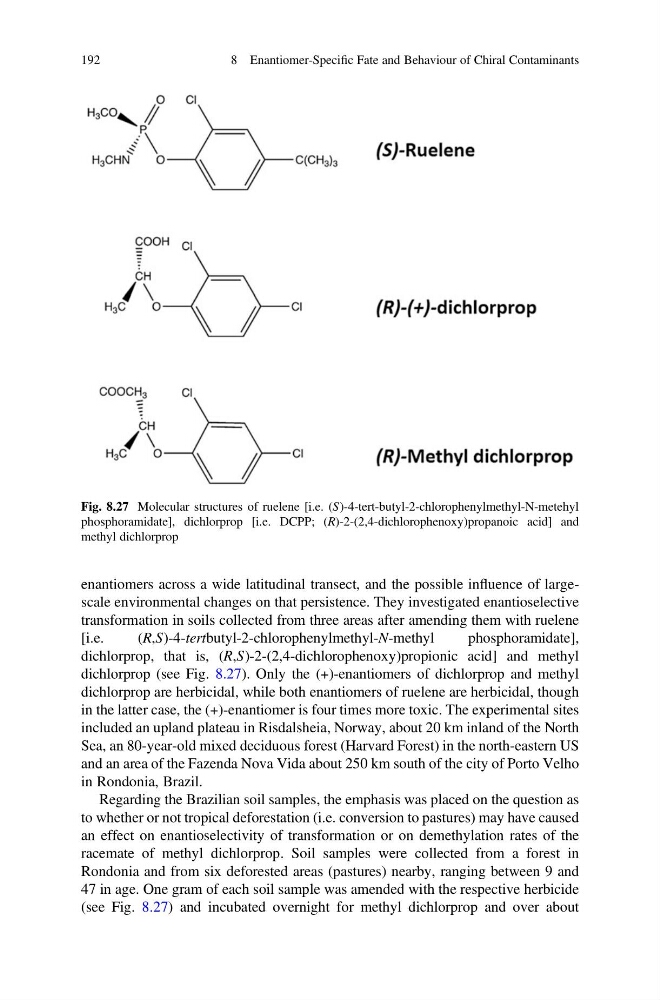
dichlorprop, that is, (R,S)-2-(2,4-dichlorophenoxy)propionic acid] and methyl
dichlorprop (see Fig. 8.27). Only the (+)-enantiomers of dichlorprop and methyl
dichlorprop are herbicidal, while both enantiomers of ruelene are herbicidal, though
in the latter case, the (+)-enantiomer is four times more toxic. The experimental sites
included an upland plateau in Risdalsheia, Norway, about 20 km inland of the North
Sea, an 80-year-old mixed deciduous forest (Harvard Forest) in the north-eastern US
and an area of the Fazenda Nova Vida about 250 km south of the city of Porto Velho
in Rondonia, Brazil.
Regarding the Brazilian soil samples, the emphasis was placed on the question as
to whether or not tropical deforestation (i.e. conversion to pastures) may have caused
an effect on enantioselectivity of transformation or on demethylation rates of the
racemate of methyl dichlorprop. Soil samples were collected from a forest in
Rondonia and from six deforested areas (pastures) nearby, ranging between 9 and
47 in age. One gram of each soil sample was amended with the respective herbicide
(see Fig. 8.27) and incubated overnight for methyl dichlorprop and over about
Fig. 8.27 Molecular structures of ruelene [i.e. (S)-4-tert-butyl-2-chlorophenylmethyl-N-metehyl
phosphoramidate], dichlorprop [i.e. DCPP; (R)-2-(2,4-dichlorophenoxy)propanoic acid] and
methyl dichlorprop
192
8 Enantiomer-Specific Fate and Behaviour of Chiral Contaminants
transformation in soils collected from three areas after amending them with ruelene
[i.e.
(R,S)-4-tertbutyl-2-chlorophenylmethyl-N-methyl
phosphoramidate],
dichlorprop, that is, (R,S)-2-(2,4-dichlorophenoxy)propionic acid] and methyl
dichlorprop (see Fig. 8.27). Only the (+)-enantiomers of dichlorprop and methyl
dichlorprop are herbicidal, while both enantiomers of ruelene are herbicidal, though
in the latter case, the (+)-enantiomer is four times more toxic. The experimental sites
included an upland plateau in Risdalsheia, Norway, about 20 km inland of the North
Sea, an 80-year-old mixed deciduous forest (Harvard Forest) in the north-eastern US
and an area of the Fazenda Nova Vida about 250 km south of the city of Porto Velho
in Rondonia, Brazil.
Regarding the Brazilian soil samples, the emphasis was placed on the question as
to whether or not tropical deforestation (i.e. conversion to pastures) may have caused
an effect on enantioselectivity of transformation or on demethylation rates of the
racemate of methyl dichlorprop. Soil samples were collected from a forest in
Rondonia and from six deforested areas (pastures) nearby, ranging between 9 and
47 in age. One gram of each soil sample was amended with the respective herbicide
(see Fig. 8.27) and incubated overnight for methyl dichlorprop and over about
Fig. 8.27 Molecular structures of ruelene [i.e. (S)-4-tert-butyl-2-chlorophenylmethyl-N-metehyl
phosphoramidate], dichlorprop [i.e. DCPP; (R)-2-(2,4-dichlorophenoxy)propanoic acid] and
methyl dichlorprop
192
8 Enantiomer-Specific Fate and Behaviour of Chiral Contaminants