

(Table 8.16). For oxychlordane, ER values between 1.0 and 1.5 were obtained
indicating a preferential enzymatic transformation of the (À)-enantiomer. An even
more pronounced transformation of the (À)-enantiomer can be inferred from the ER
values for heptachlor exoepoxide, ranging between 2.5 and 3.7. This is insofar
remarkable as the results for roe-deer liver extracts indicated a stronger transformation of the (À)-enantiomer of oxychlordane compared with that of heptachlor
exoepoxide. This phenomenon can be tentatively explained by different enzymatic
systems prevalent in roe-deer and hare livers, respectively. Furthermore, it cannot be
28
Schleswig Holstein
Concentration
24
20
16
ER
12
8
4
0
1
2
3
4
Sample No.
5
6
7
8
0
50
100
150
200
250
300
Conc. ug/kg fat
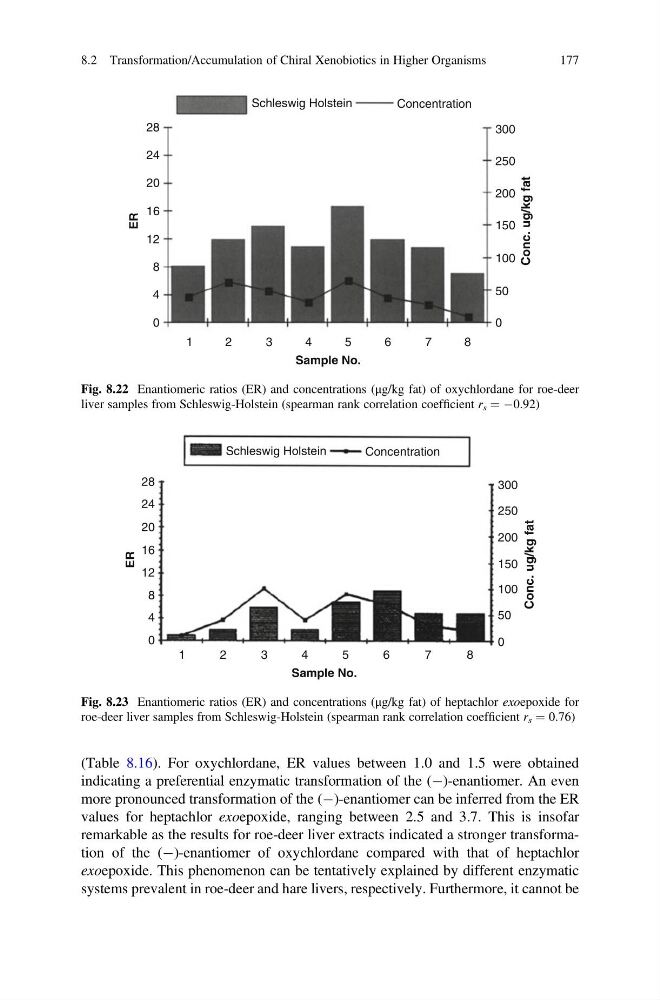
Fig. 8.22 Enantiomeric ratios (ER) and concentrations (μg/kg fat) of oxychlordane for roe-deer
liver samples from Schleswig-Holstein (spearman rank correlation coefficient r s ¼ À0.92)
28
Schleswig Holstein
Concentration
24
20
16
ER
12
8
4
0
1
2
3
4
5
Sample No.
6
7
8
0
50
100
150
200
250
300
Conc. ug/kg fat
Fig. 8.23 Enantiomeric ratios (ER) and concentrations (μg/kg fat) of heptachlor exoepoxide for
roe-deer liver samples from Schleswig-Holstein (spearman rank correlation coefficient r s ¼ 0.76)
8.2 Transformation/Accumulation of Chiral Xenobiotics in Higher Organisms
177
indicating a preferential enzymatic transformation of the (À)-enantiomer. An even
more pronounced transformation of the (À)-enantiomer can be inferred from the ER
values for heptachlor exoepoxide, ranging between 2.5 and 3.7. This is insofar
remarkable as the results for roe-deer liver extracts indicated a stronger transformation of the (À)-enantiomer of oxychlordane compared with that of heptachlor
exoepoxide. This phenomenon can be tentatively explained by different enzymatic
systems prevalent in roe-deer and hare livers, respectively. Furthermore, it cannot be
28
Schleswig Holstein
Concentration
24
20
16
ER
12
8
4
0
1
2
3
4
Sample No.
5
6
7
8
0
50
100
150
200
250
300
Conc. ug/kg fat
Fig. 8.22 Enantiomeric ratios (ER) and concentrations (μg/kg fat) of oxychlordane for roe-deer
liver samples from Schleswig-Holstein (spearman rank correlation coefficient r s ¼ À0.92)
28
Schleswig Holstein
Concentration
24
20
16
ER
12
8
4
0
1
2
3
4
5
Sample No.
6
7
8
0
50
100
150
200
250
300
Conc. ug/kg fat
Fig. 8.23 Enantiomeric ratios (ER) and concentrations (μg/kg fat) of heptachlor exoepoxide for
roe-deer liver samples from Schleswig-Holstein (spearman rank correlation coefficient r s ¼ 0.76)
8.2 Transformation/Accumulation of Chiral Xenobiotics in Higher Organisms
177