

noted that the bromocyclen concentration in fish reflects a long-term accumulation,
while the water samples represent the state during the sample collection.
The enantiomeric ratios of bromocyclen for the extracts from two trout and eight
bream samples from the river Stör are summarised in Table 8.12. In the muscle tissue
of bream, the ER values turned out to be higher than 1 and varied between 1.08 and
2.13. The values imply that the (+)-enantiomer was preferentially degraded, that is,
at least the (+)-enantiomer can be metabolised, or, alternatively, the (À)-enantiomer
was preferentially accumulated. This result appears to be at variance with the results
from a previous investigation of rainbow trouts from a Danish fish farm that led to
the contrary assumption (Pfaffenberger et al. 1994a, b). However, the two trout filet
samples included in the study by Bethan et al. also showed enantiomeric ratios
smaller than one. Therefore, it can be tentatively assumed that bream and trout are
activating different metabolic pathways with regard to bromocyclen transformation.
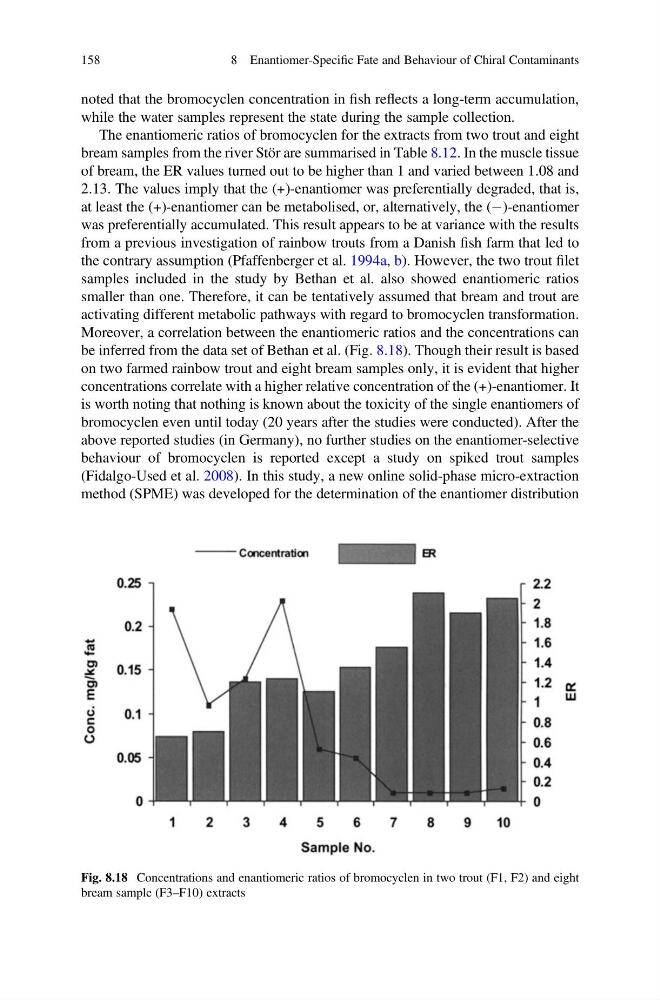
Moreover, a correlation between the enantiomeric ratios and the concentrations can
be inferred from the data set of Bethan et al. (Fig. 8.18). Though their result is based
on two farmed rainbow trout and eight bream samples only, it is evident that higher
concentrations correlate with a higher relative concentration of the (+)-enantiomer. It
is worth noting that nothing is known about the toxicity of the single enantiomers of
bromocyclen even until today (20 years after the studies were conducted). After the
above reported studies (in Germany), no further studies on the enantiomer-selective
behaviour of bromocyclen is reported except a study on spiked trout samples
(Fidalgo-Used et al. 2008). In this study, a new online solid-phase micro-extraction
method (SPME) was developed for the determination of the enantiomer distribution
Fig. 8.18 Concentrations and enantiomeric ratios of bromocyclen in two trout (F1, F2) and eight
bream sample (F3–F10) extracts
158
8 Enantiomer-Specific Fate and Behaviour of Chiral Contaminants
while the water samples represent the state during the sample collection.
The enantiomeric ratios of bromocyclen for the extracts from two trout and eight
bream samples from the river Stör are summarised in Table 8.12. In the muscle tissue
of bream, the ER values turned out to be higher than 1 and varied between 1.08 and
2.13. The values imply that the (+)-enantiomer was preferentially degraded, that is,
at least the (+)-enantiomer can be metabolised, or, alternatively, the (À)-enantiomer
was preferentially accumulated. This result appears to be at variance with the results
from a previous investigation of rainbow trouts from a Danish fish farm that led to
the contrary assumption (Pfaffenberger et al. 1994a, b). However, the two trout filet
samples included in the study by Bethan et al. also showed enantiomeric ratios
smaller than one. Therefore, it can be tentatively assumed that bream and trout are
activating different metabolic pathways with regard to bromocyclen transformation.
Moreover, a correlation between the enantiomeric ratios and the concentrations can
be inferred from the data set of Bethan et al. (Fig. 8.18). Though their result is based
on two farmed rainbow trout and eight bream samples only, it is evident that higher
concentrations correlate with a higher relative concentration of the (+)-enantiomer. It
is worth noting that nothing is known about the toxicity of the single enantiomers of
bromocyclen even until today (20 years after the studies were conducted). After the
above reported studies (in Germany), no further studies on the enantiomer-selective
behaviour of bromocyclen is reported except a study on spiked trout samples
(Fidalgo-Used et al. 2008). In this study, a new online solid-phase micro-extraction
method (SPME) was developed for the determination of the enantiomer distribution
Fig. 8.18 Concentrations and enantiomeric ratios of bromocyclen in two trout (F1, F2) and eight
bream sample (F3–F10) extracts
158
8 Enantiomer-Specific Fate and Behaviour of Chiral Contaminants