

plants into the river Stör could have been one source of contamination for the three
fishes caught in this river. However, the severe impact of bromocyclen on fish
stemming from fish farms remained unclear thus far. In order to gain deepened
insight into potential sources, Bethan et al. (1997) carried out a comprehensive study
that included the analysis of bromocyclen in water and fish samples from different
stations of the river Stör. Moreover, samples from the influent, as well as from the
effluent of various sewage plants along the river, were collected. Particular emphasis
was placed upon the question of on how bromocyclen gets into the river Stör and if
the enantiomeric ratios determined in the fish samples correlate with the concentrations. The latter aspect was intended to verify the hypothesis by Pfaffenberger et al.
outlined above.
The water samples, which were already discussed earlier, were collected from
May to August in 1995 in the river Stör. The fish samples, that is, two brook trouts
(Salmo trutta fario (L.)) and eight breams (Abramis brama orientalis BERG) were
also caught in the river Stör from July to August 1995. In addition, three samples of
the effluents of sewage plants of the cities of Hamburg, Itzehoe and Neumünster
(Germany) were taken during this period. Furthermore, two samples of the effluents
and from the influents of the sewage treatment plants in Neumünster and in Itzehoe
were collected in the autumn of 1996. The sample preparation and the clean-up
procedure is described in Bethan et al. (1996, 1997).
The concentrations in the ten fish samples varied between 0.01 and 0.24 mg/kg
(extractable organic material) and showed the same general characteristics in the
decreasing trend towards the estuary as those received from the water samples. High
concentrations were found in the trout that had been caught in Neumünster downstream of the influx of the sewage plant’s wastewater, while the fish samples
collected at the estuary of the river showed low concentrations. But it has to be
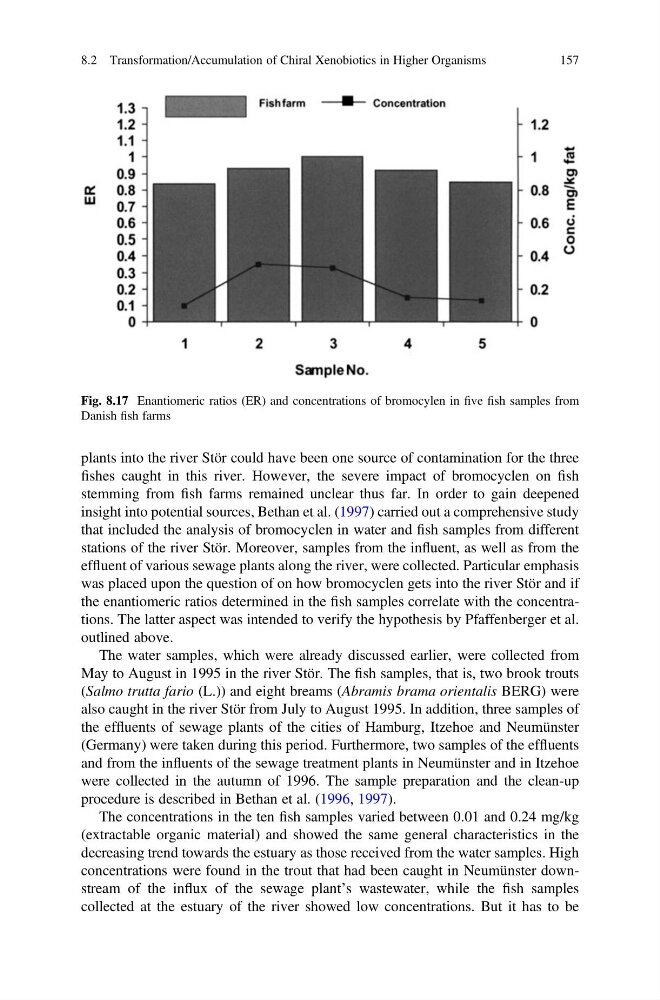
Fig. 8.17 Enantiomeric ratios (ER) and concentrations of bromocylen in five fish samples from
Danish fish farms
8.2 Transformation/Accumulation of Chiral Xenobiotics in Higher Organisms
157
fishes caught in this river. However, the severe impact of bromocyclen on fish
stemming from fish farms remained unclear thus far. In order to gain deepened
insight into potential sources, Bethan et al. (1997) carried out a comprehensive study
that included the analysis of bromocyclen in water and fish samples from different
stations of the river Stör. Moreover, samples from the influent, as well as from the
effluent of various sewage plants along the river, were collected. Particular emphasis
was placed upon the question of on how bromocyclen gets into the river Stör and if
the enantiomeric ratios determined in the fish samples correlate with the concentrations. The latter aspect was intended to verify the hypothesis by Pfaffenberger et al.
outlined above.
The water samples, which were already discussed earlier, were collected from
May to August in 1995 in the river Stör. The fish samples, that is, two brook trouts
(Salmo trutta fario (L.)) and eight breams (Abramis brama orientalis BERG) were
also caught in the river Stör from July to August 1995. In addition, three samples of
the effluents of sewage plants of the cities of Hamburg, Itzehoe and Neumünster
(Germany) were taken during this period. Furthermore, two samples of the effluents
and from the influents of the sewage treatment plants in Neumünster and in Itzehoe
were collected in the autumn of 1996. The sample preparation and the clean-up
procedure is described in Bethan et al. (1996, 1997).
The concentrations in the ten fish samples varied between 0.01 and 0.24 mg/kg
(extractable organic material) and showed the same general characteristics in the
decreasing trend towards the estuary as those received from the water samples. High
concentrations were found in the trout that had been caught in Neumünster downstream of the influx of the sewage plant’s wastewater, while the fish samples
collected at the estuary of the river showed low concentrations. But it has to be
Fig. 8.17 Enantiomeric ratios (ER) and concentrations of bromocylen in five fish samples from
Danish fish farms
8.2 Transformation/Accumulation of Chiral Xenobiotics in Higher Organisms
157