

and trans-chlordane on several cyclodextrin derivatives (e.g. heptakis(3-O-methyl2,6-di-O-n-pentyl)-β-cyclodextrin or per-O-methyl-β-cyclodextrin), the simultaneous separation of all four stereoisomers was possible only on heptakis(2-Omethyl-3,6-di-O-n-pentyl)-β-cyclodextrin.
Meanwhile, several authors applied this new experimental approach to the investigation of enzymatic transformation of cyclodiene pesticides and their metabolites
in marine and freshwater biota; see Tables 8.11 and 8.12 (Buser et al. 1992; Oehme
Cl
Cl
Cl
Cl
Cl
Cl
Cl
Cl
Cl
Cl
Cl
Cl
Cl
Cl
Cl
Cl
Cl
Cl
Cl
Cl
Cl
Cl
Cl
Cl
Cl
Cl
Cl
Cl
Cl
Cl
Cl
Cl
Cl
Cl
Cl
Cl
Cl
Cl
Cl
Cl
Cl
Cl
Cl
Cl
Cl
Cl
Cl
Cl
O
O
Cl
Cl
Cl
Cl
Cl
Cl
Cl
Cl
Cl
Cl
Cl
Cl
Cl
Cl
Cl
Cl
Cl
Cl
Cl
Cl
Cl
Cl
Cl
Cl
Cl
Cl
Cl
Cl
O
O
H
H
H
H
Cl
Cl
Cl
Cl
Cl
Cl
Cl
Cl
Cl
Cl
Cl
Cl
Cl
Cl
O
O
H H
H H
cis-chlordane
trans-chlordane
Oxy-chlordane
Heptachlor
cis-heptachlorepoxid
trans-heptachlorepoxid
Enantiomers
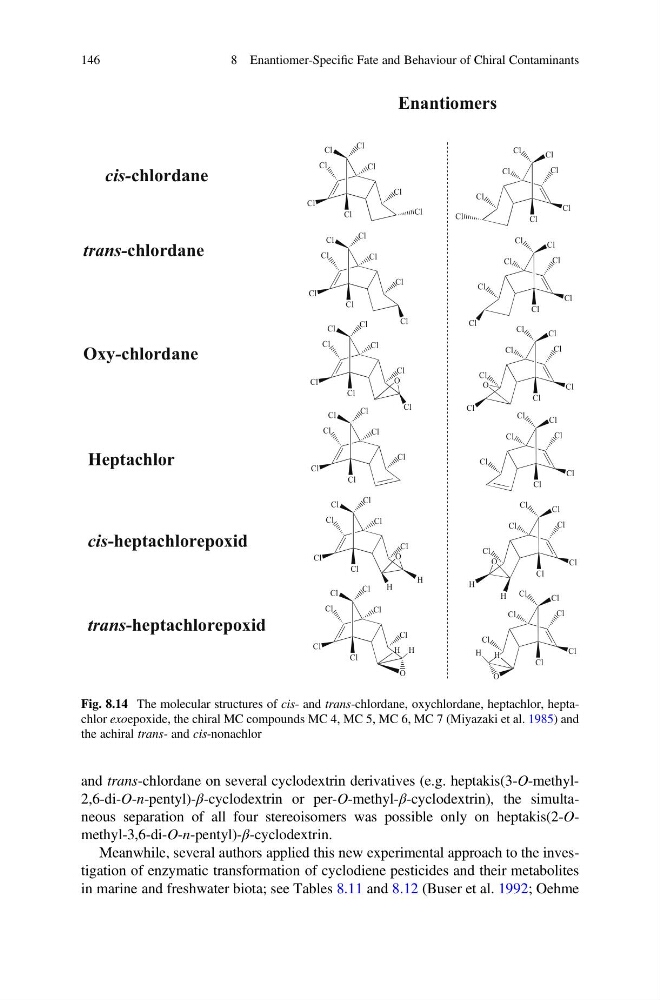
Fig. 8.14 The molecular structures of cis- and trans-chlordane, oxychlordane, heptachlor, heptachlor exoepoxide, the chiral MC compounds MC 4, MC 5, MC 6, MC 7 (Miyazaki et al. 1985) and
the achiral trans- and cis-nonachlor
146
8 Enantiomer-Specific Fate and Behaviour of Chiral Contaminants
Meanwhile, several authors applied this new experimental approach to the investigation of enzymatic transformation of cyclodiene pesticides and their metabolites
in marine and freshwater biota; see Tables 8.11 and 8.12 (Buser et al. 1992; Oehme
Cl
Cl
Cl
Cl
Cl
Cl
Cl
Cl
Cl
Cl
Cl
Cl
Cl
Cl
Cl
Cl
Cl
Cl
Cl
Cl
Cl
Cl
Cl
Cl
Cl
Cl
Cl
Cl
Cl
Cl
Cl
Cl
Cl
Cl
Cl
Cl
Cl
Cl
Cl
Cl
Cl
Cl
Cl
Cl
Cl
Cl
Cl
Cl
O
O
Cl
Cl
Cl
Cl
Cl
Cl
Cl
Cl
Cl
Cl
Cl
Cl
Cl
Cl
Cl
Cl
Cl
Cl
Cl
Cl
Cl
Cl
Cl
Cl
Cl
Cl
Cl
Cl
O
O
H
H
H
H
Cl
Cl
Cl
Cl
Cl
Cl
Cl
Cl
Cl
Cl
Cl
Cl
Cl
Cl
O
O
H H
H H
cis-chlordane
trans-chlordane
Oxy-chlordane
Heptachlor
cis-heptachlorepoxid
trans-heptachlorepoxid
Enantiomers
Fig. 8.14 The molecular structures of cis- and trans-chlordane, oxychlordane, heptachlor, heptachlor exoepoxide, the chiral MC compounds MC 4, MC 5, MC 6, MC 7 (Miyazaki et al. 1985) and
the achiral trans- and cis-nonachlor
146
8 Enantiomer-Specific Fate and Behaviour of Chiral Contaminants