

pollutant. Additional updated information about levels and distribution in higher
organisms can be found in several recently published studies, reviews and books (Ali
and Aboul-Enein 2004; Busch and Busch 2011; Garrison et al. 2011a, b; Genualdi
et al. 2011; Ma et al. 2013; Carlsson et al. 2014a, b; Wang et al. 2015a, b; Zhang
et al. 2017a, b).
8.2.1.2 Other Chlorinated Pesticides
Beside α-HCH, several other persistent polychlorinated insecticides are chiral and
many have been applied as racemates in agricultural application. Some of these
substances were banned or are severely restricted in use for about three decades
already. However, all of the conventional POPs including polychlorinated insecticides like HCHs, Toxaphene
® and chlordanes
® , after the ban of their application in
the United States, Asia and most European countries, are still found in the environment, even in remote ecosystems at all trophic levels.
An important member group are cyclodiene pesticides, for example, cis and
trans-chlordane, heptachlor, aldrin and dieldrin, as well as some of their oxygenated
metabolites like oxychlordane and heptachlor exoepoxide. These compounds were
extensively used in many countries (e.g. U.S.A.), but reportedly not in others, for
example, not in Scandinavia. The fact that they are still being detected in biota from
remote areas, for example, the Arctic and Antarctic, points to global distribution
mechanisms such as long-range atmospheric transport. This latter aspect will be
presented in a separate section of this chapter.
In 1991, König et al. were the first to report the successful enantiomer separation
of cis- and trans-chlordane, oxychlordane, heptachlor, heptachlor exoepoxide (see
Fig. 8.14) using selectively derivatised cyclodextrin phases (König et al. 1991).
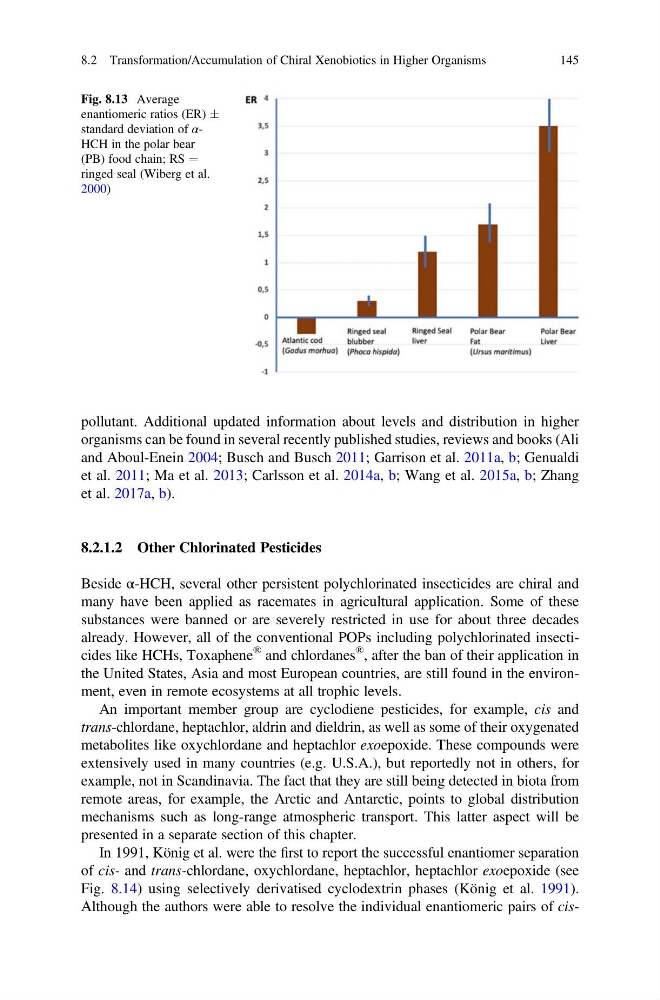
Although the authors were able to resolve the individual enantiomeric pairs of cisFig. 8.13 Average
enantiomeric ratios (ER) Æ
standard deviation of αHCH in the polar bear
(PB) food chain; RS ¼
ringed seal (Wiberg et al.
2000)
8.2 Transformation/Accumulation of Chiral Xenobiotics in Higher Organisms
145
organisms can be found in several recently published studies, reviews and books (Ali
and Aboul-Enein 2004; Busch and Busch 2011; Garrison et al. 2011a, b; Genualdi
et al. 2011; Ma et al. 2013; Carlsson et al. 2014a, b; Wang et al. 2015a, b; Zhang
et al. 2017a, b).
8.2.1.2 Other Chlorinated Pesticides
Beside α-HCH, several other persistent polychlorinated insecticides are chiral and
many have been applied as racemates in agricultural application. Some of these
substances were banned or are severely restricted in use for about three decades
already. However, all of the conventional POPs including polychlorinated insecticides like HCHs, Toxaphene
® and chlordanes
® , after the ban of their application in
the United States, Asia and most European countries, are still found in the environment, even in remote ecosystems at all trophic levels.
An important member group are cyclodiene pesticides, for example, cis and
trans-chlordane, heptachlor, aldrin and dieldrin, as well as some of their oxygenated
metabolites like oxychlordane and heptachlor exoepoxide. These compounds were
extensively used in many countries (e.g. U.S.A.), but reportedly not in others, for
example, not in Scandinavia. The fact that they are still being detected in biota from
remote areas, for example, the Arctic and Antarctic, points to global distribution
mechanisms such as long-range atmospheric transport. This latter aspect will be
presented in a separate section of this chapter.
In 1991, König et al. were the first to report the successful enantiomer separation
of cis- and trans-chlordane, oxychlordane, heptachlor, heptachlor exoepoxide (see
Fig. 8.14) using selectively derivatised cyclodextrin phases (König et al. 1991).
Although the authors were able to resolve the individual enantiomeric pairs of cisFig. 8.13 Average
enantiomeric ratios (ER) Æ
standard deviation of αHCH in the polar bear
(PB) food chain; RS ¼
ringed seal (Wiberg et al.
2000)
8.2 Transformation/Accumulation of Chiral Xenobiotics in Higher Organisms
145