

processes may also be revealed by the analysis of enantiomeric ratios of α-HCH in
marine biota of different trophic levels. Therefore, during a research cruise in 1991,
Pfaffenberger et al. collected water samples, blue mussels as well as flounders
(Platychthys flesus L.) and common Eider from three areas typical of the German
Bight, that is, the mouth of the river, two coastal sites and in the central/northwestern part of the German Bight (Pfaffenberger et al. 1992). All samples investigated were taken in marine areas that had been studied and characterised thoroughly
since 1987 during several research cruises of two national research projects (i.e.:
ZISCH ¼ “Zirkulation und Schadstoffumsatz in der Nordsee” and PRISMA ¼
“Prozesse im Schadstoffkreislauf Meer-Atmosphäre: Ökosystem Deutsche Bucht”)
coordinated by the University of Hamburg. Thus, complementary background
information about nutrients, heavy metals and various non-chiral organic pollutants
was also available for the here-performed assessment. Thus, the sampling strategy
was developed on already available information on “more polluted” and “less
polluted” sampling sites for the here-conducted study. On the basis of this valuable
background information, as “more polluted sampling site” the estuary of the river
Elbe (F1, E1, M1, W1, W2; see Table 8.9) was chosen, while “less polluted
sampling sites” include the estuary of the river Eider (F2), the isle of Amrum (E2,
M2) and the German Bight area of the river Elbe plume (W3, W4).
After field work and analysis, the results were interpreted focussing on the
question of whether or not higher levels of pollutants may induce stronger enzymatic
activities and thus larger shifts of the enantiomeric ratios of α-HCH. The mean
enantiomeric ratio of α-HCH determined in the sea water samples of the German
Bight was determined with an average value of 0.84 Æ 0.03. This result compared
well within the error limits with earlier values for the eastern part of the North Sea
and the Skagerrak (Faller et al. 1991a, b). Furthermore, this value, which is assumed
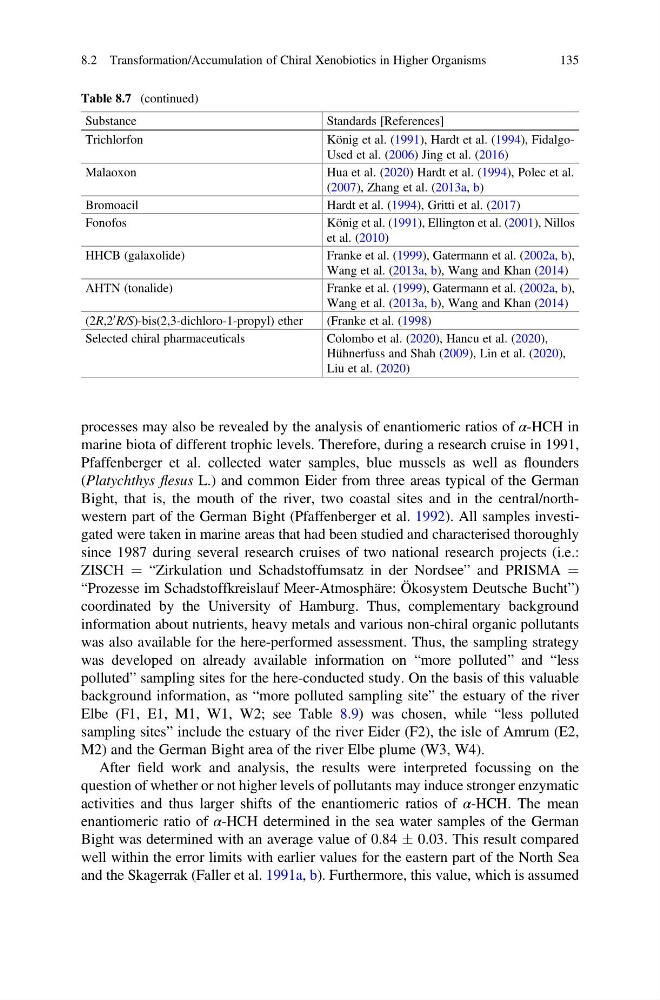
Table 8.7 (continued)
Substance
Standards [References]
Trichlorfon
König et al. (1991), Hardt et al. (1994), FidalgoUsed et al. (2006) Jing et al. (2016)
Malaoxon
Hua et al. (2020) Hardt et al. (1994), Polec et al.
(2007), Zhang et al. (2013a, b)
Bromoacil
Hardt et al. (1994), Gritti et al. (2017)
Fonofos
König et al. (1991), Ellington et al. (2001), Nillos
et al. (2010)
HHCB (galaxolide)
Franke et al. (1999), Gatermann et al. (2002a, b),
Wang et al. (2013a, b), Wang and Khan (2014)
AHTN (tonalide)
Franke et al. (1999), Gatermann et al. (2002a, b),
Wang et al. (2013a, b), Wang and Khan (2014)
(2R,2
0 R/S)-bis(2,3-dichloro-1-propyl) ether
(Franke et al. (1998)
Selected chiral pharmaceuticals
Colombo et al. (2020), Hancu et al. (2020),
Hühnerfuss and Shah (2009), Lin et al. (2020),
Liu et al. (2020)
8.2 Transformation/Accumulation of Chiral Xenobiotics in Higher Organisms
135
marine biota of different trophic levels. Therefore, during a research cruise in 1991,
Pfaffenberger et al. collected water samples, blue mussels as well as flounders
(Platychthys flesus L.) and common Eider from three areas typical of the German
Bight, that is, the mouth of the river, two coastal sites and in the central/northwestern part of the German Bight (Pfaffenberger et al. 1992). All samples investigated were taken in marine areas that had been studied and characterised thoroughly
since 1987 during several research cruises of two national research projects (i.e.:
ZISCH ¼ “Zirkulation und Schadstoffumsatz in der Nordsee” and PRISMA ¼
“Prozesse im Schadstoffkreislauf Meer-Atmosphäre: Ökosystem Deutsche Bucht”)
coordinated by the University of Hamburg. Thus, complementary background
information about nutrients, heavy metals and various non-chiral organic pollutants
was also available for the here-performed assessment. Thus, the sampling strategy
was developed on already available information on “more polluted” and “less
polluted” sampling sites for the here-conducted study. On the basis of this valuable
background information, as “more polluted sampling site” the estuary of the river
Elbe (F1, E1, M1, W1, W2; see Table 8.9) was chosen, while “less polluted
sampling sites” include the estuary of the river Eider (F2), the isle of Amrum (E2,
M2) and the German Bight area of the river Elbe plume (W3, W4).
After field work and analysis, the results were interpreted focussing on the
question of whether or not higher levels of pollutants may induce stronger enzymatic
activities and thus larger shifts of the enantiomeric ratios of α-HCH. The mean
enantiomeric ratio of α-HCH determined in the sea water samples of the German
Bight was determined with an average value of 0.84 Æ 0.03. This result compared
well within the error limits with earlier values for the eastern part of the North Sea
and the Skagerrak (Faller et al. 1991a, b). Furthermore, this value, which is assumed
Table 8.7 (continued)
Substance
Standards [References]
Trichlorfon
König et al. (1991), Hardt et al. (1994), FidalgoUsed et al. (2006) Jing et al. (2016)
Malaoxon
Hua et al. (2020) Hardt et al. (1994), Polec et al.
(2007), Zhang et al. (2013a, b)
Bromoacil
Hardt et al. (1994), Gritti et al. (2017)
Fonofos
König et al. (1991), Ellington et al. (2001), Nillos
et al. (2010)
HHCB (galaxolide)
Franke et al. (1999), Gatermann et al. (2002a, b),
Wang et al. (2013a, b), Wang and Khan (2014)
AHTN (tonalide)
Franke et al. (1999), Gatermann et al. (2002a, b),
Wang et al. (2013a, b), Wang and Khan (2014)
(2R,2
0 R/S)-bis(2,3-dichloro-1-propyl) ether
(Franke et al. (1998)
Selected chiral pharmaceuticals
Colombo et al. (2020), Hancu et al. (2020),
Hühnerfuss and Shah (2009), Lin et al. (2020),
Liu et al. (2020)
8.2 Transformation/Accumulation of Chiral Xenobiotics in Higher Organisms
135