

However, it turned out that during an experimental period of 4 weeks, the amount
of α-HCH that had been transformed was less than 10%, that is, the background level
of technical (racemic) α-HCH with an enantiomeric ratio of 1:1 remained too high to
obtain sufficiently reliable values for the determination of a potential enantiomerselective transformation and, thus, to follow and verify an enantioselective process.
Therefore, the authors (Ludwig et al. 1992a) suggested to investigate the transformation process by continuously determining the enantiomeric excess of the transformation products of α-HCH. In the case of the prochiral γ-HCH, an
enantioselective microbial transformation can be studied only by the determination
of the enantiomeric excess of its chiral transformation products, for example, γPCCH.
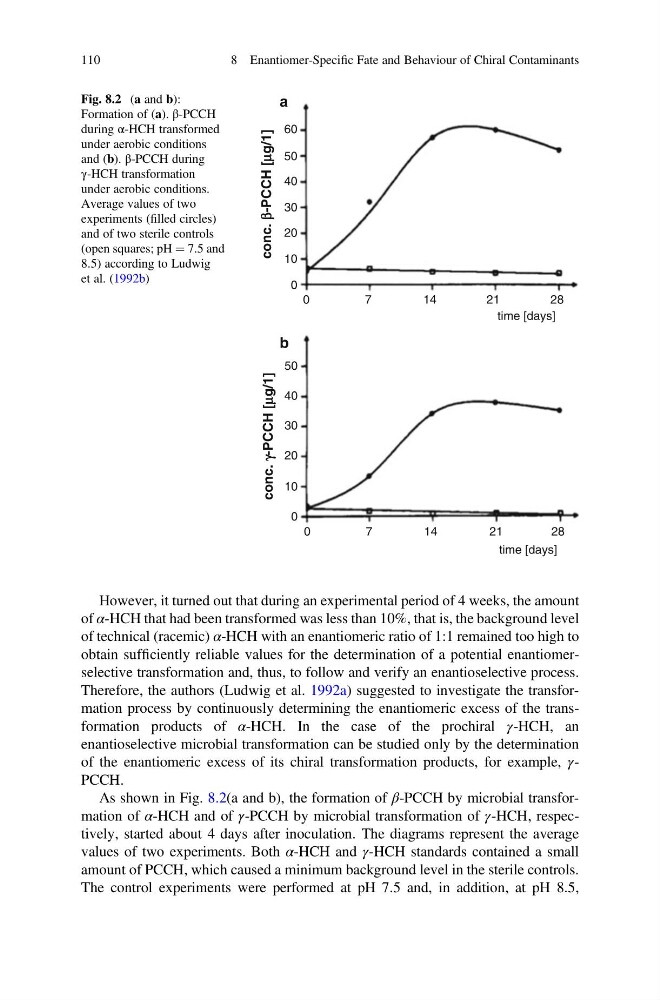
As shown in Fig. 8.2(a and b), the formation of β-PCCH by microbial transformation of α-HCH and of γ-PCCH by microbial transformation of γ-HCH, respectively, started about 4 days after inoculation. The diagrams represent the average
values of two experiments. Both α-HCH and γ-HCH standards contained a small
amount of PCCH, which caused a minimum background level in the sterile controls.
The control experiments were performed at pH 7.5 and, in addition, at pH 8.5,
conc.
b-PCCH [mg/1]
a
0
7
14
21
28
time [days]
conc.
g-PCCH [mg/1]
b
time [days]
60
50
40
30
20
10
0
50
40
30
20
10
0
0
7
14
21
28
Fig. 8.2 (a and b):
Formation of (a). β-PCCH
during α-HCH transformed
under aerobic conditions
and (b). β-PCCH during
γ-HCH transformation
under aerobic conditions.
Average values of two
experiments (filled circles)
and of two sterile controls
(open squares; pH ¼ 7.5 and
8.5) according to Ludwig
et al. (1992b)
110
8 Enantiomer-Specific Fate and Behaviour of Chiral Contaminants
of α-HCH that had been transformed was less than 10%, that is, the background level
of technical (racemic) α-HCH with an enantiomeric ratio of 1:1 remained too high to
obtain sufficiently reliable values for the determination of a potential enantiomerselective transformation and, thus, to follow and verify an enantioselective process.
Therefore, the authors (Ludwig et al. 1992a) suggested to investigate the transformation process by continuously determining the enantiomeric excess of the transformation products of α-HCH. In the case of the prochiral γ-HCH, an
enantioselective microbial transformation can be studied only by the determination
of the enantiomeric excess of its chiral transformation products, for example, γPCCH.
As shown in Fig. 8.2(a and b), the formation of β-PCCH by microbial transformation of α-HCH and of γ-PCCH by microbial transformation of γ-HCH, respectively, started about 4 days after inoculation. The diagrams represent the average
values of two experiments. Both α-HCH and γ-HCH standards contained a small
amount of PCCH, which caused a minimum background level in the sterile controls.
The control experiments were performed at pH 7.5 and, in addition, at pH 8.5,
conc.
b-PCCH [mg/1]
a
0
7
14
21
28
time [days]
conc.
g-PCCH [mg/1]
b
time [days]
60
50
40
30
20
10
0
50
40
30
20
10
0
0
7
14
21
28
Fig. 8.2 (a and b):
Formation of (a). β-PCCH
during α-HCH transformed
under aerobic conditions
and (b). β-PCCH during
γ-HCH transformation
under aerobic conditions.
Average values of two
experiments (filled circles)
and of two sterile controls
(open squares; pH ¼ 7.5 and
8.5) according to Ludwig
et al. (1992b)
110
8 Enantiomer-Specific Fate and Behaviour of Chiral Contaminants