

Toxicant A (Parlar42) and Toxicant B (Parlar32) in a flooded loamy silt
(i.e. anaerobic conditions) in laboratory experiments, as 7b,8c,9ctrichlorocamphene-2-one using 400 MHz proton NMR spectra (DQF-COSY and
NOE difference spectra).
Furthermore, important mechanistic details about molecular interactions may be
obtained from nuclear magnetic resonance studies (Dodziuk et al. 2004; Duddeck
and Gomez 2009; Buckingham 2015; Harada 2017). Investigations with unmodified
cyclodextrins showed that they may function as chiral shift reagents in solution
together with a racemic substrate (Dignam et al. 2005; Rudzinska et al. 2010;
Molaabasi and Talebpour 2011). These properties are today actively used for
R/S- Malaoxon
OCH
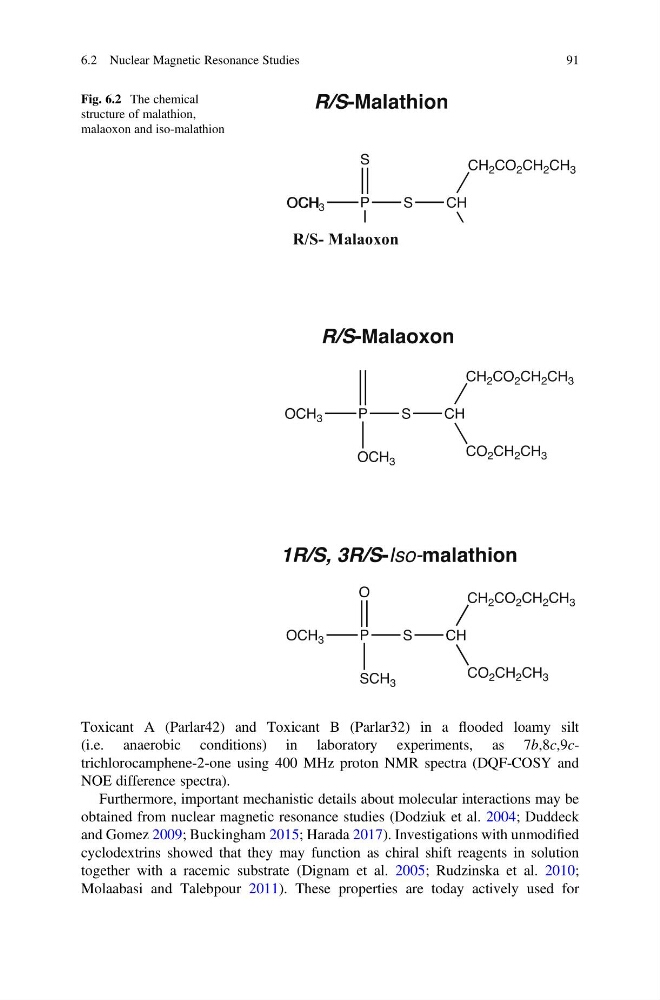
Fig. 6.2 The chemical
structure of malathion,
malaoxon and iso-malathion
6.2 Nuclear Magnetic Resonance Studies
91
(i.e. anaerobic conditions) in laboratory experiments, as 7b,8c,9ctrichlorocamphene-2-one using 400 MHz proton NMR spectra (DQF-COSY and
NOE difference spectra).
Furthermore, important mechanistic details about molecular interactions may be
obtained from nuclear magnetic resonance studies (Dodziuk et al. 2004; Duddeck
and Gomez 2009; Buckingham 2015; Harada 2017). Investigations with unmodified
cyclodextrins showed that they may function as chiral shift reagents in solution
together with a racemic substrate (Dignam et al. 2005; Rudzinska et al. 2010;
Molaabasi and Talebpour 2011). These properties are today actively used for
R/S- Malaoxon
OCH
Fig. 6.2 The chemical
structure of malathion,
malaoxon and iso-malathion
6.2 Nuclear Magnetic Resonance Studies
91