

enantiomer was carried out on a LiChrocart 250-4 ChiraDex (5 m) column from
Merck, Darmstadt (Germany). Recrystallisation from diethyl ether (p.a. quality)
afforded single crystals of this enantiomer which were suitable for X-ray analysis.
The exact parameters used for the X-ray analysis can be found in the previously cited
references.
The
molecular
structure
of
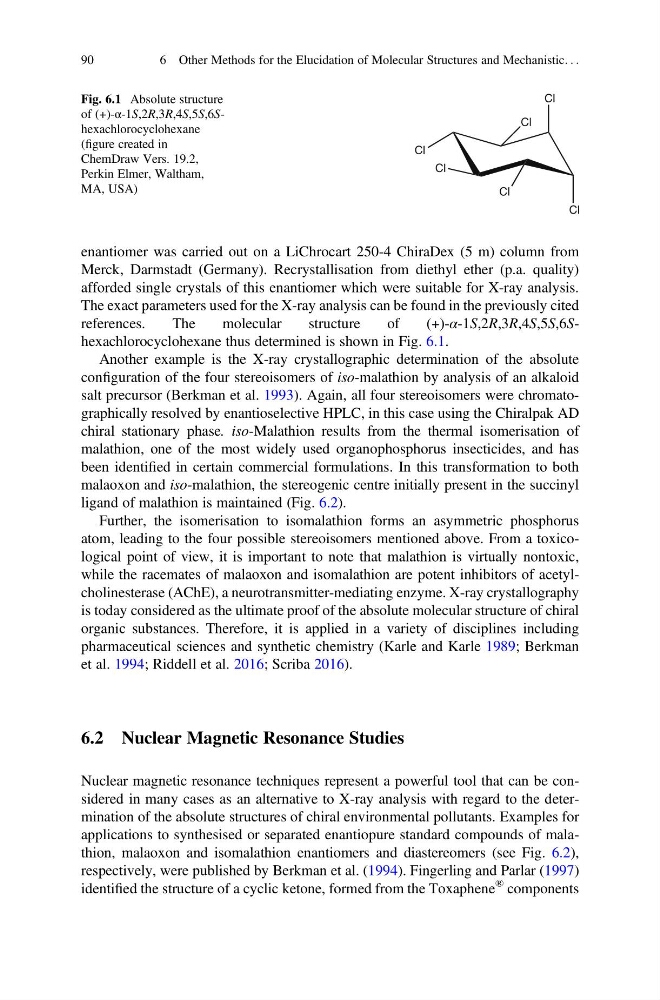
(+)-α-1S,2R,3R,4S,5S,6Shexachlorocyclohexane thus determined is shown in Fig. 6.1.
Another example is the X-ray crystallographic determination of the absolute
configuration of the four stereoisomers of iso-malathion by analysis of an alkaloid
salt precursor (Berkman et al. 1993). Again, all four stereoisomers were chromatographically resolved by enantioselective HPLC, in this case using the Chiralpak AD
chiral stationary phase. iso-Malathion results from the thermal isomerisation of
malathion, one of the most widely used organophosphorus insecticides, and has
been identified in certain commercial formulations. In this transformation to both
malaoxon and iso-malathion, the stereogenic centre initially present in the succinyl
ligand of malathion is maintained (Fig. 6.2).
Further, the isomerisation to isomalathion forms an asymmetric phosphorus
atom, leading to the four possible stereoisomers mentioned above. From a toxicological point of view, it is important to note that malathion is virtually nontoxic,
while the racemates of malaoxon and isomalathion are potent inhibitors of acetylcholinesterase (AChE), a neurotransmitter-mediating enzyme. X-ray crystallography
is today considered as the ultimate proof of the absolute molecular structure of chiral
organic substances. Therefore, it is applied in a variety of disciplines including
pharmaceutical sciences and synthetic chemistry (Karle and Karle 1989; Berkman
et al. 1994; Riddell et al. 2016; Scriba 2016).
6.2 Nuclear Magnetic Resonance Studies
Nuclear magnetic resonance techniques represent a powerful tool that can be considered in many cases as an alternative to X-ray analysis with regard to the determination of the absolute structures of chiral environmental pollutants. Examples for
applications to synthesised or separated enantiopure standard compounds of malathion, malaoxon and isomalathion enantiomers and diastereomers (see Fig. 6.2),
respectively, were published by Berkman et al. (1994). Fingerling and Parlar (1997)
identified the structure of a cyclic ketone, formed from the Toxaphene
® components
Fig. 6.1 Absolute structure
of (+)-α-1S,2R,3R,4S,5S,6Shexachlorocyclohexane
(figure created in
ChemDraw Vers. 19.2,
Perkin Elmer, Waltham,
MA, USA)
90
6 Other Methods for the Elucidation of Molecular Structures and Mechanistic. . .
Merck, Darmstadt (Germany). Recrystallisation from diethyl ether (p.a. quality)
afforded single crystals of this enantiomer which were suitable for X-ray analysis.
The exact parameters used for the X-ray analysis can be found in the previously cited
references.
The
molecular
structure
of
(+)-α-1S,2R,3R,4S,5S,6Shexachlorocyclohexane thus determined is shown in Fig. 6.1.
Another example is the X-ray crystallographic determination of the absolute
configuration of the four stereoisomers of iso-malathion by analysis of an alkaloid
salt precursor (Berkman et al. 1993). Again, all four stereoisomers were chromatographically resolved by enantioselective HPLC, in this case using the Chiralpak AD
chiral stationary phase. iso-Malathion results from the thermal isomerisation of
malathion, one of the most widely used organophosphorus insecticides, and has
been identified in certain commercial formulations. In this transformation to both
malaoxon and iso-malathion, the stereogenic centre initially present in the succinyl
ligand of malathion is maintained (Fig. 6.2).
Further, the isomerisation to isomalathion forms an asymmetric phosphorus
atom, leading to the four possible stereoisomers mentioned above. From a toxicological point of view, it is important to note that malathion is virtually nontoxic,
while the racemates of malaoxon and isomalathion are potent inhibitors of acetylcholinesterase (AChE), a neurotransmitter-mediating enzyme. X-ray crystallography
is today considered as the ultimate proof of the absolute molecular structure of chiral
organic substances. Therefore, it is applied in a variety of disciplines including
pharmaceutical sciences and synthetic chemistry (Karle and Karle 1989; Berkman
et al. 1994; Riddell et al. 2016; Scriba 2016).
6.2 Nuclear Magnetic Resonance Studies
Nuclear magnetic resonance techniques represent a powerful tool that can be considered in many cases as an alternative to X-ray analysis with regard to the determination of the absolute structures of chiral environmental pollutants. Examples for
applications to synthesised or separated enantiopure standard compounds of malathion, malaoxon and isomalathion enantiomers and diastereomers (see Fig. 6.2),
respectively, were published by Berkman et al. (1994). Fingerling and Parlar (1997)
identified the structure of a cyclic ketone, formed from the Toxaphene
® components
Fig. 6.1 Absolute structure
of (+)-α-1S,2R,3R,4S,5S,6Shexachlorocyclohexane
(figure created in
ChemDraw Vers. 19.2,
Perkin Elmer, Waltham,
MA, USA)
90
6 Other Methods for the Elucidation of Molecular Structures and Mechanistic. . .