

72
Treatment of Galactosemia
Galactosemia can be controlled by adopting a healthy life style and controlled diet.
Foods that are rich in galactose like dairy products are not given to the patients that
are suffering from galactosemia. However, the diet plan can be vary depending upon
the severity of the disease. Some of them are prescribed to take less fruits and vegetables as they contain small amount of galactose. During ripening of fruit, some
plants secrete galactose in alpha and beta forms so that the quantity of galactose
increases in fruits [13]. Fermented fruits like soy sauce, miso, etc. are avoided for
galactosemia patients. List of food containing galactose contents is given in
Table 4.2 [14]. Moreover, the young ones that are suffering from galactosemia have
deficiency of soya proteins. So, calcium and vit D tablets are recommended for
those in which these minerals and vitamins are deficient [15]. Some metabolic foods
which are helpful to avoid accumulation of toxic substances in the body can also be
used for the treatment of galactosemia [16].
α-D-galactose
Type II
galactosemia
MgATP
GALKI
MgADP
α-D-galactose-1phosphate
Type I
galactosemia
GALT
α-D-galactose-1phosphate
UDP-Glucose
UDP-Galactose
GALE
Type III
galactosemia
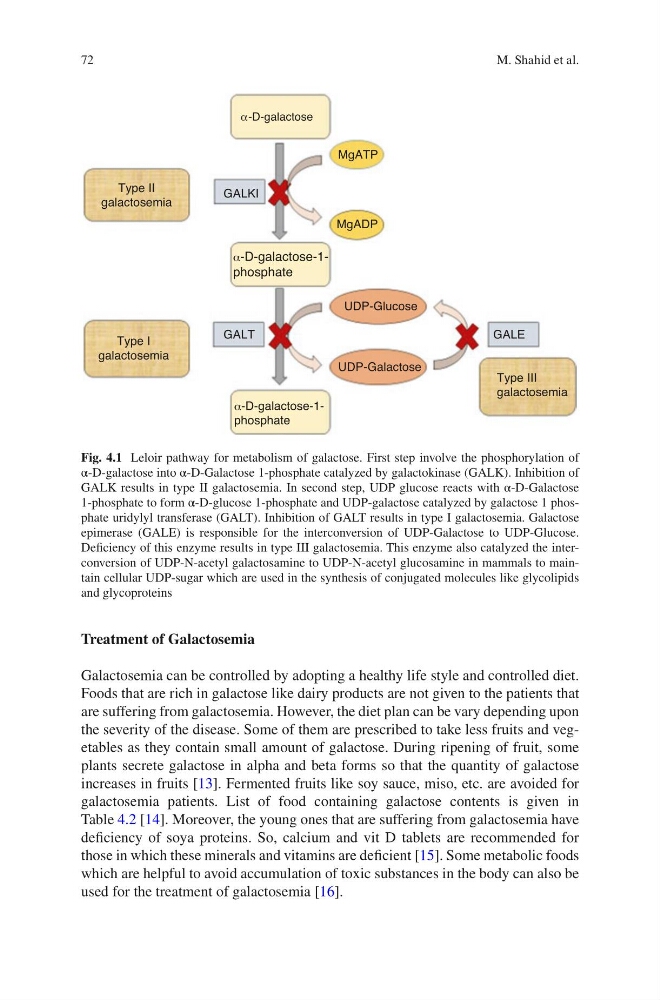
Fig. 4.1 Leloir pathway for metabolism of galactose. First step involve the phosphorylation of
α-D-galactose into α-D-Galactose 1-phosphate catalyzed by galactokinase (GALK). Inhibition of
GALK results in type ІІ galactosemia. In second step, UDP glucose reacts with α-D-Galactose
1-phosphate to form α-D-glucose 1-phosphate and UDP-galactose catalyzed by galactose 1 phosphate uridylyl transferase (GALT). Inhibition of GALT results in type І galactosemia. Galactose
epimerase (GALE) is responsible for the interconversion of UDP-Galactose to UDP-Glucose.
Deficiency of this enzyme results in type ІІІ galactosemia. This enzyme also catalyzed the interconversion of UDP-N-acetyl galactosamine to UDP-N-acetyl glucosamine in mammals to maintain cellular UDP-sugar which are used in the synthesis of conjugated molecules like glycolipids
and glycoproteins
M. Shahid et al.
Treatment of Galactosemia
Galactosemia can be controlled by adopting a healthy life style and controlled diet.
Foods that are rich in galactose like dairy products are not given to the patients that
are suffering from galactosemia. However, the diet plan can be vary depending upon
the severity of the disease. Some of them are prescribed to take less fruits and vegetables as they contain small amount of galactose. During ripening of fruit, some
plants secrete galactose in alpha and beta forms so that the quantity of galactose
increases in fruits [13]. Fermented fruits like soy sauce, miso, etc. are avoided for
galactosemia patients. List of food containing galactose contents is given in
Table 4.2 [14]. Moreover, the young ones that are suffering from galactosemia have
deficiency of soya proteins. So, calcium and vit D tablets are recommended for
those in which these minerals and vitamins are deficient [15]. Some metabolic foods
which are helpful to avoid accumulation of toxic substances in the body can also be
used for the treatment of galactosemia [16].
α-D-galactose
Type II
galactosemia
MgATP
GALKI
MgADP
α-D-galactose-1phosphate
Type I
galactosemia
GALT
α-D-galactose-1phosphate
UDP-Glucose
UDP-Galactose
GALE
Type III
galactosemia
Fig. 4.1 Leloir pathway for metabolism of galactose. First step involve the phosphorylation of
α-D-galactose into α-D-Galactose 1-phosphate catalyzed by galactokinase (GALK). Inhibition of
GALK results in type ІІ galactosemia. In second step, UDP glucose reacts with α-D-Galactose
1-phosphate to form α-D-glucose 1-phosphate and UDP-galactose catalyzed by galactose 1 phosphate uridylyl transferase (GALT). Inhibition of GALT results in type І galactosemia. Galactose
epimerase (GALE) is responsible for the interconversion of UDP-Galactose to UDP-Glucose.
Deficiency of this enzyme results in type ІІІ galactosemia. This enzyme also catalyzed the interconversion of UDP-N-acetyl galactosamine to UDP-N-acetyl glucosamine in mammals to maintain cellular UDP-sugar which are used in the synthesis of conjugated molecules like glycolipids
and glycoproteins
M. Shahid et al.