

24
Metabolic Disorders
Thyroid Gland Related
Hyperthyroidism
Hyperthyroidism is thyroid gland’s hyperactivity which is known as thyrotoxicosis
(hyper metabolic state). Thyroid storm is a rare but life-threating condition which
occurs in just 1–2% of hyperthyroidism patients. Another most usual type of hypothyroidism is Graves’ disease. It is an autoimmune disease in which thyroid hormone’s secretion is enhanced by the antibodies mimicking the effects of TSH. This
disease can occur in any age but most commonly found in middle-aged women and
can also affect men. There are some other causes of hyperthyroidism, i.e., acute
poisoning triggered by thyroid hormones (exogenous), high iodine-loaded drugs
(such as amiodarone or iodine iodinated IV agents), resulting in abrupt excessive
thyroid hormone’s secretion in susceptible individuals. As a result of thyroid gland’s
autoimmune destruction, temporary hyperthyroidism may occur, followed by
chronic hypothyroidism. Thyroid storm occurs when the body is under stress due to
adverse reaction of a drug, diabetic emergency, or some other serious challenges. If
the patient is suffering from cardiac decompensation after taking amiodarone, an
iodine-rich antiarrhythmic drug, thyroid storm should be suspected [36].
Signs and Symptoms
Typical clinical manifestations of patients with hyperthyroidism include anxiety,
heart palpitations, agitation, impatience, and weight loss (up to 40 pounds/few
months). Excessive sweating and intolerance of heat caused by this metabolic
abnormality is a common symptom. Signs and symptoms of thyrotoxicosis will be
revealed after a thorough physical examination, which specifically include a
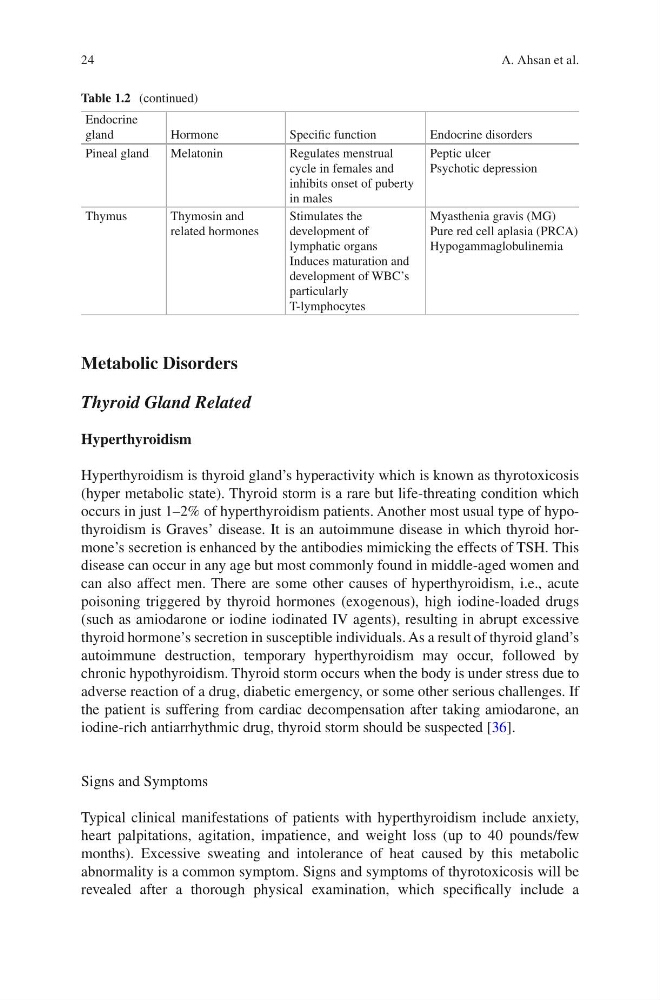
Table 1.2 (continued)
Endocrine
gland
Hormone
Specific function
Endocrine disorders
Pineal gland
Melatonin
Regulates menstrual
cycle in females and
inhibits onset of puberty
in males
Peptic ulcer
Psychotic depression
Thymus
Thymosin and
related hormones
Stimulates the
development of
lymphatic organs
Induces maturation and
development of WBC’s
particularly
T-lymphocytes
Myasthenia gravis (MG)
Pure red cell aplasia (PRCA)
Hypogammaglobulinemia
A. Ahsan et al.
Metabolic Disorders
Thyroid Gland Related
Hyperthyroidism
Hyperthyroidism is thyroid gland’s hyperactivity which is known as thyrotoxicosis
(hyper metabolic state). Thyroid storm is a rare but life-threating condition which
occurs in just 1–2% of hyperthyroidism patients. Another most usual type of hypothyroidism is Graves’ disease. It is an autoimmune disease in which thyroid hormone’s secretion is enhanced by the antibodies mimicking the effects of TSH. This
disease can occur in any age but most commonly found in middle-aged women and
can also affect men. There are some other causes of hyperthyroidism, i.e., acute
poisoning triggered by thyroid hormones (exogenous), high iodine-loaded drugs
(such as amiodarone or iodine iodinated IV agents), resulting in abrupt excessive
thyroid hormone’s secretion in susceptible individuals. As a result of thyroid gland’s
autoimmune destruction, temporary hyperthyroidism may occur, followed by
chronic hypothyroidism. Thyroid storm occurs when the body is under stress due to
adverse reaction of a drug, diabetic emergency, or some other serious challenges. If
the patient is suffering from cardiac decompensation after taking amiodarone, an
iodine-rich antiarrhythmic drug, thyroid storm should be suspected [36].
Signs and Symptoms
Typical clinical manifestations of patients with hyperthyroidism include anxiety,
heart palpitations, agitation, impatience, and weight loss (up to 40 pounds/few
months). Excessive sweating and intolerance of heat caused by this metabolic
abnormality is a common symptom. Signs and symptoms of thyrotoxicosis will be
revealed after a thorough physical examination, which specifically include a
Table 1.2 (continued)
Endocrine
gland
Hormone
Specific function
Endocrine disorders
Pineal gland
Melatonin
Regulates menstrual
cycle in females and
inhibits onset of puberty
in males
Peptic ulcer
Psychotic depression
Thymus
Thymosin and
related hormones
Stimulates the
development of
lymphatic organs
Induces maturation and
development of WBC’s
particularly
T-lymphocytes
Myasthenia gravis (MG)
Pure red cell aplasia (PRCA)
Hypogammaglobulinemia
A. Ahsan et al.