

22
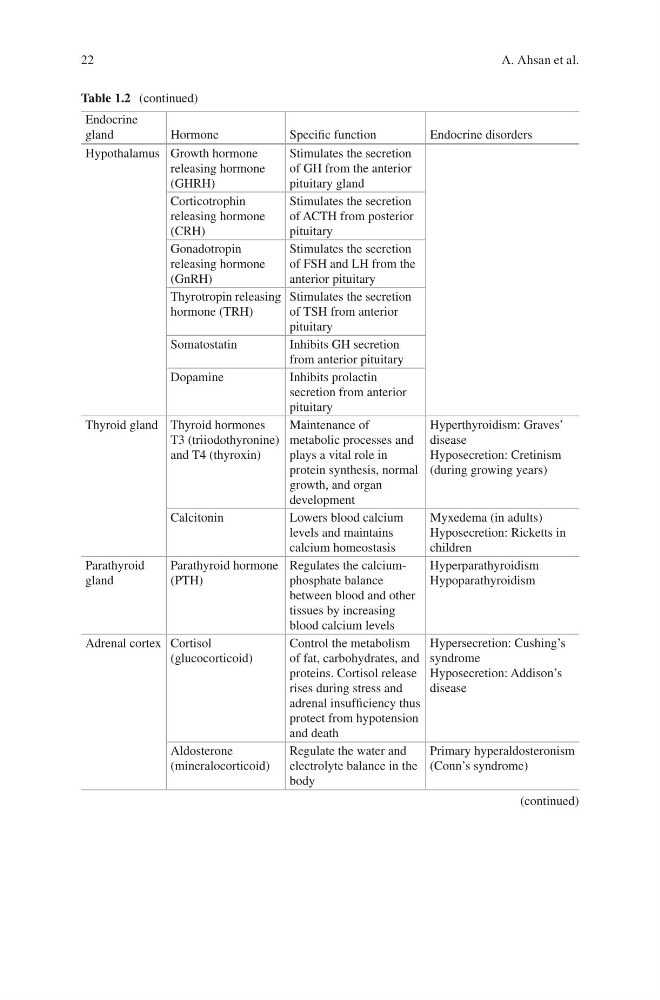
Table 1.2 (continued)
Endocrine
gland
Hormone
Specific function
Endocrine disorders
Hypothalamus Growth hormone
releasing hormone
(GHRH)
Stimulates the secretion
of GH from the anterior
pituitary gland
Corticotrophin
releasing hormone
(CRH)
Stimulates the secretion
of ACTH from posterior
pituitary
Gonadotropin
releasing hormone
(GnRH)
Stimulates the secretion
of FSH and LH from the
anterior pituitary
Thyrotropin releasing
hormone (TRH)
Stimulates the secretion
of TSH from anterior
pituitary
Somatostatin
Inhibits GH secretion
from anterior pituitary
Dopamine
Inhibits prolactin
secretion from anterior
pituitary
Thyroid gland Thyroid hormones
T3 (triiodothyronine)
and T4 (thyroxin)
Maintenance of
metabolic processes and
plays a vital role in
protein synthesis, normal
growth, and organ
development
Hyperthyroidism: Graves’
disease
Hyposecretion: Cretinism
(during growing years)
Calcitonin
Lowers blood calcium
levels and maintains
calcium homeostasis
Myxedema (in adults)
Hyposecretion: Ricketts in
children
Parathyroid
gland
Parathyroid hormone
(PTH)
Regulates the calciumphosphate balance
between blood and other
tissues by increasing
blood calcium levels
Hyperparathyroidism
Hypoparathyroidism
Adrenal cortex Cortisol
(glucocorticoid)
Control the metabolism
of fat, carbohydrates, and
proteins. Cortisol release
rises during stress and
adrenal insufficiency thus
protect from hypotension
and death
Hypersecretion: Cushing’s
syndrome
Hyposecretion: Addison’s
disease
Aldosterone
(mineralocorticoid)
Regulate the water and
electrolyte balance in the
body
Primary hyperaldosteronism
(Conn’s syndrome)
(continued)
A. Ahsan et al.
Table 1.2 (continued)
Endocrine
gland
Hormone
Specific function
Endocrine disorders
Hypothalamus Growth hormone
releasing hormone
(GHRH)
Stimulates the secretion
of GH from the anterior
pituitary gland
Corticotrophin
releasing hormone
(CRH)
Stimulates the secretion
of ACTH from posterior
pituitary
Gonadotropin
releasing hormone
(GnRH)
Stimulates the secretion
of FSH and LH from the
anterior pituitary
Thyrotropin releasing
hormone (TRH)
Stimulates the secretion
of TSH from anterior
pituitary
Somatostatin
Inhibits GH secretion
from anterior pituitary
Dopamine
Inhibits prolactin
secretion from anterior
pituitary
Thyroid gland Thyroid hormones
T3 (triiodothyronine)
and T4 (thyroxin)
Maintenance of
metabolic processes and
plays a vital role in
protein synthesis, normal
growth, and organ
development
Hyperthyroidism: Graves’
disease
Hyposecretion: Cretinism
(during growing years)
Calcitonin
Lowers blood calcium
levels and maintains
calcium homeostasis
Myxedema (in adults)
Hyposecretion: Ricketts in
children
Parathyroid
gland
Parathyroid hormone
(PTH)
Regulates the calciumphosphate balance
between blood and other
tissues by increasing
blood calcium levels
Hyperparathyroidism
Hypoparathyroidism
Adrenal cortex Cortisol
(glucocorticoid)
Control the metabolism
of fat, carbohydrates, and
proteins. Cortisol release
rises during stress and
adrenal insufficiency thus
protect from hypotension
and death
Hypersecretion: Cushing’s
syndrome
Hyposecretion: Addison’s
disease
Aldosterone
(mineralocorticoid)
Regulate the water and
electrolyte balance in the
body
Primary hyperaldosteronism
(Conn’s syndrome)
(continued)
A. Ahsan et al.