

374
overweight, otherwise these may lead to numerous metabolic disorders mainly
including insulin resistance. Thus, increasing morbidity and mortality rates. So, it is
advisable to minimize the usage of parabens.
Influence of Parabens on Estrogen
Estrogen is an important steroid sex hormone, associated with various functions
including cholesterol mobilization, cardiovascular system functions, skin physiology, regulating bone density, and brain functions [63]. In females, estrogen is mainly
responsible for regulating secondary sexual characteristics as well as development
of reproductive tissues at puberty [64]. Estrogen mainly mediate their effect/functions through their receptors α and β (ERα and ERβ) [63]. The 17β-hydroxysteroid
dehydrogenase type 1 (17β-HSD1) as well as 17β-hydroxysteroid dehydrogenase
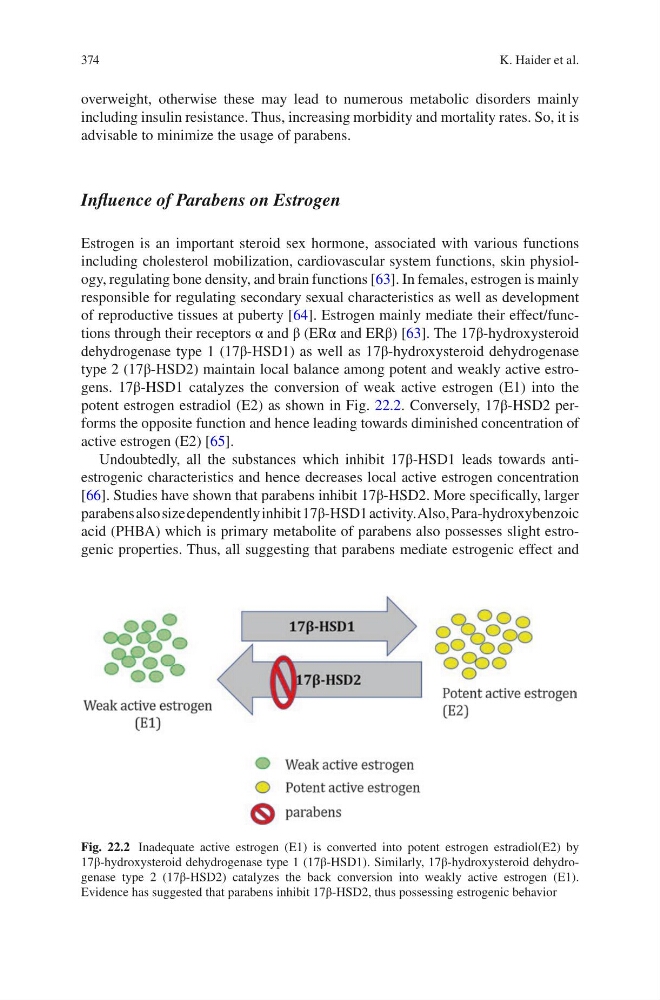
type 2 (17β-HSD2) maintain local balance among potent and weakly active estrogens. 17β-HSD1 catalyzes the conversion of weak active estrogen (E1) into the
potent estrogen estradiol (E2) as shown in Fig. 22.2. Conversely, 17β-HSD2 performs the opposite function and hence leading towards diminished concentration of
active estrogen (E2) [65].
Undoubtedly, all the substances which inhibit 17β-HSD1 leads towards antiestrogenic characteristics and hence decreases local active estrogen concentration
[66]. Studies have shown that parabens inhibit 17β-HSD2. More specifically, larger
parabens also size dependently inhibit 17β-HSD1 activity. Also, Para-hydroxybenzoic
acid (PHBA) which is primary metabolite of parabens also possesses slight estrogenic properties. Thus, all suggesting that parabens mediate estrogenic effect and
Fig. 22.2 Inadequate active estrogen (E1) is converted into potent estrogen estradiol(E2) by
17β-hydroxysteroid dehydrogenase type 1 (17β-HSD1). Similarly, 17β-hydroxysteroid dehydrogenase type 2 (17β-HSD2) catalyzes the back conversion into weakly active estrogen (E1).
Evidence has suggested that parabens inhibit 17β-HSD2, thus possessing estrogenic behavior
K. Haider et al.
overweight, otherwise these may lead to numerous metabolic disorders mainly
including insulin resistance. Thus, increasing morbidity and mortality rates. So, it is
advisable to minimize the usage of parabens.
Influence of Parabens on Estrogen
Estrogen is an important steroid sex hormone, associated with various functions
including cholesterol mobilization, cardiovascular system functions, skin physiology, regulating bone density, and brain functions [63]. In females, estrogen is mainly
responsible for regulating secondary sexual characteristics as well as development
of reproductive tissues at puberty [64]. Estrogen mainly mediate their effect/functions through their receptors α and β (ERα and ERβ) [63]. The 17β-hydroxysteroid
dehydrogenase type 1 (17β-HSD1) as well as 17β-hydroxysteroid dehydrogenase
type 2 (17β-HSD2) maintain local balance among potent and weakly active estrogens. 17β-HSD1 catalyzes the conversion of weak active estrogen (E1) into the
potent estrogen estradiol (E2) as shown in Fig. 22.2. Conversely, 17β-HSD2 performs the opposite function and hence leading towards diminished concentration of
active estrogen (E2) [65].
Undoubtedly, all the substances which inhibit 17β-HSD1 leads towards antiestrogenic characteristics and hence decreases local active estrogen concentration
[66]. Studies have shown that parabens inhibit 17β-HSD2. More specifically, larger
parabens also size dependently inhibit 17β-HSD1 activity. Also, Para-hydroxybenzoic
acid (PHBA) which is primary metabolite of parabens also possesses slight estrogenic properties. Thus, all suggesting that parabens mediate estrogenic effect and
Fig. 22.2 Inadequate active estrogen (E1) is converted into potent estrogen estradiol(E2) by
17β-hydroxysteroid dehydrogenase type 1 (17β-HSD1). Similarly, 17β-hydroxysteroid dehydrogenase type 2 (17β-HSD2) catalyzes the back conversion into weakly active estrogen (E1).
Evidence has suggested that parabens inhibit 17β-HSD2, thus possessing estrogenic behavior
K. Haider et al.