

344
oxidative stress. Reactive oxygen species (ROS) work as a second messenger in
miscellaneous mitochondrial and cellular procedures and signaling pathways. On
the other hand, excessive ROS might react with nucleic acid, lipids, carbohydrates,
and protein causing inflammation and oxidative stress that are the main causes for
the development of various metabolic disorders. Hence, this chapter will include the
detailed discussion about the impact of cigarette smoking on metabolic disorder
along with its effects on several enzymatic and metabolic pathways.
Keywords Cigarette · Endocrine disrupting chemicals · Metabolic disorders
Cardiovascular diseases
Introduction
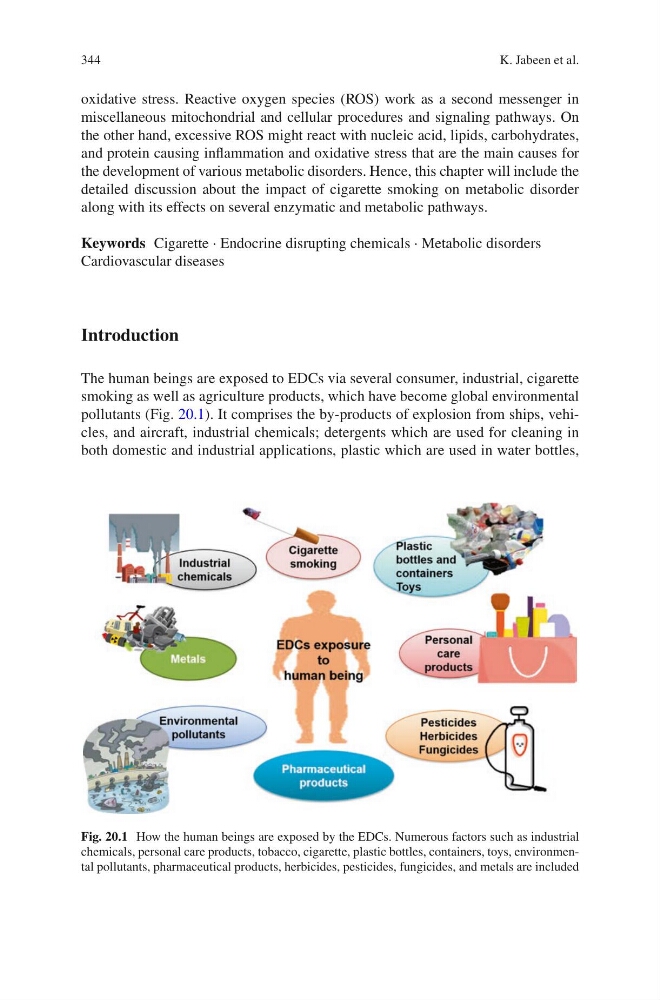
The human beings are exposed to EDCs via several consumer, industrial, cigarette
smoking as well as agriculture products, which have become global environmental
pollutants (Fig. 20.1). It comprises the by-products of explosion from ships, vehicles, and aircraft, industrial chemicals; detergents which are used for cleaning in
both domestic and industrial applications, plastic which are used in water bottles,
Fig. 20.1 How the human beings are exposed by the EDCs. Numerous factors such as industrial
chemicals, personal care products, tobacco, cigarette, plastic bottles, containers, toys, environmental pollutants, pharmaceutical products, herbicides, pesticides, fungicides, and metals are included
K. Jabeen et al.
oxidative stress. Reactive oxygen species (ROS) work as a second messenger in
miscellaneous mitochondrial and cellular procedures and signaling pathways. On
the other hand, excessive ROS might react with nucleic acid, lipids, carbohydrates,
and protein causing inflammation and oxidative stress that are the main causes for
the development of various metabolic disorders. Hence, this chapter will include the
detailed discussion about the impact of cigarette smoking on metabolic disorder
along with its effects on several enzymatic and metabolic pathways.
Keywords Cigarette · Endocrine disrupting chemicals · Metabolic disorders
Cardiovascular diseases
Introduction
The human beings are exposed to EDCs via several consumer, industrial, cigarette
smoking as well as agriculture products, which have become global environmental
pollutants (Fig. 20.1). It comprises the by-products of explosion from ships, vehicles, and aircraft, industrial chemicals; detergents which are used for cleaning in
both domestic and industrial applications, plastic which are used in water bottles,
Fig. 20.1 How the human beings are exposed by the EDCs. Numerous factors such as industrial
chemicals, personal care products, tobacco, cigarette, plastic bottles, containers, toys, environmental pollutants, pharmaceutical products, herbicides, pesticides, fungicides, and metals are included
K. Jabeen et al.