

268
treat plants without penetrating the vascular system, e.g., diquat dibromide, etc.
[11]. Vegetable, fruit, and soil pests can be removed by fumigants. Some pesticides
like acaricide is a well-known insectoid but it may have ability to control mites,
nematodes while herbicide 2,4-D is a potent plant growth regulator [12]. Pesticides
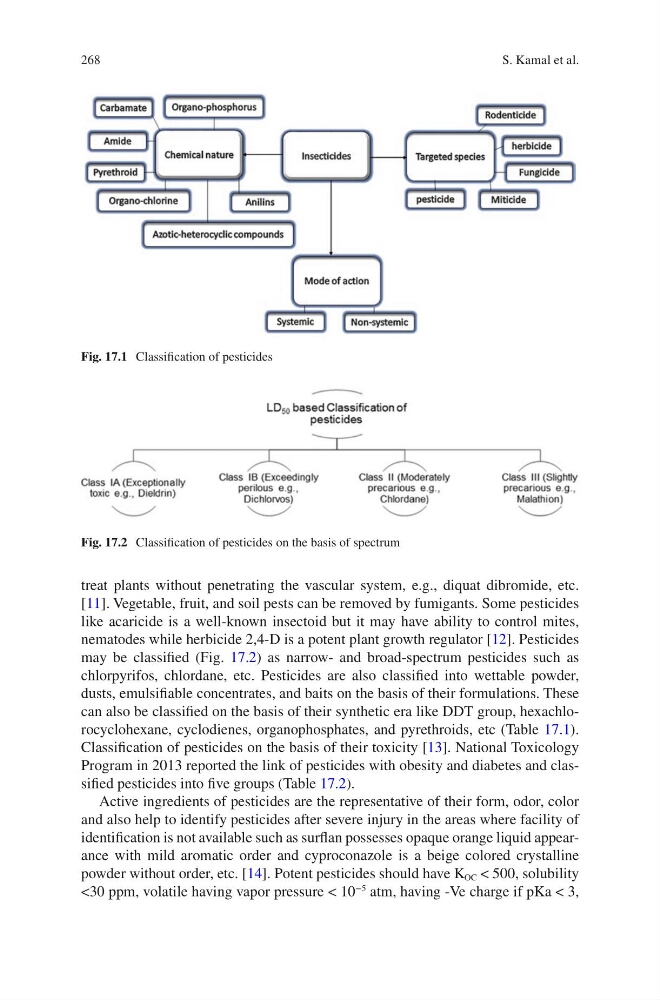
may be classified (Fig. 17.2) as narrow- and broad-spectrum pesticides such as
chlorpyrifos, chlordane, etc. Pesticides are also classified into wettable powder,
dusts, emulsifiable concentrates, and baits on the basis of their formulations. These
can also be classified on the basis of their synthetic era like DDT group, hexachlorocyclohexane, cyclodienes, organophosphates, and pyrethroids, etc (Table 17.1).
Classification of pesticides on the basis of their toxicity [13]. National Toxicology
Program in 2013 reported the link of pesticides with obesity and diabetes and classified pesticides into five groups (Table 17.2).
Active ingredients of pesticides are the representative of their form, odor, color
and also help to identify pesticides after severe injury in the areas where facility of
identification is not available such as surflan possesses opaque orange liquid appearance with mild aromatic order and cyproconazole is a beige colored crystalline
powder without order, etc. [14]. Potent pesticides should have K OC < 500, solubility
<30 ppm, volatile having vapor pressure < 10
−5
atm, having -Ve charge if pKa < 3,
Fig. 17.1 Classification of pesticides
Fig. 17.2 Classification of pesticides on the basis of spectrum
S. Kamal et al.
treat plants without penetrating the vascular system, e.g., diquat dibromide, etc.
[11]. Vegetable, fruit, and soil pests can be removed by fumigants. Some pesticides
like acaricide is a well-known insectoid but it may have ability to control mites,
nematodes while herbicide 2,4-D is a potent plant growth regulator [12]. Pesticides
may be classified (Fig. 17.2) as narrow- and broad-spectrum pesticides such as
chlorpyrifos, chlordane, etc. Pesticides are also classified into wettable powder,
dusts, emulsifiable concentrates, and baits on the basis of their formulations. These
can also be classified on the basis of their synthetic era like DDT group, hexachlorocyclohexane, cyclodienes, organophosphates, and pyrethroids, etc (Table 17.1).
Classification of pesticides on the basis of their toxicity [13]. National Toxicology
Program in 2013 reported the link of pesticides with obesity and diabetes and classified pesticides into five groups (Table 17.2).
Active ingredients of pesticides are the representative of their form, odor, color
and also help to identify pesticides after severe injury in the areas where facility of
identification is not available such as surflan possesses opaque orange liquid appearance with mild aromatic order and cyproconazole is a beige colored crystalline
powder without order, etc. [14]. Potent pesticides should have K OC < 500, solubility
<30 ppm, volatile having vapor pressure < 10
−5
atm, having -Ve charge if pKa < 3,
Fig. 17.1 Classification of pesticides
Fig. 17.2 Classification of pesticides on the basis of spectrum
S. Kamal et al.