

229
emia [62]. The alteration in hormonal sensitivity of adipose tissue by PBDPEs has
been examined in male rat [63]. The findings of this study showed marked increase
in lipolysis and decrease in glucose oxidation, both of which are associated with
obesity, insulin resistance, and type 2 diabetes [48, 64–66]. Thus, the abnormal
health issues such as disturbance of lipid and glucose metabolism may be associated
with PBDPEs [67].
The diabetogenesis may be correlated to environmental pollutants. Lee and coworkers [64, 68] draw attention regarding an influential factor, i.e., existence of
obesity and diabetes in relation to environmental pollutants depending upon their
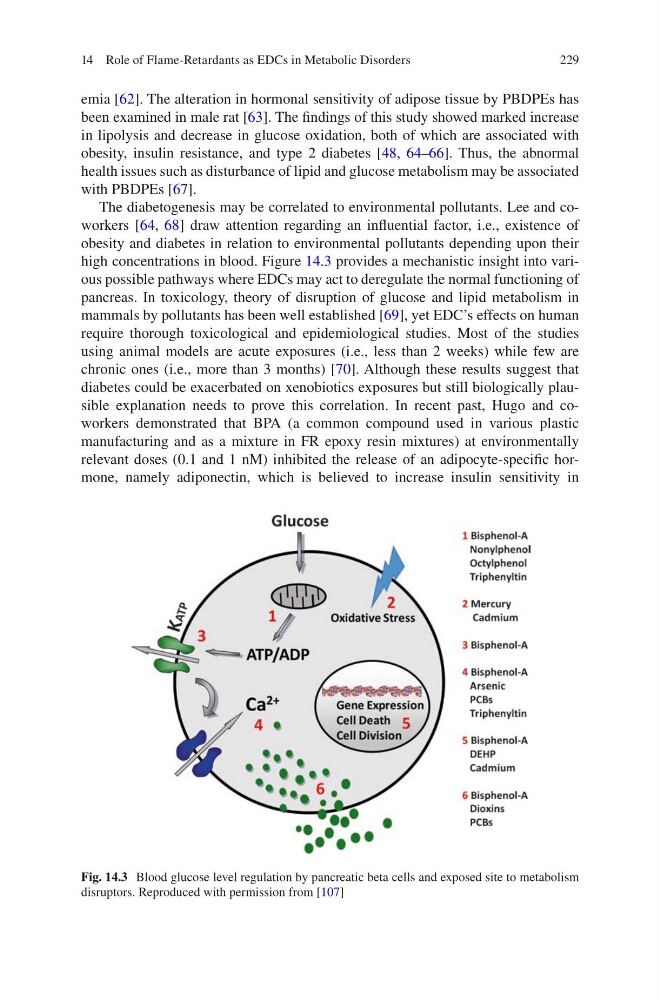
high concentrations in blood. Figure 14.3 provides a mechanistic insight into various possible pathways where EDCs may act to deregulate the normal functioning of
pancreas. In toxicology, theory of disruption of glucose and lipid metabolism in
mammals by pollutants has been well established [69], yet EDC’s effects on human
require thorough toxicological and epidemiological studies. Most of the studies
using animal models are acute exposures (i.e., less than 2 weeks) while few are
chronic ones (i.e., more than 3 months) [70]. Although these results suggest that
diabetes could be exacerbated on xenobiotics exposures but still biologically plausible explanation needs to prove this correlation. In recent past, Hugo and coworkers demonstrated that BPA (a common compound used in various plastic
manufacturing and as a mixture in FR epoxy resin mixtures) at environmentally
relevant doses (0.1 and 1 nM) inhibited the release of an adipocyte-specific hormone, namely adiponectin, which is believed to increase insulin sensitivity in
Fig. 14.3 Blood glucose level regulation by pancreatic beta cells and exposed site to metabolism
disruptors. Reproduced with permission from [107]
14 Role of Flame-Retardants as EDCs in Metabolic Disorders
emia [62]. The alteration in hormonal sensitivity of adipose tissue by PBDPEs has
been examined in male rat [63]. The findings of this study showed marked increase
in lipolysis and decrease in glucose oxidation, both of which are associated with
obesity, insulin resistance, and type 2 diabetes [48, 64–66]. Thus, the abnormal
health issues such as disturbance of lipid and glucose metabolism may be associated
with PBDPEs [67].
The diabetogenesis may be correlated to environmental pollutants. Lee and coworkers [64, 68] draw attention regarding an influential factor, i.e., existence of
obesity and diabetes in relation to environmental pollutants depending upon their
high concentrations in blood. Figure 14.3 provides a mechanistic insight into various possible pathways where EDCs may act to deregulate the normal functioning of
pancreas. In toxicology, theory of disruption of glucose and lipid metabolism in
mammals by pollutants has been well established [69], yet EDC’s effects on human
require thorough toxicological and epidemiological studies. Most of the studies
using animal models are acute exposures (i.e., less than 2 weeks) while few are
chronic ones (i.e., more than 3 months) [70]. Although these results suggest that
diabetes could be exacerbated on xenobiotics exposures but still biologically plausible explanation needs to prove this correlation. In recent past, Hugo and coworkers demonstrated that BPA (a common compound used in various plastic
manufacturing and as a mixture in FR epoxy resin mixtures) at environmentally
relevant doses (0.1 and 1 nM) inhibited the release of an adipocyte-specific hormone, namely adiponectin, which is believed to increase insulin sensitivity in
Fig. 14.3 Blood glucose level regulation by pancreatic beta cells and exposed site to metabolism
disruptors. Reproduced with permission from [107]
14 Role of Flame-Retardants as EDCs in Metabolic Disorders