

228
prime contributor of obesity. However, recent research has indicated another
unheeded factor, i.e., environmental chemicals or EDCs which are a key source of
air, water, and food contamination [48, 49]. Many EDCs have been identified to
significantly alter the adipose tissue functioning in various animal models after
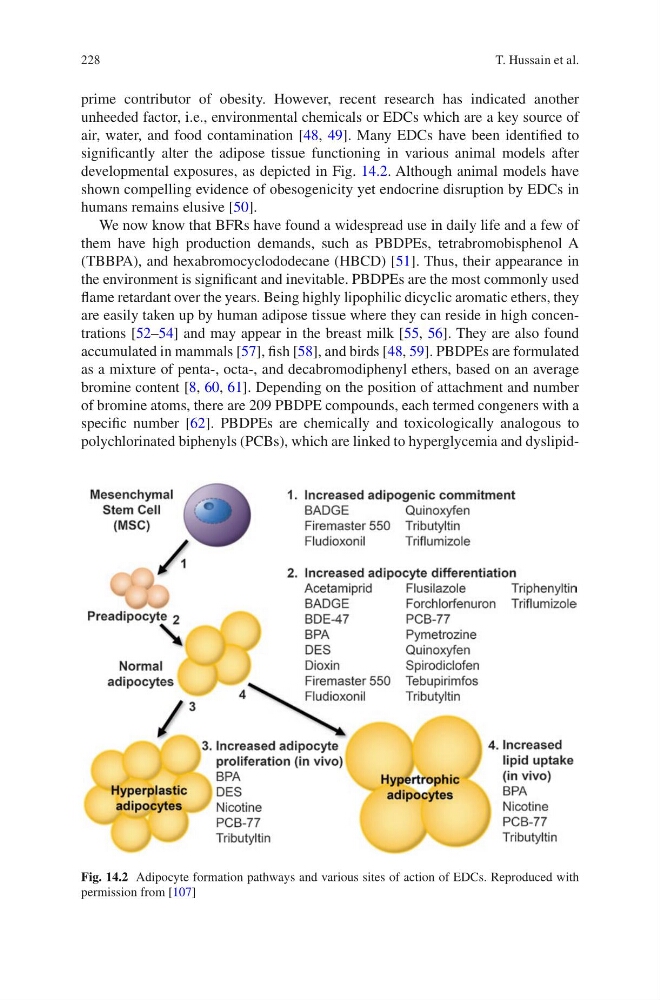
developmental exposures, as depicted in Fig. 14.2. Although animal models have
shown compelling evidence of obesogenicity yet endocrine disruption by EDCs in
humans remains elusive [50].
We now know that BFRs have found a widespread use in daily life and a few of
them have high production demands, such as PBDPEs, tetrabromobisphenol A
(TBBPA), and hexabromocyclododecane (HBCD) [51]. Thus, their appearance in
the environment is significant and inevitable. PBDPEs are the most commonly used
flame retardant over the years. Being highly lipophilic dicyclic aromatic ethers, they
are easily taken up by human adipose tissue where they can reside in high concentrations [52–54] and may appear in the breast milk [55, 56]. They are also found
accumulated in mammals [57], fish [58], and birds [48, 59]. PBDPEs are formulated
as a mixture of penta-, octa-, and decabromodiphenyl ethers, based on an average
bromine content [8, 60, 61]. Depending on the position of attachment and number
of bromine atoms, there are 209 PBDPE compounds, each termed congeners with a
specific number [62]. PBDPEs are chemically and toxicologically analogous to
polychlorinated biphenyls (PCBs), which are linked to hyperglycemia and dyslipidFig. 14.2 Adipocyte formation pathways and various sites of action of EDCs. Reproduced with
permission from [107]
T. Hussain et al.
prime contributor of obesity. However, recent research has indicated another
unheeded factor, i.e., environmental chemicals or EDCs which are a key source of
air, water, and food contamination [48, 49]. Many EDCs have been identified to
significantly alter the adipose tissue functioning in various animal models after
developmental exposures, as depicted in Fig. 14.2. Although animal models have
shown compelling evidence of obesogenicity yet endocrine disruption by EDCs in
humans remains elusive [50].
We now know that BFRs have found a widespread use in daily life and a few of
them have high production demands, such as PBDPEs, tetrabromobisphenol A
(TBBPA), and hexabromocyclododecane (HBCD) [51]. Thus, their appearance in
the environment is significant and inevitable. PBDPEs are the most commonly used
flame retardant over the years. Being highly lipophilic dicyclic aromatic ethers, they
are easily taken up by human adipose tissue where they can reside in high concentrations [52–54] and may appear in the breast milk [55, 56]. They are also found
accumulated in mammals [57], fish [58], and birds [48, 59]. PBDPEs are formulated
as a mixture of penta-, octa-, and decabromodiphenyl ethers, based on an average
bromine content [8, 60, 61]. Depending on the position of attachment and number
of bromine atoms, there are 209 PBDPE compounds, each termed congeners with a
specific number [62]. PBDPEs are chemically and toxicologically analogous to
polychlorinated biphenyls (PCBs), which are linked to hyperglycemia and dyslipidFig. 14.2 Adipocyte formation pathways and various sites of action of EDCs. Reproduced with
permission from [107]
T. Hussain et al.