

213
Lead-Induced Inflammatory Responses
Lead exhibits a negative impact on the immune system which is an important key
element for the process of inflammation and plays a defensive role in injury within
a living organism [65]. Lead exposure does not cause complete deficiencies of
immune cells but it has a negative impact on the regulation of the immune system
[66]. COX-2, an enzyme that is responsible for catalyzing the formation of prostaglandins H 2 from arachidonic acid. The resultant prostaglandins H 2 are involved in
a unique series of enzymatic and non-enzymatic reactions for the formation of primary prostanoids; PGE2, PGF2α, PGI2, PGD2, and TXA2, and also the generation
of reactive oxygen species [67]. Lead has the ability to influence the COX-2 gene by
alteration in a nuclear factor of activated T-cells(NFAT) which is a transcription
factor. Lead causes mutation in the NFAT binding site which is responsible for the
eradication of COX-2 gene transcription [68]. IL-8 which has the ability to exhibit
antioxidant response, is also bound with Nrf2. Lead is responsible for activation of
IL-8 synthesis but their secretion depends upon Nrf2. The blocking of Nrf2, by
small interfering RNA (siRNA), causes the complete blocking of transcription,
translation, and secretion of IL-8 produced by lead [69].
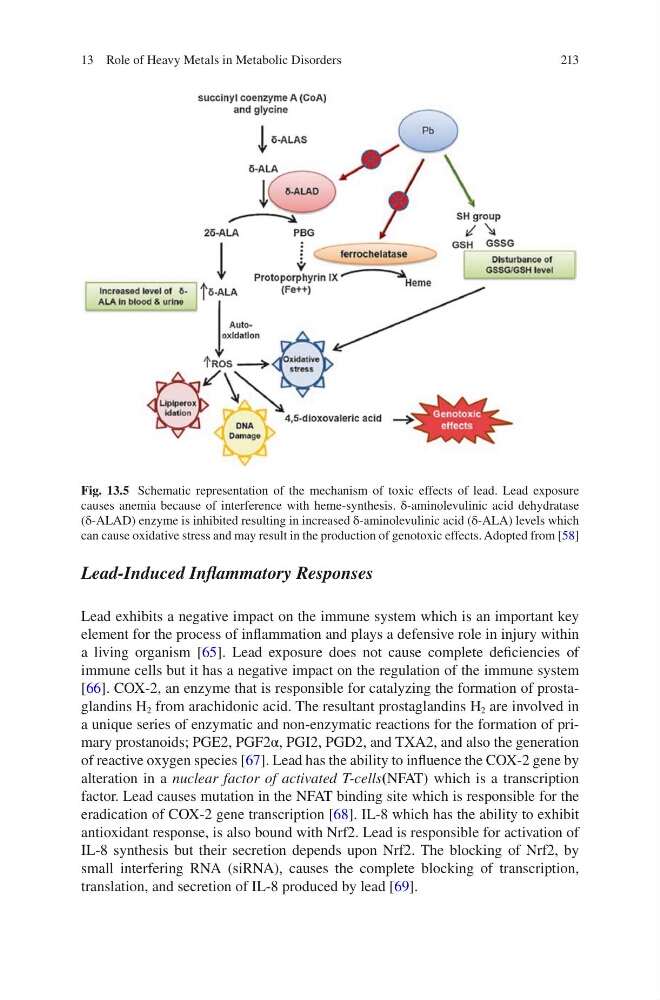
Fig. 13.5 Schematic representation of the mechanism of toxic effects of lead. Lead exposure
causes anemia because of interference with heme-synthesis. δ-aminolevulinic acid dehydratase
(δ-ALAD) enzyme is inhibited resulting in increased δ-aminolevulinic acid (δ-ALA) levels which
can cause oxidative stress and may result in the production of genotoxic effects. Adopted from [58]
13 Role of Heavy Metals in Metabolic Disorders
Lead-Induced Inflammatory Responses
Lead exhibits a negative impact on the immune system which is an important key
element for the process of inflammation and plays a defensive role in injury within
a living organism [65]. Lead exposure does not cause complete deficiencies of
immune cells but it has a negative impact on the regulation of the immune system
[66]. COX-2, an enzyme that is responsible for catalyzing the formation of prostaglandins H 2 from arachidonic acid. The resultant prostaglandins H 2 are involved in
a unique series of enzymatic and non-enzymatic reactions for the formation of primary prostanoids; PGE2, PGF2α, PGI2, PGD2, and TXA2, and also the generation
of reactive oxygen species [67]. Lead has the ability to influence the COX-2 gene by
alteration in a nuclear factor of activated T-cells(NFAT) which is a transcription
factor. Lead causes mutation in the NFAT binding site which is responsible for the
eradication of COX-2 gene transcription [68]. IL-8 which has the ability to exhibit
antioxidant response, is also bound with Nrf2. Lead is responsible for activation of
IL-8 synthesis but their secretion depends upon Nrf2. The blocking of Nrf2, by
small interfering RNA (siRNA), causes the complete blocking of transcription,
translation, and secretion of IL-8 produced by lead [69].
Fig. 13.5 Schematic representation of the mechanism of toxic effects of lead. Lead exposure
causes anemia because of interference with heme-synthesis. δ-aminolevulinic acid dehydratase
(δ-ALAD) enzyme is inhibited resulting in increased δ-aminolevulinic acid (δ-ALA) levels which
can cause oxidative stress and may result in the production of genotoxic effects. Adopted from [58]
13 Role of Heavy Metals in Metabolic Disorders