

182
Furan Formation via Amino Acids Thermal Degradation
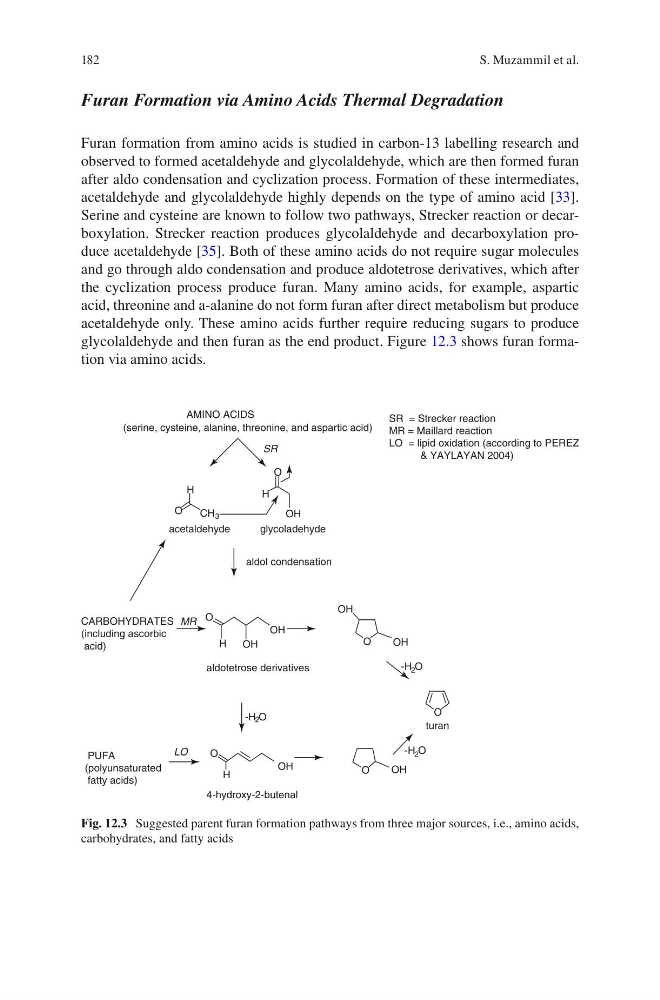
Furan formation from amino acids is studied in carbon-13 labelling research and
observed to formed acetaldehyde and glycolaldehyde, which are then formed furan
after aldo condensation and cyclization process. Formation of these intermediates,
acetaldehyde and glycolaldehyde highly depends on the type of amino acid [33].
Serine and cysteine are known to follow two pathways, Strecker reaction or decarboxylation. Strecker reaction produces glycolaldehyde and decarboxylation produce acetaldehyde [35]. Both of these amino acids do not require sugar molecules
and go through aldo condensation and produce aldotetrose derivatives, which after
the cyclization process produce furan. Many amino acids, for example, aspartic
acid, threonine and a-alanine do not form furan after direct metabolism but produce
acetaldehyde only. These amino acids further require reducing sugars to produce
glycolaldehyde and then furan as the end product. Figure 12.3 shows furan formation via amino acids.
SR
H
H
H
H
O
O
O
O
O
O
O
OH
CH 3
2
2
2
glycoladehyde
acetaldehyde
aldol condensation
CARBOHYDRATES
(including ascorbic
acid)
SR = Strecker reaction
MR = Maillard reaction
LO = lipid oxidation (according to PEREZ
& YAYLAYAN 2004)
MR
OH
OH
OH
OH
OH
OH
aldotetrose derivatives
-H O
-H O
-H O
turan
LO
PUFA
(polyunsaturated
fatty acids)
4-hydroxy-2-butenal
AMINO ACIDS
(serine, cysteine, alanine, threonine, and aspartic acid)
Fig. 12.3 Suggested parent furan formation pathways from three major sources, i.e., amino acids,
carbohydrates, and fatty acids
S. Muzammil et al.
Furan Formation via Amino Acids Thermal Degradation
Furan formation from amino acids is studied in carbon-13 labelling research and
observed to formed acetaldehyde and glycolaldehyde, which are then formed furan
after aldo condensation and cyclization process. Formation of these intermediates,
acetaldehyde and glycolaldehyde highly depends on the type of amino acid [33].
Serine and cysteine are known to follow two pathways, Strecker reaction or decarboxylation. Strecker reaction produces glycolaldehyde and decarboxylation produce acetaldehyde [35]. Both of these amino acids do not require sugar molecules
and go through aldo condensation and produce aldotetrose derivatives, which after
the cyclization process produce furan. Many amino acids, for example, aspartic
acid, threonine and a-alanine do not form furan after direct metabolism but produce
acetaldehyde only. These amino acids further require reducing sugars to produce
glycolaldehyde and then furan as the end product. Figure 12.3 shows furan formation via amino acids.
SR
H
H
H
H
O
O
O
O
O
O
O
OH
CH 3
2
2
2
glycoladehyde
acetaldehyde
aldol condensation
CARBOHYDRATES
(including ascorbic
acid)
SR = Strecker reaction
MR = Maillard reaction
LO = lipid oxidation (according to PEREZ
& YAYLAYAN 2004)
MR
OH
OH
OH
OH
OH
OH
aldotetrose derivatives
-H O
-H O
-H O
turan
LO
PUFA
(polyunsaturated
fatty acids)
4-hydroxy-2-butenal
AMINO ACIDS
(serine, cysteine, alanine, threonine, and aspartic acid)
Fig. 12.3 Suggested parent furan formation pathways from three major sources, i.e., amino acids,
carbohydrates, and fatty acids
S. Muzammil et al.