

114
the ecosystem and human health have already been deeply concerned over several
years. However, several questions arise about the mechanisms of action of the endocrine disruptors, and further research is required. This chapter studies the current
understanding of the potential health risks of endocrine-disrupting chemicals in
humans and highlights a need for increasing awareness of EDCs exposure and their
lifelong health effects.
Keywords Endocrine-disrupting chemicals · Exposure · Human health ·
Biomonitoring · Environment · Risk assessment
Background
Chemicals are a significant part of our everyday life. However, some chemicals can
be proven harmful to our body’s natural hormone system. Endocrine disruptors that
affect the normal endocrine functions are a group of diverse chemical compounds.
These endocrine chemicals have the potency to impede the physiology of the endocrine system in animals and humans. Endocrine-disrupting chemicals (EDCs) are
defined by the Endocrine Society (endcrine.org) as: “an exogenous [non-natural]
chemical, or a mixture of chemicals, that interferes with any aspect of hormone
action [1].” In regulating critical biological processes like metabolism, breeding,
growth, and behavior, the endocrine system plays a vital role [2]. More than 85
thousand chemical compounds, of which a thousand have been acknowledged as
possible endocrine disruptors. A broad range of active ingredients found in different
materials, including food, pesticides, plasticizers, metals, additives, personal care
products, and toys, are believed to result in endocrine disruption. In everyday life,
several xenobiotic compounds are used and released into the environment. These
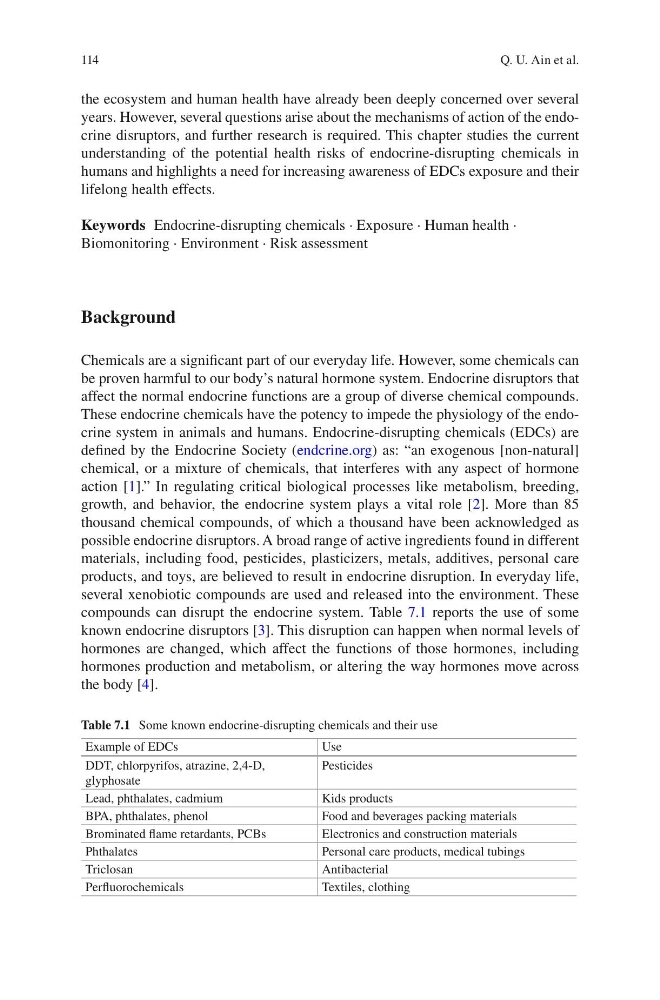
compounds can disrupt the endocrine system. Table 7.1 reports the use of some
known endocrine disruptors [3]. This disruption can happen when normal levels of
hormones are changed, which affect the functions of those hormones, including
hormones production and metabolism, or altering the way hormones move across
the body [4].
Table 7.1 Some known endocrine-disrupting chemicals and their use
Example of EDCs
Use
DDT, chlorpyrifos, atrazine, 2,4-D,
glyphosate
Pesticides
Lead, phthalates, cadmium
Kids products
BPA, phthalates, phenol
Food and beverages packing materials
Brominated flame retardants, PCBs
Electronics and construction materials
Phthalates
Personal care products, medical tubings
Triclosan
Antibacterial
Perfluorochemicals
Textiles, clothing
Q. U. Ain et al.
the ecosystem and human health have already been deeply concerned over several
years. However, several questions arise about the mechanisms of action of the endocrine disruptors, and further research is required. This chapter studies the current
understanding of the potential health risks of endocrine-disrupting chemicals in
humans and highlights a need for increasing awareness of EDCs exposure and their
lifelong health effects.
Keywords Endocrine-disrupting chemicals · Exposure · Human health ·
Biomonitoring · Environment · Risk assessment
Background
Chemicals are a significant part of our everyday life. However, some chemicals can
be proven harmful to our body’s natural hormone system. Endocrine disruptors that
affect the normal endocrine functions are a group of diverse chemical compounds.
These endocrine chemicals have the potency to impede the physiology of the endocrine system in animals and humans. Endocrine-disrupting chemicals (EDCs) are
defined by the Endocrine Society (endcrine.org) as: “an exogenous [non-natural]
chemical, or a mixture of chemicals, that interferes with any aspect of hormone
action [1].” In regulating critical biological processes like metabolism, breeding,
growth, and behavior, the endocrine system plays a vital role [2]. More than 85
thousand chemical compounds, of which a thousand have been acknowledged as
possible endocrine disruptors. A broad range of active ingredients found in different
materials, including food, pesticides, plasticizers, metals, additives, personal care
products, and toys, are believed to result in endocrine disruption. In everyday life,
several xenobiotic compounds are used and released into the environment. These
compounds can disrupt the endocrine system. Table 7.1 reports the use of some
known endocrine disruptors [3]. This disruption can happen when normal levels of
hormones are changed, which affect the functions of those hormones, including
hormones production and metabolism, or altering the way hormones move across
the body [4].
Table 7.1 Some known endocrine-disrupting chemicals and their use
Example of EDCs
Use
DDT, chlorpyrifos, atrazine, 2,4-D,
glyphosate
Pesticides
Lead, phthalates, cadmium
Kids products
BPA, phthalates, phenol
Food and beverages packing materials
Brominated flame retardants, PCBs
Electronics and construction materials
Phthalates
Personal care products, medical tubings
Triclosan
Antibacterial
Perfluorochemicals
Textiles, clothing
Q. U. Ain et al.