

87
homeostasis. But other toxins also specifically mediates its toxic effect and arouses
switching to chronic fatty liver disease [32].
Besides ethanol, epidemiological studies have illustrated that consumption of
dietary cholesterol elicits strong association with development of fatty liver disease.
Moreover, consumption of high fat diet along with alcohol has more detrimental
effect and induces liver injury, in contrast to simple high-fat diet without cholesterol
and alcohol [33]. Meanwhile, several mechanisms give rise to steatosis such as (i)
increased fat diet and enhanced adipose lipolysis, (ii) diminished fat export in
VLDL-TG form, (iii) downregulation in free fatty β-oxidation, and (iv) elevated de
novo lipogenesis. So, subsequently developed hepatic steatosis is helpful for histological identification of NAFLD [31].
Importantly, treatment strategies to overcome and overt NAFLD include healthy
life-style adaptation and nutritional interventions. Lifestyle management especially
dietary restriction along with regular physical exercise can reverse NAFLD, as
weight reduction has dose-response relationship with treating NAFLD. Particularly,
weight reduction ≥10% is interlinked with improvement in almost half of patients
having liver fibrosis [34]. No doubt, weight reduction is laborious to attain and then
maintain. For this, NAFLD patients necessitate also pharmacotherapy [35].
Therefore, a number of novel targets are under consideration in randomized clinical
trials to prevent the consequence of disease from last 5–10 years [34]. Recently, one
study has indicated that protease-activated receptors 2 (PAR2) contributes a role in
lipid homeostasis and cholesterol in NAFLD. It is demonstrated that PAR2 mediates
its role in suppressing reverse cholesterol transport and also in lipid breakdown. An
evidence from a study on mice presents reduction in cholesterol synthesis and
increased β-oxidation by PAR2 deficiency. Thus, PAR2 can be a novel target in
treating NAFLD and other associated metabolic conditions [36]. Among currently
available drugs, pioglitazone and vitamin E have shown positive outcomes.
Additionally, a single-center study has also demonstrated that vitamin E may have
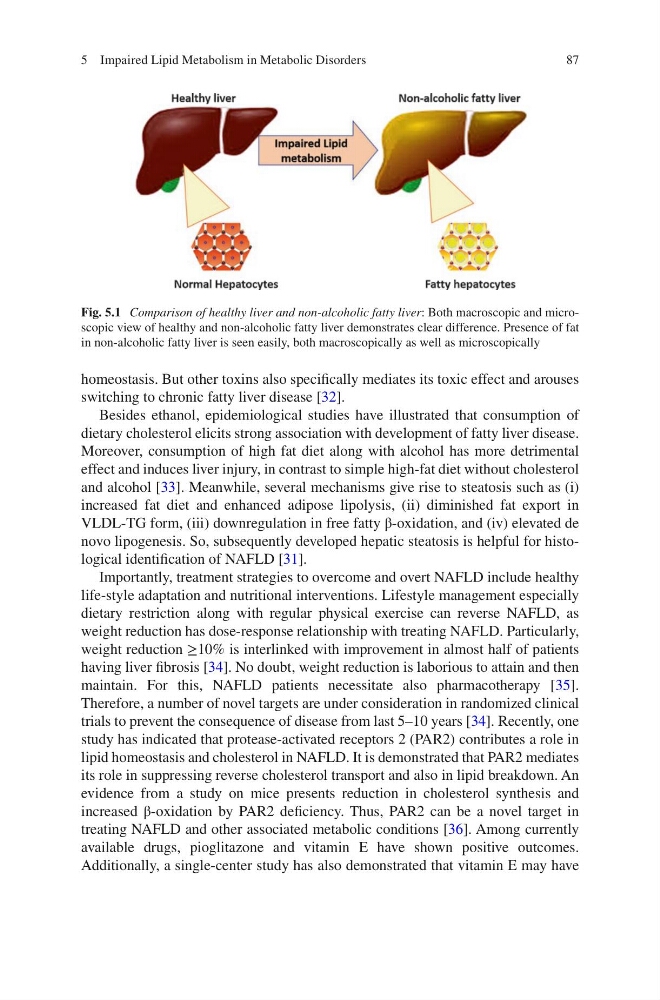
Fig. 5.1 Comparison of healthy liver and non-alcoholic fatty liver: Both macroscopic and microscopic view of healthy and non-alcoholic fatty liver demonstrates clear difference. Presence of fat
in non-alcoholic fatty liver is seen easily, both macroscopically as well as microscopically
5 Impaired Lipid Metabolism in Metabolic Disorders
homeostasis. But other toxins also specifically mediates its toxic effect and arouses
switching to chronic fatty liver disease [32].
Besides ethanol, epidemiological studies have illustrated that consumption of
dietary cholesterol elicits strong association with development of fatty liver disease.
Moreover, consumption of high fat diet along with alcohol has more detrimental
effect and induces liver injury, in contrast to simple high-fat diet without cholesterol
and alcohol [33]. Meanwhile, several mechanisms give rise to steatosis such as (i)
increased fat diet and enhanced adipose lipolysis, (ii) diminished fat export in
VLDL-TG form, (iii) downregulation in free fatty β-oxidation, and (iv) elevated de
novo lipogenesis. So, subsequently developed hepatic steatosis is helpful for histological identification of NAFLD [31].
Importantly, treatment strategies to overcome and overt NAFLD include healthy
life-style adaptation and nutritional interventions. Lifestyle management especially
dietary restriction along with regular physical exercise can reverse NAFLD, as
weight reduction has dose-response relationship with treating NAFLD. Particularly,
weight reduction ≥10% is interlinked with improvement in almost half of patients
having liver fibrosis [34]. No doubt, weight reduction is laborious to attain and then
maintain. For this, NAFLD patients necessitate also pharmacotherapy [35].
Therefore, a number of novel targets are under consideration in randomized clinical
trials to prevent the consequence of disease from last 5–10 years [34]. Recently, one
study has indicated that protease-activated receptors 2 (PAR2) contributes a role in
lipid homeostasis and cholesterol in NAFLD. It is demonstrated that PAR2 mediates
its role in suppressing reverse cholesterol transport and also in lipid breakdown. An
evidence from a study on mice presents reduction in cholesterol synthesis and
increased β-oxidation by PAR2 deficiency. Thus, PAR2 can be a novel target in
treating NAFLD and other associated metabolic conditions [36]. Among currently
available drugs, pioglitazone and vitamin E have shown positive outcomes.
Additionally, a single-center study has also demonstrated that vitamin E may have
Fig. 5.1 Comparison of healthy liver and non-alcoholic fatty liver: Both macroscopic and microscopic view of healthy and non-alcoholic fatty liver demonstrates clear difference. Presence of fat
in non-alcoholic fatty liver is seen easily, both macroscopically as well as microscopically
5 Impaired Lipid Metabolism in Metabolic Disorders