

stabilized dunes. The Oakville soil series is common on
dunes along the shorelines of Lakes Michigan, Erie, and
Ontario.
4.3.4 The Time Factor and Soil Distribution
Soils of the GLCZ occur in five age classes related to dated
lake stages and drift units. Nearly half (46%) of the soil
series are derived from lake-stage events at 11.2 kyr BP, i.e.,
from the Duluth (Lake Superior), Main Algonquin (Lakes
Superior, Michigan, and Huron); 28% began forming during
lake-stage events at 13.8 kyr BP, i.e., from the Glenwood,
Calumet, Maumee (Lake Michigan), and Whittlesey and
Warren (Lakes Huron and Erie) (Fig. 4.15).
Whereas Entisols are most common on the mid-Holocene
Algoma and Nipissing surfaces, Spodosols and Inceptisols
are dominant on Algonquin and Duluth surfaces of
approximately 11.2 kyr in age, and Alfisols and Mollisols
are most common on Glenwood, Whittlesey, and Warren
surfaces of approximately 13.8 kyr in age (Fig. 4.16).
These data enable the determination of the time required
to develop different diagnostic horizons. The argillic horizon, the most common diagnostic horizon, may form in 11.2
kyr, but is most common in soils that are 13.8 kyr in age
(Fig. 4.17). The spodic horizon, the second most common
diagnostic horizon in Great Lakes soils, appears to require
11.2 kyr to form. The glossic, fragipan, and ortstein horizons
all seem to require 11.2 kyr to develop. The mollic and
cambic horizons are most common in 11.2 kyr and 13.8 kyr
soils, but are somewhat common on soils of Nipissing (5.3
kyr BP) age.
These trends are borne out by published soil chronosquences along the Great Lakes shoreline (Table 4.3). On
coarse-textured (sands and loamy sands), quartz-rich beach
ridges, dunes, outwash, and lake sediments, Psammaquents
persist under wet conditions and Udipsamments and
Quartzipsamments under dry conditions throughout the late
Wisconsinan and Holocene (Fig. 4.13). However, on sandy
loam and loamy fine sand outwash, lake sediments, and till,
Udorthents evolve to Dystrudepts by 5.3 kyr, become
weakly developed Spodosols on materials dated at *7 kyr,
and form strongly developed Spodosols at 11.2 kyr
(Figs. 4.17 and 4.18).
4.4
Conclusions
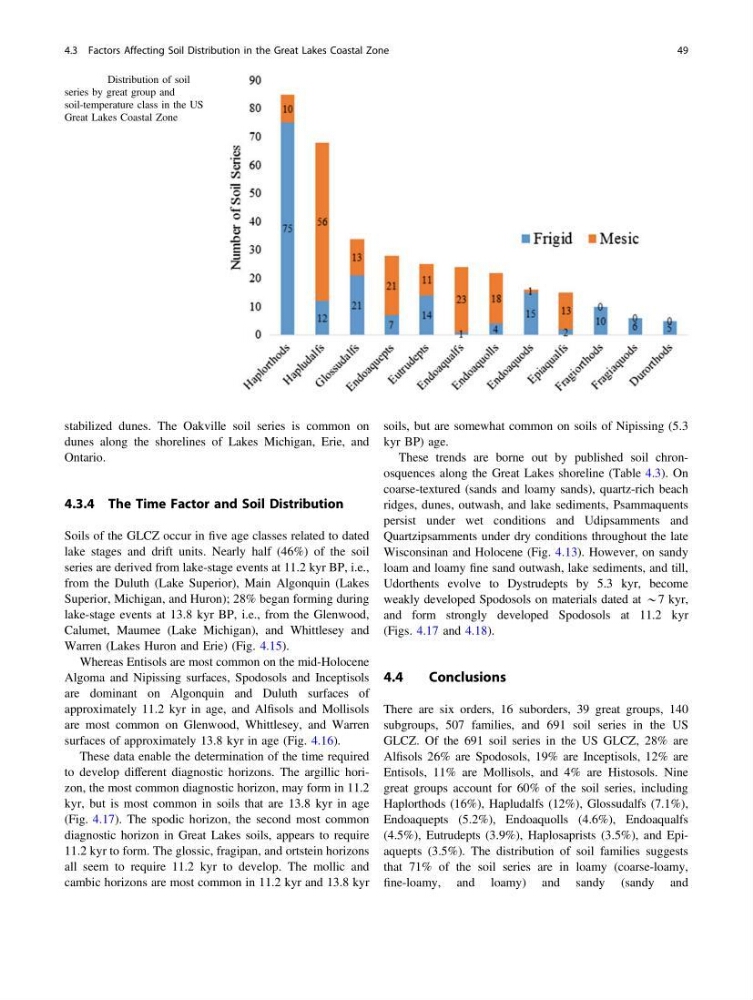
There are six orders, 16 suborders, 39 great groups, 140
subgroups, 507 families, and 691 soil series in the US
GLCZ. Of the 691 soil series in the US GLCZ, 28% are
Alfisols 26% are Spodosols, 19% are Inceptisols, 12% are
Entisols, 11% are Mollisols, and 4% are Histosols. Nine
great groups account for 60% of the soil series, including
Haplorthods (16%), Hapludalfs (12%), Glossudalfs (7.1%),
Endoaquepts (5.2%), Endoaquolls (4.6%), Endoaqualfs
(4.5%), Eutrudepts (3.9%), Haplosaprists (3.5%), and Epiaquepts (3.5%). The distribution of soil families suggests
that 71% of the soil series are in loamy (coarse-loamy,
fine-loamy, and loamy) and sandy (sandy and
Fig. 4.7 Distribution of soil
series by great group and
soil-temperature class in the US
Great Lakes Coastal Zone
4.3 Factors Affecting Soil Distribution in the Great Lakes Coastal Zone
49
dunes along the shorelines of Lakes Michigan, Erie, and
Ontario.
4.3.4 The Time Factor and Soil Distribution
Soils of the GLCZ occur in five age classes related to dated
lake stages and drift units. Nearly half (46%) of the soil
series are derived from lake-stage events at 11.2 kyr BP, i.e.,
from the Duluth (Lake Superior), Main Algonquin (Lakes
Superior, Michigan, and Huron); 28% began forming during
lake-stage events at 13.8 kyr BP, i.e., from the Glenwood,
Calumet, Maumee (Lake Michigan), and Whittlesey and
Warren (Lakes Huron and Erie) (Fig. 4.15).
Whereas Entisols are most common on the mid-Holocene
Algoma and Nipissing surfaces, Spodosols and Inceptisols
are dominant on Algonquin and Duluth surfaces of
approximately 11.2 kyr in age, and Alfisols and Mollisols
are most common on Glenwood, Whittlesey, and Warren
surfaces of approximately 13.8 kyr in age (Fig. 4.16).
These data enable the determination of the time required
to develop different diagnostic horizons. The argillic horizon, the most common diagnostic horizon, may form in 11.2
kyr, but is most common in soils that are 13.8 kyr in age
(Fig. 4.17). The spodic horizon, the second most common
diagnostic horizon in Great Lakes soils, appears to require
11.2 kyr to form. The glossic, fragipan, and ortstein horizons
all seem to require 11.2 kyr to develop. The mollic and
cambic horizons are most common in 11.2 kyr and 13.8 kyr
soils, but are somewhat common on soils of Nipissing (5.3
kyr BP) age.
These trends are borne out by published soil chronosquences along the Great Lakes shoreline (Table 4.3). On
coarse-textured (sands and loamy sands), quartz-rich beach
ridges, dunes, outwash, and lake sediments, Psammaquents
persist under wet conditions and Udipsamments and
Quartzipsamments under dry conditions throughout the late
Wisconsinan and Holocene (Fig. 4.13). However, on sandy
loam and loamy fine sand outwash, lake sediments, and till,
Udorthents evolve to Dystrudepts by 5.3 kyr, become
weakly developed Spodosols on materials dated at *7 kyr,
and form strongly developed Spodosols at 11.2 kyr
(Figs. 4.17 and 4.18).
4.4
Conclusions
There are six orders, 16 suborders, 39 great groups, 140
subgroups, 507 families, and 691 soil series in the US
GLCZ. Of the 691 soil series in the US GLCZ, 28% are
Alfisols 26% are Spodosols, 19% are Inceptisols, 12% are
Entisols, 11% are Mollisols, and 4% are Histosols. Nine
great groups account for 60% of the soil series, including
Haplorthods (16%), Hapludalfs (12%), Glossudalfs (7.1%),
Endoaquepts (5.2%), Endoaquolls (4.6%), Endoaqualfs
(4.5%), Eutrudepts (3.9%), Haplosaprists (3.5%), and Epiaquepts (3.5%). The distribution of soil families suggests
that 71% of the soil series are in loamy (coarse-loamy,
fine-loamy, and loamy) and sandy (sandy and
Fig. 4.7 Distribution of soil
series by great group and
soil-temperature class in the US
Great Lakes Coastal Zone
4.3 Factors Affecting Soil Distribution in the Great Lakes Coastal Zone
49