

divided into mesic and frigid soil-temperature classes
(Fig. 4.3). In the Canadian GLCZ, the largest proportion of
the soil series are in the moderately fine particle-size class
(20%), followed by the medium (18%), fine (16%), very
coarse (14%), and other classes (Fig. 4.5).
There are 16 soil series with the same name in the US and
Canadian GLCZ, eight of which are classified similarly. These
include the Eastport (Orthic Regosol/Udipsamments), Granby
(Orthic Humic Gleysol/Endoaquolls), Guelph (Brunisolic Gray
Brown Luvisol/Glossudalfs), Niagara (Gleyed Gray Brown
Luvisol/Endoaqualfs), Ontario (Brunisolic Gray Brown Luvisol/Hapludalfs), Rubicon (Gleyed Humo-Ferric Podzol/
Haplorthods), Toledo (Orthic Humic Gleysol/Endoaquolls),
and Wauseon (Orthic Humic Gleysol/Epiaquolls) soil series.
A large portion of the soils in the Canadian GLCZ are
calcareous, including 100% of those derived from glaciolacustrine materials, 70% from till, 39% from lacustrine
deposits, and 32% from outwash (Fig. 4.6).
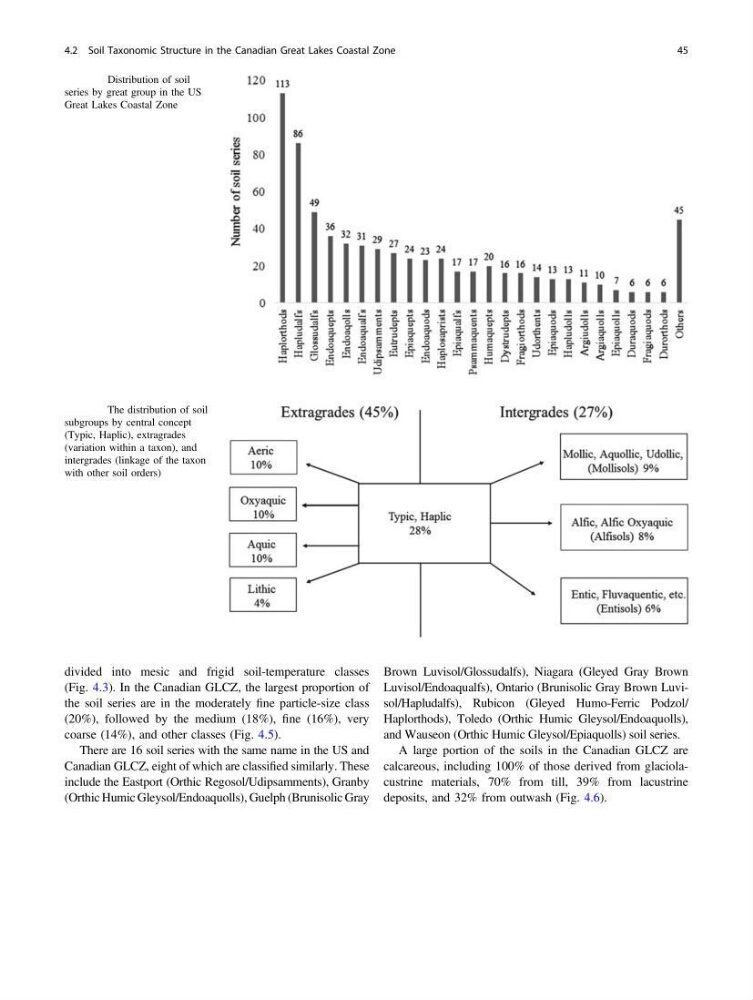
Fig. 4.1 Distribution of soil
series by great group in the US
Great Lakes Coastal Zone
Fig. 4.2 The distribution of soil
subgroups by central concept
(Typic, Haplic), extragrades
(variation within a taxon), and
intergrades (linkage of the taxon
with other soil orders)
4.2 Soil Taxonomic Structure in the Canadian Great Lakes Coastal Zone
45
(Fig. 4.3). In the Canadian GLCZ, the largest proportion of
the soil series are in the moderately fine particle-size class
(20%), followed by the medium (18%), fine (16%), very
coarse (14%), and other classes (Fig. 4.5).
There are 16 soil series with the same name in the US and
Canadian GLCZ, eight of which are classified similarly. These
include the Eastport (Orthic Regosol/Udipsamments), Granby
(Orthic Humic Gleysol/Endoaquolls), Guelph (Brunisolic Gray
Brown Luvisol/Glossudalfs), Niagara (Gleyed Gray Brown
Luvisol/Endoaqualfs), Ontario (Brunisolic Gray Brown Luvisol/Hapludalfs), Rubicon (Gleyed Humo-Ferric Podzol/
Haplorthods), Toledo (Orthic Humic Gleysol/Endoaquolls),
and Wauseon (Orthic Humic Gleysol/Epiaquolls) soil series.
A large portion of the soils in the Canadian GLCZ are
calcareous, including 100% of those derived from glaciolacustrine materials, 70% from till, 39% from lacustrine
deposits, and 32% from outwash (Fig. 4.6).
Fig. 4.1 Distribution of soil
series by great group in the US
Great Lakes Coastal Zone
Fig. 4.2 The distribution of soil
subgroups by central concept
(Typic, Haplic), extragrades
(variation within a taxon), and
intergrades (linkage of the taxon
with other soil orders)
4.2 Soil Taxonomic Structure in the Canadian Great Lakes Coastal Zone
45