

greatest numbers along the Erie (12 million), Michigan (10
million), and Ontario (8 million) shores.
2.8
Conclusions
Because the Great Lakes watershed occupies a large area
(522,000 km
2
), there is considerable variation in the soil
forming factors, including climate, vegetation, relief, parent
materials, and the duration of soil formation. The Great Lakes
exert a modifying effect on summer and winter air temperatures and on snowfall amounts within 50 km of the shoreline.
Four broad vegetation types in the Great Lakes Coastal Zone
include boreal forest, temperate mixed forest, temperate
broad-leaved forest, and native prairie. A floristic tension zone
cuts across central portions of Lake Michigan, Huron, and
Ontario. Wetlands occupy about 25% of the shoreline. The
northern portion of the Great Lakes shoreline is underlain by
Precambrian granitic and metamorphic rocks and the southern
portion by carbonate rocks. The Niagara Escarpment follows
the southern Lake Ontario shoreline, bisects Georgian Bay
from the main body of Lake Huron, and connects the Garden
Peninsula and Door Peninsula in Lake Michigan. The entire
Great Lakes basin was glaciated during the late Wisconsinan.
The Great Lakes basin features exposed bedrock, sandy outwash and lacustrine sediments, and clayey till in roughly equal
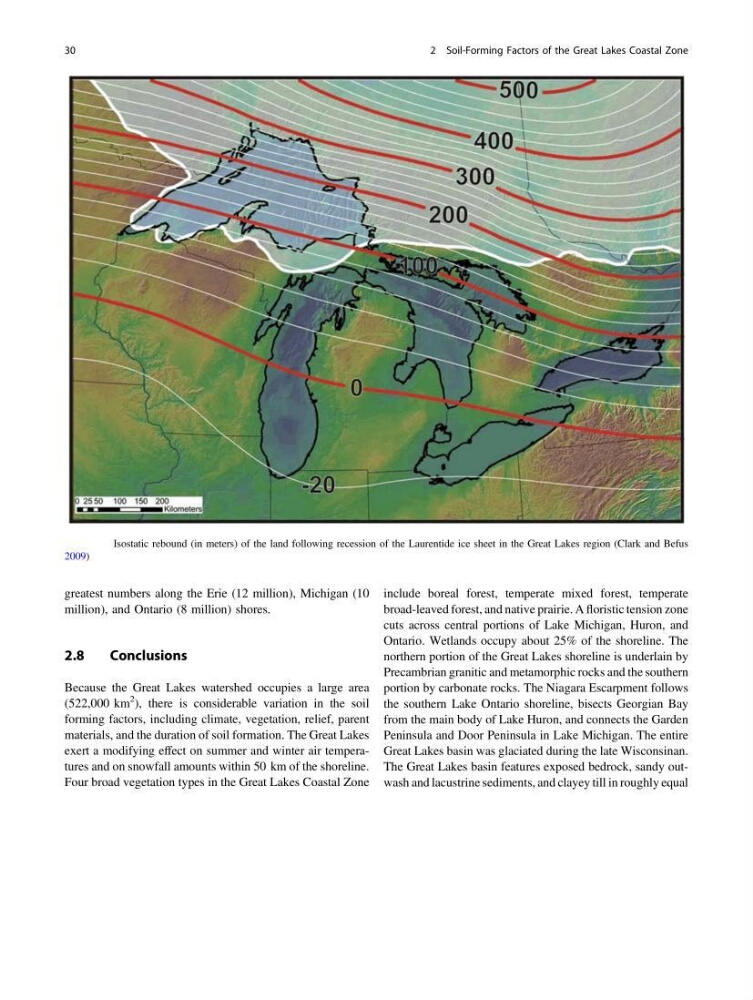
Fig. 2.14 Isostatic rebound (in meters) of the land following recession of the Laurentide ice sheet in the Great Lakes region (Clark and Befus
2009)
30
2 Soil-Forming Factors of the Great Lakes Coastal Zone
million), and Ontario (8 million) shores.
2.8
Conclusions
Because the Great Lakes watershed occupies a large area
(522,000 km
2
), there is considerable variation in the soil
forming factors, including climate, vegetation, relief, parent
materials, and the duration of soil formation. The Great Lakes
exert a modifying effect on summer and winter air temperatures and on snowfall amounts within 50 km of the shoreline.
Four broad vegetation types in the Great Lakes Coastal Zone
include boreal forest, temperate mixed forest, temperate
broad-leaved forest, and native prairie. A floristic tension zone
cuts across central portions of Lake Michigan, Huron, and
Ontario. Wetlands occupy about 25% of the shoreline. The
northern portion of the Great Lakes shoreline is underlain by
Precambrian granitic and metamorphic rocks and the southern
portion by carbonate rocks. The Niagara Escarpment follows
the southern Lake Ontario shoreline, bisects Georgian Bay
from the main body of Lake Huron, and connects the Garden
Peninsula and Door Peninsula in Lake Michigan. The entire
Great Lakes basin was glaciated during the late Wisconsinan.
The Great Lakes basin features exposed bedrock, sandy outwash and lacustrine sediments, and clayey till in roughly equal
Fig. 2.14 Isostatic rebound (in meters) of the land following recession of the Laurentide ice sheet in the Great Lakes region (Clark and Befus
2009)
30
2 Soil-Forming Factors of the Great Lakes Coastal Zone