

is from Lake Nipissing 3.5 to 5.0 ka yr BP. The glaciolacustrine deposits are dated at 9.5–7.3 ka yr BP.
14.4 Early People
There have been extensive archaeological investigations in
the Great Lakes region (Fig. 14.10). Here, two case studies
of early people in the GLCZ briefly are discussed. Sonnenburg et al. (2012) studied Holocene paleoshorelines and
the submerged, prehistoric sites near Rice Lake, Ontario.
Figure 14.11 shows shoreline extent of Rice Lake in the
Lake Erie basin, and known terrestrial occupation sites and
areas of archaeological potential.
O’Shea and Meadows (2009) identified a series of stone
structures along the Alpena-Amberley ridge (Fig. 14.12
upper), a feature that would have been a dry land corridor
crossing Lake Huron during the Lake Stanley low water
states 10–7.5 ka BP. The hypothesized that the aligned
stones (Fig. 14.12 lower) were used for caribou hunting in
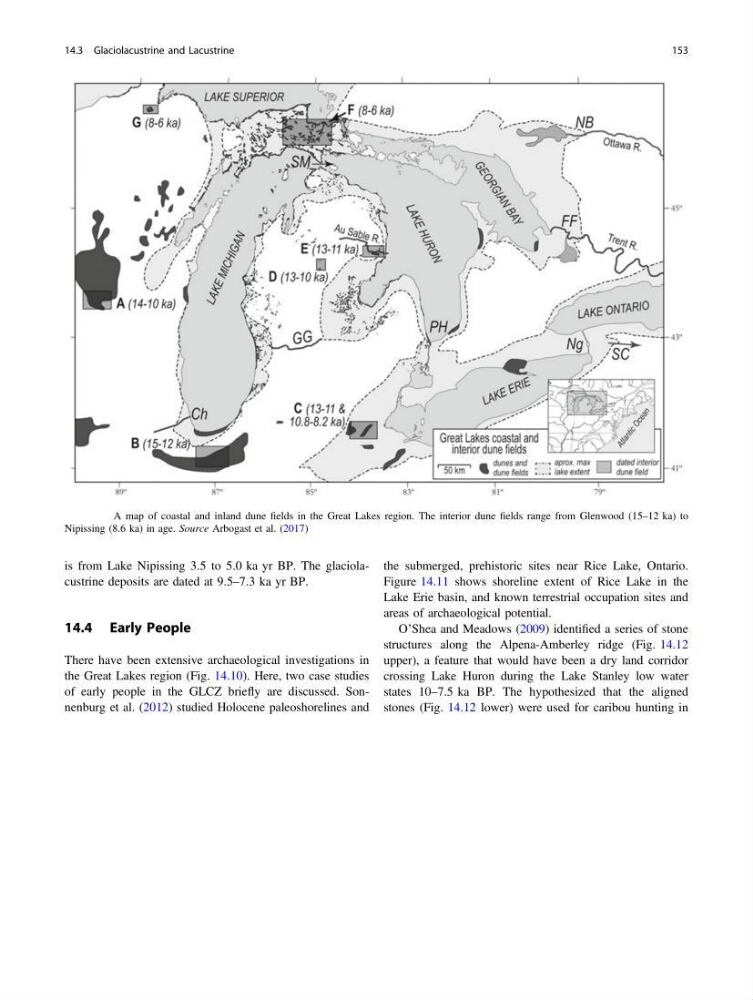
Fig. 14.5 A map of coastal and inland dune fields in the Great Lakes region. The interior dune fields range from Glenwood (15–12 ka) to
Nipissing (8.6 ka) in age. Source Arbogast et al. (2017)
14.3 Glaciolacustrine and Lacustrine
153
14.4 Early People
There have been extensive archaeological investigations in
the Great Lakes region (Fig. 14.10). Here, two case studies
of early people in the GLCZ briefly are discussed. Sonnenburg et al. (2012) studied Holocene paleoshorelines and
the submerged, prehistoric sites near Rice Lake, Ontario.
Figure 14.11 shows shoreline extent of Rice Lake in the
Lake Erie basin, and known terrestrial occupation sites and
areas of archaeological potential.
O’Shea and Meadows (2009) identified a series of stone
structures along the Alpena-Amberley ridge (Fig. 14.12
upper), a feature that would have been a dry land corridor
crossing Lake Huron during the Lake Stanley low water
states 10–7.5 ka BP. The hypothesized that the aligned
stones (Fig. 14.12 lower) were used for caribou hunting in
Fig. 14.5 A map of coastal and inland dune fields in the Great Lakes region. The interior dune fields range from Glenwood (15–12 ka) to
Nipissing (8.6 ka) in age. Source Arbogast et al. (2017)
14.3 Glaciolacustrine and Lacustrine
153