

The US GLCZ has a three-fold greater average pedodiversity
(0.014) than for Land Resource Regions, Major Land
Resource Areas, and individual states. The high pedodiversity of the GLCZ can be attributed to (i) a diversity of parent
materials related to a geological contrast between the Precambrian igneous and metamorphic rocks of the Canadian
Shield to the north and Paleozoic sedimentary rocks to the
south and repeated glaciations during the late Quaternary
accompanied by ancestral lakes; (ii) a strong climatic gradient and the effects of the lakes on snow distribution (i.e.,
“lake-effect” snow belts), and (iii) a bioclimatic tension zone
that separates the temperate mixed broad-leaved and coniferous forest (boreal and Great Lakes-St. Lawrence Forests)
to the north from broad-leaved forest (Carolinian Forest) to
the south.
References
Arbogast, A.F. 2000. Estimating the time since final stabilization of a
perched dune field along Lake Superior. Professor—Department of
Geography 52: 594–606.
Arbogast, A.F., and W.L. Loope. 1999. Maximum-limiting age of Lake
Michigan coastal dunes: Their correlation with Holocene lake level
history. Journal of Great Lakes Research 25: 372–382.
Bockheim, J.G. 1997. Soils in hemlock-hardwood ecosystem-mosaic.
Canadian Journal of Forest Research 27: 1147–1153.
Bockheim, J.G. 2005. Soil endemism and its relation to soil formation
theory. Geoderma 129: 109–124.
Bockheim, J.G., and S.A. Schliemann. 2014. Soil richness and
endemism across an environmental transition zone in Wisconsin,
USA. Catena 113: 86–94.
Clark, J.A., K.M. Befus, and G.R. Sharman. 2012. A model of surface
water hydrology of the Great Lakes, North America during the past
16,000 years. Physics & Chemistry Earth 53–54: 61–71.
Curtis, J.T. 1959. Vegetation of Wisconsin: An ordination of plant
communities. Madison: University of Wisconsin Press.
Ditzler, C. 2003. Endangered soils. National Cooperative Soil Survey.
Newsletter No. 25, 1–2.
Hole, F.D. 1976. Soils of Wisconsin. Madison: University of Wisconsin
Press.
Hough, J.L. 1958. Geology of the Great Lakes. University of Illinois
Press. 313 pp.
Loope, H.M., W.L. Loope, R.J. Goble, T.G. Fisher, H.M. Jol, and J.C.
Seong. 2010. Early Holocene dune activity linked with final
destruction of glacial Lake Minong, Eastern Upper Michigan, USA.
Quaternary Research 74: 73–81.
Loope, W.L., T.G. Fisher, H.M. Jol, R.J. Goble, J.B. Anderton, and W.
L. Blewett. 2004. A Holocene history of dune-mediated landscape
change along the southeastern shore of Lake Superior. Geomorphology 61: 303–322.
Prest, V.K. 1970. Quaternary geology of Canada. In Douglas, R.J.W.
(ed.) Geology and economic minerals of Canada. Geological
Survey of Canada Economic Geology 1: 676–764.
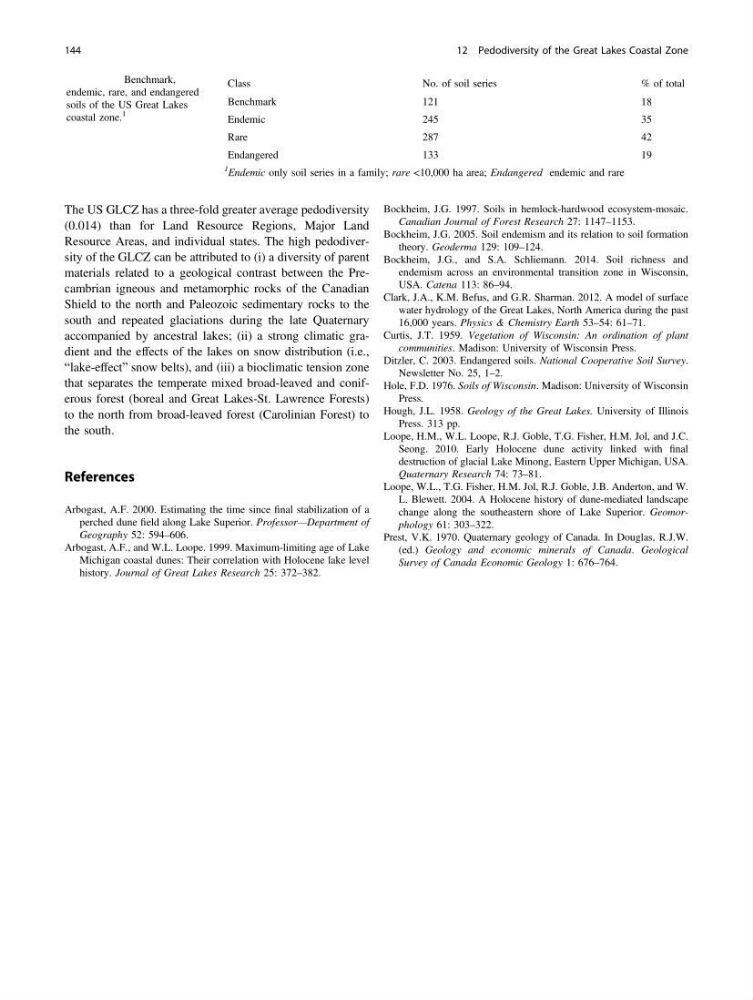
Table 12.3 Benchmark,
endemic, rare, and endangered
soils of the US Great Lakes
coastal zone.
1
Class
No. of soil series
% of total
Benchmark
121
18
Endemic
245
35
Rare
287
42
Endangered
133
19
1
Endemic only soil series in a family; rare <10,000 ha area; Endangered endemic and rare
144
12 Pedodiversity of the Great Lakes Coastal Zone
(0.014) than for Land Resource Regions, Major Land
Resource Areas, and individual states. The high pedodiversity of the GLCZ can be attributed to (i) a diversity of parent
materials related to a geological contrast between the Precambrian igneous and metamorphic rocks of the Canadian
Shield to the north and Paleozoic sedimentary rocks to the
south and repeated glaciations during the late Quaternary
accompanied by ancestral lakes; (ii) a strong climatic gradient and the effects of the lakes on snow distribution (i.e.,
“lake-effect” snow belts), and (iii) a bioclimatic tension zone
that separates the temperate mixed broad-leaved and coniferous forest (boreal and Great Lakes-St. Lawrence Forests)
to the north from broad-leaved forest (Carolinian Forest) to
the south.
References
Arbogast, A.F. 2000. Estimating the time since final stabilization of a
perched dune field along Lake Superior. Professor—Department of
Geography 52: 594–606.
Arbogast, A.F., and W.L. Loope. 1999. Maximum-limiting age of Lake
Michigan coastal dunes: Their correlation with Holocene lake level
history. Journal of Great Lakes Research 25: 372–382.
Bockheim, J.G. 1997. Soils in hemlock-hardwood ecosystem-mosaic.
Canadian Journal of Forest Research 27: 1147–1153.
Bockheim, J.G. 2005. Soil endemism and its relation to soil formation
theory. Geoderma 129: 109–124.
Bockheim, J.G., and S.A. Schliemann. 2014. Soil richness and
endemism across an environmental transition zone in Wisconsin,
USA. Catena 113: 86–94.
Clark, J.A., K.M. Befus, and G.R. Sharman. 2012. A model of surface
water hydrology of the Great Lakes, North America during the past
16,000 years. Physics & Chemistry Earth 53–54: 61–71.
Curtis, J.T. 1959. Vegetation of Wisconsin: An ordination of plant
communities. Madison: University of Wisconsin Press.
Ditzler, C. 2003. Endangered soils. National Cooperative Soil Survey.
Newsletter No. 25, 1–2.
Hole, F.D. 1976. Soils of Wisconsin. Madison: University of Wisconsin
Press.
Hough, J.L. 1958. Geology of the Great Lakes. University of Illinois
Press. 313 pp.
Loope, H.M., W.L. Loope, R.J. Goble, T.G. Fisher, H.M. Jol, and J.C.
Seong. 2010. Early Holocene dune activity linked with final
destruction of glacial Lake Minong, Eastern Upper Michigan, USA.
Quaternary Research 74: 73–81.
Loope, W.L., T.G. Fisher, H.M. Jol, R.J. Goble, J.B. Anderton, and W.
L. Blewett. 2004. A Holocene history of dune-mediated landscape
change along the southeastern shore of Lake Superior. Geomorphology 61: 303–322.
Prest, V.K. 1970. Quaternary geology of Canada. In Douglas, R.J.W.
(ed.) Geology and economic minerals of Canada. Geological
Survey of Canada Economic Geology 1: 676–764.
Table 12.3 Benchmark,
endemic, rare, and endangered
soils of the US Great Lakes
coastal zone.
1
Class
No. of soil series
% of total
Benchmark
121
18
Endemic
245
35
Rare
287
42
Endangered
133
19
1
Endemic only soil series in a family; rare <10,000 ha area; Endangered endemic and rare
144
12 Pedodiversity of the Great Lakes Coastal Zone