

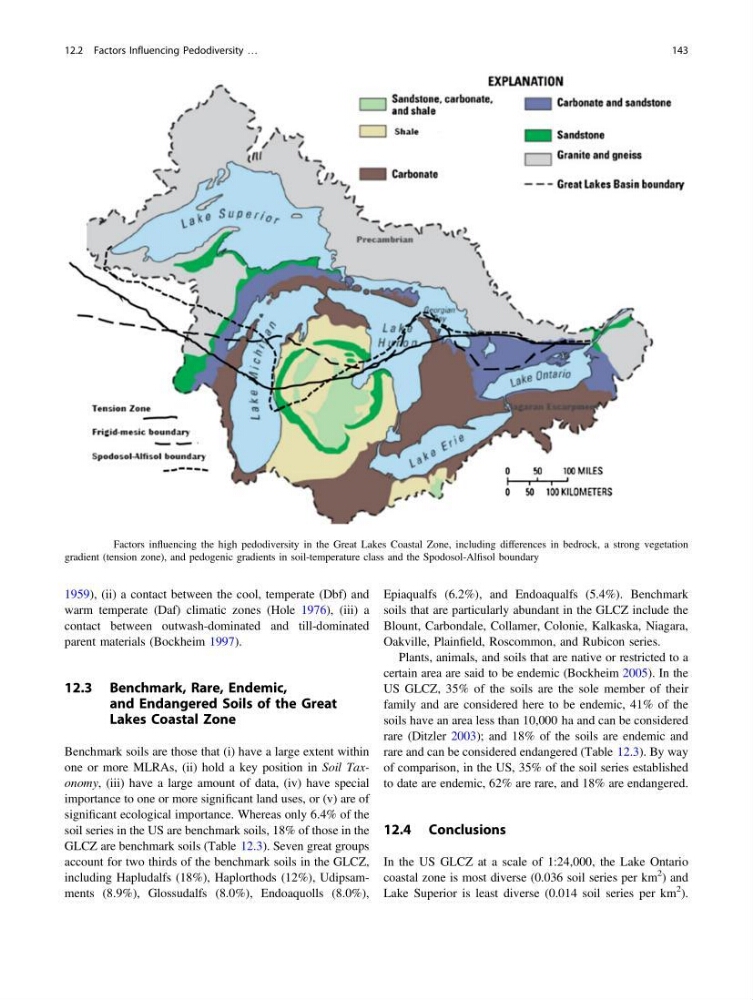
1959), (ii) a contact between the cool, temperate (Dbf) and
warm temperate (Daf) climatic zones (Hole 1976), (iii) a
contact between outwash-dominated and till-dominated
parent materials (Bockheim 1997).
12.3 Benchmark, Rare, Endemic,
and Endangered Soils of the Great
Lakes Coastal Zone
Benchmark soils are those that (i) have a large extent within
one or more MLRAs, (ii) hold a key position in Soil Taxonomy, (iii) have a large amount of data, (iv) have special
importance to one or more significant land uses, or (v) are of
significant ecological importance. Whereas only 6.4% of the
soil series in the US are benchmark soils, 18% of those in the
GLCZ are benchmark soils (Table 12.3). Seven great groups
account for two thirds of the benchmark soils in the GLCZ,
including Hapludalfs (18%), Haplorthods (12%), Udipsamments (8.9%), Glossudalfs (8.0%), Endoaquolls (8.0%),
Epiaqualfs (6.2%), and Endoaqualfs (5.4%). Benchmark
soils that are particularly abundant in the GLCZ include the
Blount, Carbondale, Collamer, Colonie, Kalkaska, Niagara,
Oakville, Plainfield, Roscommon, and Rubicon series.
Plants, animals, and soils that are native or restricted to a
certain area are said to be endemic (Bockheim 2005). In the
US GLCZ, 35% of the soils are the sole member of their
family and are considered here to be endemic, 41% of the
soils have an area less than 10,000 ha and can be considered
rare (Ditzler 2003); and 18% of the soils are endemic and
rare and can be considered endangered (Table 12.3). By way
of comparison, in the US, 35% of the soil series established
to date are endemic, 62% are rare, and 18% are endangered.
12.4 Conclusions
In the US GLCZ at a scale of 1:24,000, the Lake Ontario
coastal zone is most diverse (0.036 soil series per km
2 ) and
Lake Superior is least diverse (0.014 soil series per km
2 ).
Fig. 12.1 Factors influencing the high pedodiversity in the Great Lakes Coastal Zone, including differences in bedrock, a strong vegetation
gradient (tension zone), and pedogenic gradients in soil-temperature class and the Spodosol-Alfisol boundary
12.2 Factors Influencing Pedodiversity …
143
warm temperate (Daf) climatic zones (Hole 1976), (iii) a
contact between outwash-dominated and till-dominated
parent materials (Bockheim 1997).
12.3 Benchmark, Rare, Endemic,
and Endangered Soils of the Great
Lakes Coastal Zone
Benchmark soils are those that (i) have a large extent within
one or more MLRAs, (ii) hold a key position in Soil Taxonomy, (iii) have a large amount of data, (iv) have special
importance to one or more significant land uses, or (v) are of
significant ecological importance. Whereas only 6.4% of the
soil series in the US are benchmark soils, 18% of those in the
GLCZ are benchmark soils (Table 12.3). Seven great groups
account for two thirds of the benchmark soils in the GLCZ,
including Hapludalfs (18%), Haplorthods (12%), Udipsamments (8.9%), Glossudalfs (8.0%), Endoaquolls (8.0%),
Epiaqualfs (6.2%), and Endoaqualfs (5.4%). Benchmark
soils that are particularly abundant in the GLCZ include the
Blount, Carbondale, Collamer, Colonie, Kalkaska, Niagara,
Oakville, Plainfield, Roscommon, and Rubicon series.
Plants, animals, and soils that are native or restricted to a
certain area are said to be endemic (Bockheim 2005). In the
US GLCZ, 35% of the soils are the sole member of their
family and are considered here to be endemic, 41% of the
soils have an area less than 10,000 ha and can be considered
rare (Ditzler 2003); and 18% of the soils are endemic and
rare and can be considered endangered (Table 12.3). By way
of comparison, in the US, 35% of the soil series established
to date are endemic, 62% are rare, and 18% are endangered.
12.4 Conclusions
In the US GLCZ at a scale of 1:24,000, the Lake Ontario
coastal zone is most diverse (0.036 soil series per km
2 ) and
Lake Superior is least diverse (0.014 soil series per km
2 ).
Fig. 12.1 Factors influencing the high pedodiversity in the Great Lakes Coastal Zone, including differences in bedrock, a strong vegetation
gradient (tension zone), and pedogenic gradients in soil-temperature class and the Spodosol-Alfisol boundary
12.2 Factors Influencing Pedodiversity …
143