

86
S. H. Sadeghi and E. Sharifi Moghadam
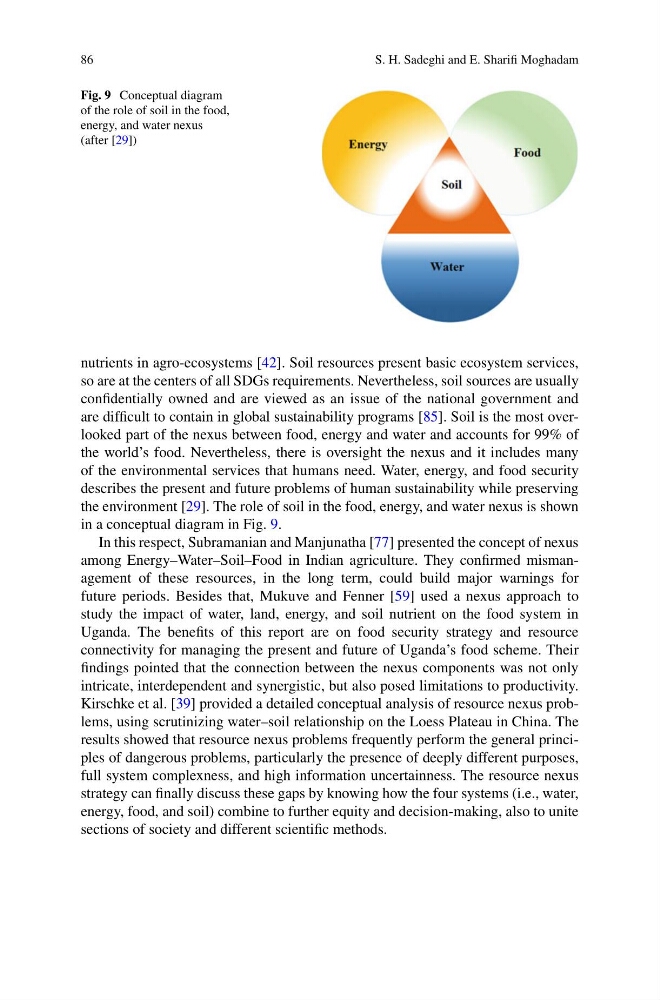
Fig. 9 Conceptual diagram
of the role of soil in the food,
energy, and water nexus
(after [29])
nutrients in agro-ecosystems [42]. Soil resources present basic ecosystem services,
so are at the centers of all SDGs requirements. Nevertheless, soil sources are usually
confidentially owned and are viewed as an issue of the national government and
are difficult to contain in global sustainability programs [85]. Soil is the most overlooked part of the nexus between food, energy and water and accounts for 99% of
the world’s food. Nevertheless, there is oversight the nexus and it includes many
of the environmental services that humans need. Water, energy, and food security
describes the present and future problems of human sustainability while preserving
the environment [29]. The role of soil in the food, energy, and water nexus is shown
in a conceptual diagram in Fig. 9.
In this respect, Subramanian and Manjunatha [77] presented the concept of nexus
among Energy–Water–Soil–Food in Indian agriculture. They confirmed mismanagement of these resources, in the long term, could build major warnings for
future periods. Besides that, Mukuve and Fenner [59] used a nexus approach to
study the impact of water, land, energy, and soil nutrient on the food system in
Uganda. The benefits of this report are on food security strategy and resource
connectivity for managing the present and future of Uganda’s food scheme. Their
findings pointed that the connection between the nexus components was not only
intricate, interdependent and synergistic, but also posed limitations to productivity.
Kirschke et al. [39] provided a detailed conceptual analysis of resource nexus problems, using scrutinizing water–soil relationship on the Loess Plateau in China. The
results showed that resource nexus problems frequently perform the general principles of dangerous problems, particularly the presence of deeply different purposes,
full system complexness, and high information uncertainness. The resource nexus
strategy can finally discuss these gaps by knowing how the four systems (i.e., water,
energy, food, and soil) combine to further equity and decision-making, also to unite
sections of society and different scientific methods.
S. H. Sadeghi and E. Sharifi Moghadam
Fig. 9 Conceptual diagram
of the role of soil in the food,
energy, and water nexus
(after [29])
nutrients in agro-ecosystems [42]. Soil resources present basic ecosystem services,
so are at the centers of all SDGs requirements. Nevertheless, soil sources are usually
confidentially owned and are viewed as an issue of the national government and
are difficult to contain in global sustainability programs [85]. Soil is the most overlooked part of the nexus between food, energy and water and accounts for 99% of
the world’s food. Nevertheless, there is oversight the nexus and it includes many
of the environmental services that humans need. Water, energy, and food security
describes the present and future problems of human sustainability while preserving
the environment [29]. The role of soil in the food, energy, and water nexus is shown
in a conceptual diagram in Fig. 9.
In this respect, Subramanian and Manjunatha [77] presented the concept of nexus
among Energy–Water–Soil–Food in Indian agriculture. They confirmed mismanagement of these resources, in the long term, could build major warnings for
future periods. Besides that, Mukuve and Fenner [59] used a nexus approach to
study the impact of water, land, energy, and soil nutrient on the food system in
Uganda. The benefits of this report are on food security strategy and resource
connectivity for managing the present and future of Uganda’s food scheme. Their
findings pointed that the connection between the nexus components was not only
intricate, interdependent and synergistic, but also posed limitations to productivity.
Kirschke et al. [39] provided a detailed conceptual analysis of resource nexus problems, using scrutinizing water–soil relationship on the Loess Plateau in China. The
results showed that resource nexus problems frequently perform the general principles of dangerous problems, particularly the presence of deeply different purposes,
full system complexness, and high information uncertainness. The resource nexus
strategy can finally discuss these gaps by knowing how the four systems (i.e., water,
energy, food, and soil) combine to further equity and decision-making, also to unite
sections of society and different scientific methods.