

Integrated Watershed Management Vis-a-Vis Water–Energy–Food Nexus
85
Functions such as soil fertility and primary production are highly dependent on the
amount of nutrients in the soil/water, meaning they are closely connected to biogeochemical cycles [80]. In addition, reduction of land degradation can play a critical
role in saving water and energy for human use through increasing soil water storage
and groundwater recharge, and also decreasing the utilization of energy-intensive
fertilizer [70]. The foundation of any food–water–energy nexus system is formed by
the unique natural organization of soil. It also moderates the soil–water–plant–energy
nexus with the replenishment of green-water supply (from precipitation) for plants
and soil biota, which in turn enables the production of biomass as a resource of food,
feed, fiber, and biofuel feedstock. Indeed, the soil is a very large reservoir for water
and carbon with strong influences on local, regional, and global climate [43]. As
Rasul [66] mentioned, the soil formation needs synergy among water, air, the parent
materials of soil, and plants, whereas net ecosystem productivity needs soil, water,
energy inputs, and living organisms. Besides, a strong nexus exists among population, food, climate, soil, water, and waste. The reduction in availability of natural
resources (e.g., soil, water, and energy) and climate change lead to increase of the
importance of such a nexus. With understanding this matter that larger challenges lie
ahead, the crucial role of the nexus cannot be overemphasized [42]. The importance
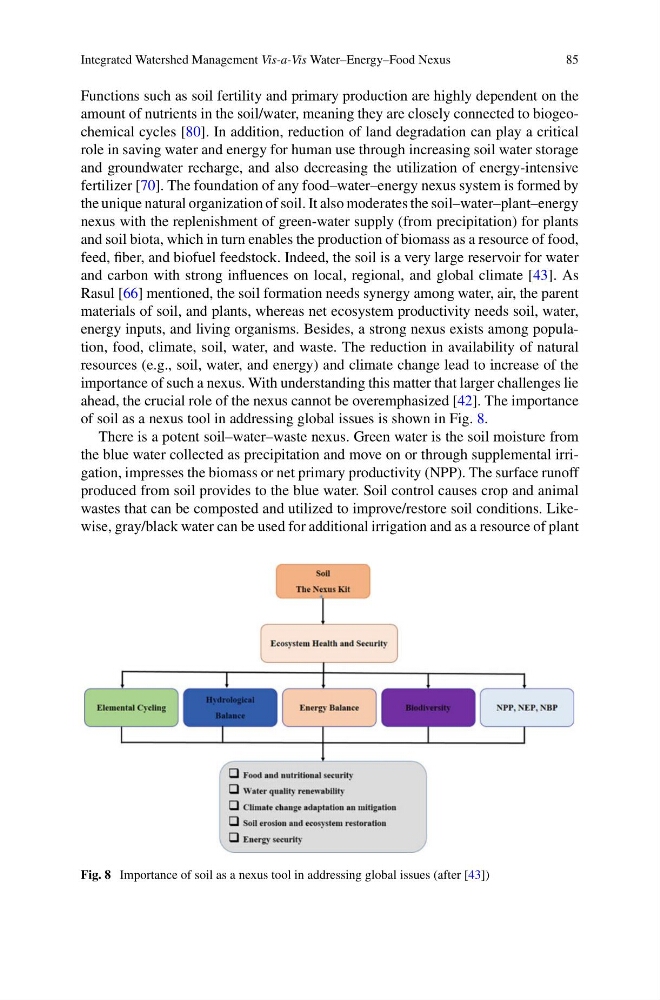
of soil as a nexus tool in addressing global issues is shown in Fig. 8.
There is a potent soil–water–waste nexus. Green water is the soil moisture from
the blue water collected as precipitation and move on or through supplemental irrigation, impresses the biomass or net primary productivity (NPP). The surface runoff
produced from soil provides to the blue water. Soil control causes crop and animal
wastes that can be composted and utilized to improve/restore soil conditions. Likewise, gray/black water can be used for additional irrigation and as a resource of plant
Fig. 8 Importance of soil as a nexus tool in addressing global issues (after [43])
85
Functions such as soil fertility and primary production are highly dependent on the
amount of nutrients in the soil/water, meaning they are closely connected to biogeochemical cycles [80]. In addition, reduction of land degradation can play a critical
role in saving water and energy for human use through increasing soil water storage
and groundwater recharge, and also decreasing the utilization of energy-intensive
fertilizer [70]. The foundation of any food–water–energy nexus system is formed by
the unique natural organization of soil. It also moderates the soil–water–plant–energy
nexus with the replenishment of green-water supply (from precipitation) for plants
and soil biota, which in turn enables the production of biomass as a resource of food,
feed, fiber, and biofuel feedstock. Indeed, the soil is a very large reservoir for water
and carbon with strong influences on local, regional, and global climate [43]. As
Rasul [66] mentioned, the soil formation needs synergy among water, air, the parent
materials of soil, and plants, whereas net ecosystem productivity needs soil, water,
energy inputs, and living organisms. Besides, a strong nexus exists among population, food, climate, soil, water, and waste. The reduction in availability of natural
resources (e.g., soil, water, and energy) and climate change lead to increase of the
importance of such a nexus. With understanding this matter that larger challenges lie
ahead, the crucial role of the nexus cannot be overemphasized [42]. The importance
of soil as a nexus tool in addressing global issues is shown in Fig. 8.
There is a potent soil–water–waste nexus. Green water is the soil moisture from
the blue water collected as precipitation and move on or through supplemental irrigation, impresses the biomass or net primary productivity (NPP). The surface runoff
produced from soil provides to the blue water. Soil control causes crop and animal
wastes that can be composted and utilized to improve/restore soil conditions. Likewise, gray/black water can be used for additional irrigation and as a resource of plant
Fig. 8 Importance of soil as a nexus tool in addressing global issues (after [43])