

52
S. Liphadzi et al.
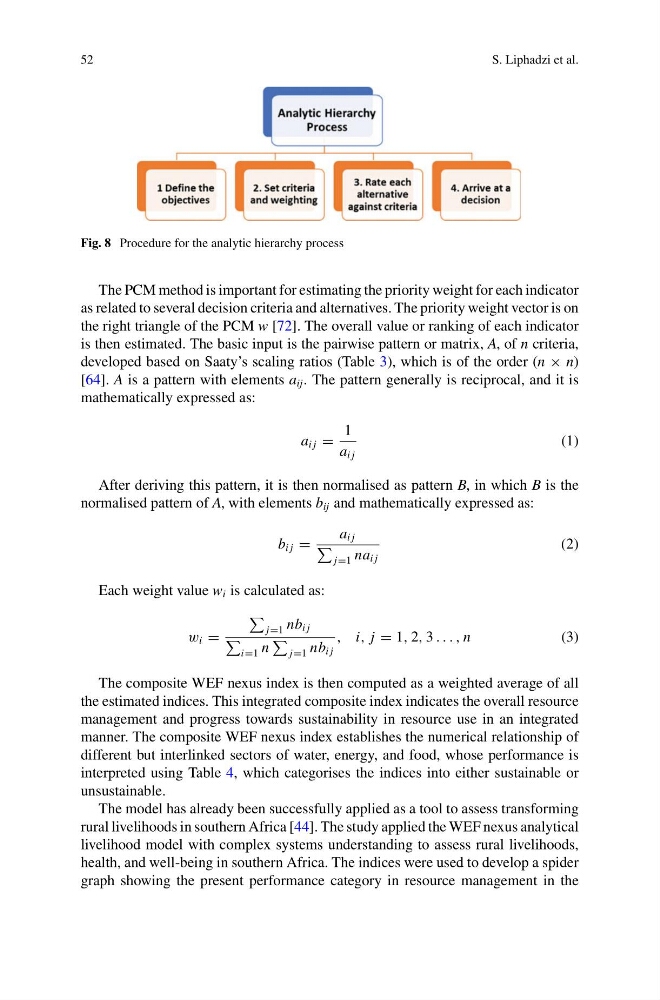
Fig. 8 Procedure for the analytic hierarchy process
The PCM method is important for estimating the priority weight for each indicator
as related to several decision criteria and alternatives. The priority weight vector is on
the right triangle of the PCM w [72]. The overall value or ranking of each indicator
is then estimated. The basic input is the pairwise pattern or matrix, A, of n criteria,
developed based on Saaty’s scaling ratios (Table 3), which is of the order (n × n)
[64]. A is a pattern with elements a ij . The pattern generally is reciprocal, and it is
mathematically expressed as:
a i j =
1
a i j
(1)
After deriving this pattern, it is then normalised as pattern B, in which B is the
normalised pattern of A, with elements b ij and mathematically expressed as:
b i j =
a i j
j=1 na i j
(2)
Each weight value w i is calculated as:
w i =
j=1 nb i j
i=1 n
j=1 nb i j
, i, j = 1, 2, 3 . . . , n
(3)
The composite WEF nexus index is then computed as a weighted average of all
the estimated indices. This integrated composite index indicates the overall resource
management and progress towards sustainability in resource use in an integrated
manner. The composite WEF nexus index establishes the numerical relationship of
different but interlinked sectors of water, energy, and food, whose performance is
interpreted using Table 4, which categorises the indices into either sustainable or
unsustainable.
The model has already been successfully applied as a tool to assess transforming
rural livelihoods in southern Africa [44]. The study applied the WEF nexus analytical
livelihood model with complex systems understanding to assess rural livelihoods,
health, and well-being in southern Africa. The indices were used to develop a spider
graph showing the present performance category in resource management in the
S. Liphadzi et al.
Fig. 8 Procedure for the analytic hierarchy process
The PCM method is important for estimating the priority weight for each indicator
as related to several decision criteria and alternatives. The priority weight vector is on
the right triangle of the PCM w [72]. The overall value or ranking of each indicator
is then estimated. The basic input is the pairwise pattern or matrix, A, of n criteria,
developed based on Saaty’s scaling ratios (Table 3), which is of the order (n × n)
[64]. A is a pattern with elements a ij . The pattern generally is reciprocal, and it is
mathematically expressed as:
a i j =
1
a i j
(1)
After deriving this pattern, it is then normalised as pattern B, in which B is the
normalised pattern of A, with elements b ij and mathematically expressed as:
b i j =
a i j
j=1 na i j
(2)
Each weight value w i is calculated as:
w i =
j=1 nb i j
i=1 n
j=1 nb i j
, i, j = 1, 2, 3 . . . , n
(3)
The composite WEF nexus index is then computed as a weighted average of all
the estimated indices. This integrated composite index indicates the overall resource
management and progress towards sustainability in resource use in an integrated
manner. The composite WEF nexus index establishes the numerical relationship of
different but interlinked sectors of water, energy, and food, whose performance is
interpreted using Table 4, which categorises the indices into either sustainable or
unsustainable.
The model has already been successfully applied as a tool to assess transforming
rural livelihoods in southern Africa [44]. The study applied the WEF nexus analytical
livelihood model with complex systems understanding to assess rural livelihoods,
health, and well-being in southern Africa. The indices were used to develop a spider
graph showing the present performance category in resource management in the