

The Evolution of the Water–Energy–Food Nexus …
41
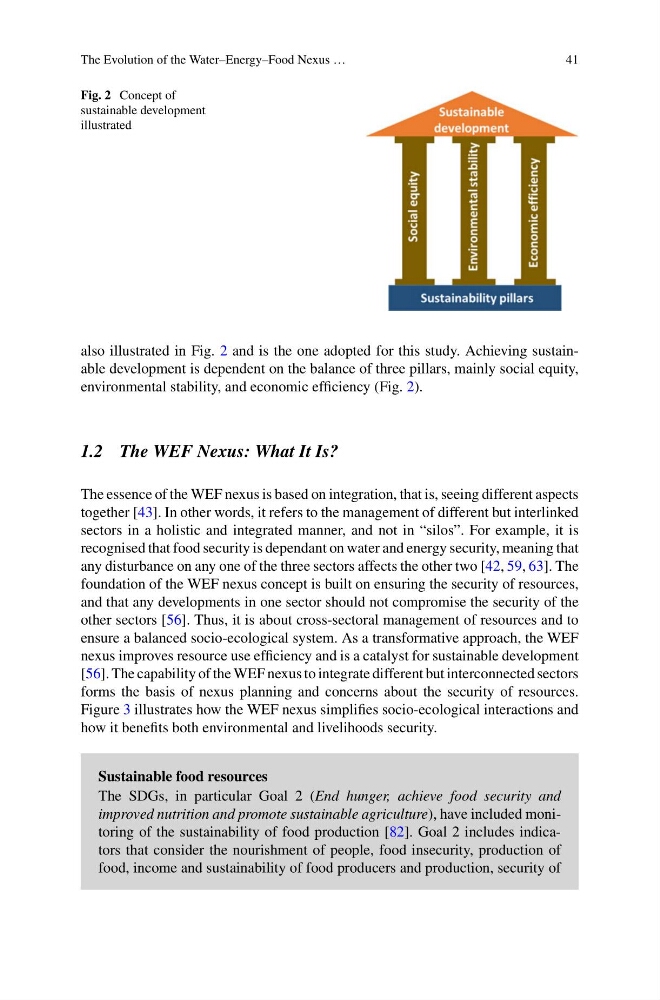
Fig. 2 Concept of
sustainable development
illustrated
also illustrated in Fig. 2 and is the one adopted for this study. Achieving sustainable development is dependent on the balance of three pillars, mainly social equity,
environmental stability, and economic efficiency (Fig. 2).
1.2 The WEF Nexus: What It Is?
The essence of the WEF nexus is based on integration, that is, seeing different aspects
together [43]. In other words, it refers to the management of different but interlinked
sectors in a holistic and integrated manner, and not in “silos”. For example, it is
recognised that food security is dependant on water and energy security, meaning that
any disturbance on any one of the three sectors affects the other two [42, 59, 63]. The
foundation of the WEF nexus concept is built on ensuring the security of resources,
and that any developments in one sector should not compromise the security of the
other sectors [56]. Thus, it is about cross-sectoral management of resources and to
ensure a balanced socio-ecological system. As a transformative approach, the WEF
nexus improves resource use efficiency and is a catalyst for sustainable development
[56]. The capability of the WEF nexus to integrate different but interconnected sectors
forms the basis of nexus planning and concerns about the security of resources.
Figure 3 illustrates how the WEF nexus simplifies socio-ecological interactions and
how it benefits both environmental and livelihoods security.
Sustainable food resources
The SDGs, in particular Goal 2 (End hunger, achieve food security and
improved nutrition and promote sustainable agriculture), have included monitoring of the sustainability of food production [82]. Goal 2 includes indicators that consider the nourishment of people, food insecurity, production of
food, income and sustainability of food producers and production, security of
41
Fig. 2 Concept of
sustainable development
illustrated
also illustrated in Fig. 2 and is the one adopted for this study. Achieving sustainable development is dependent on the balance of three pillars, mainly social equity,
environmental stability, and economic efficiency (Fig. 2).
1.2 The WEF Nexus: What It Is?
The essence of the WEF nexus is based on integration, that is, seeing different aspects
together [43]. In other words, it refers to the management of different but interlinked
sectors in a holistic and integrated manner, and not in “silos”. For example, it is
recognised that food security is dependant on water and energy security, meaning that
any disturbance on any one of the three sectors affects the other two [42, 59, 63]. The
foundation of the WEF nexus concept is built on ensuring the security of resources,
and that any developments in one sector should not compromise the security of the
other sectors [56]. Thus, it is about cross-sectoral management of resources and to
ensure a balanced socio-ecological system. As a transformative approach, the WEF
nexus improves resource use efficiency and is a catalyst for sustainable development
[56]. The capability of the WEF nexus to integrate different but interconnected sectors
forms the basis of nexus planning and concerns about the security of resources.
Figure 3 illustrates how the WEF nexus simplifies socio-ecological interactions and
how it benefits both environmental and livelihoods security.
Sustainable food resources
The SDGs, in particular Goal 2 (End hunger, achieve food security and
improved nutrition and promote sustainable agriculture), have included monitoring of the sustainability of food production [82]. Goal 2 includes indicators that consider the nourishment of people, food insecurity, production of
food, income and sustainability of food producers and production, security of