

20
H. Schlör et al.
XD t,i,Co = f t,i
K t,i L t,i
= α K
VKS i,CO
t,i,Co
· L
1−VKS i,CO
t,i,Co
, Co = Countries A, B, C, D
(20)
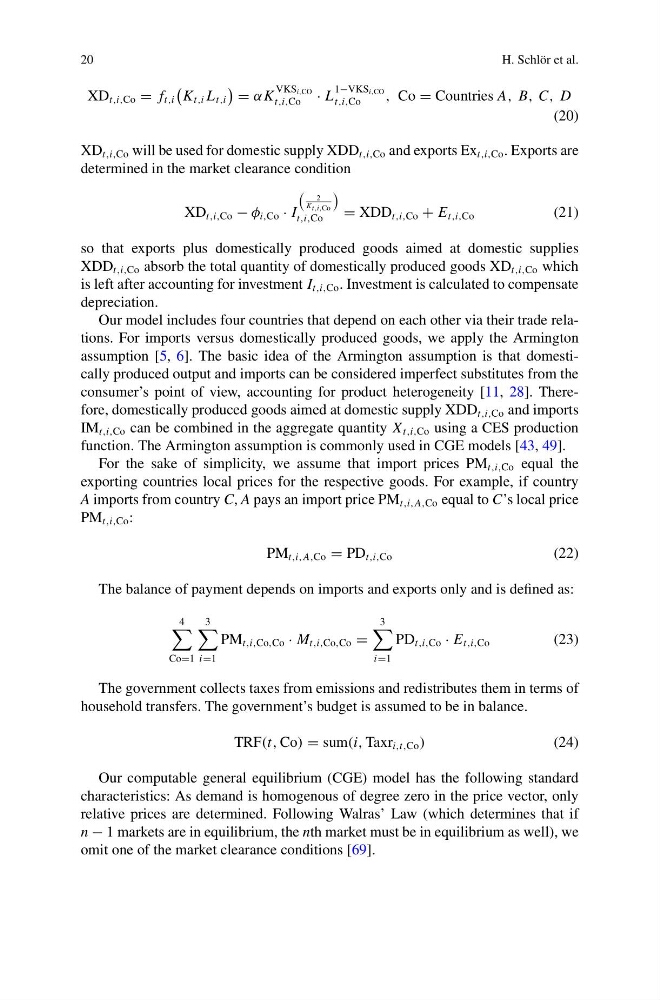
XD t,i,Co will be used for domestic supply XDD t,i,Co and exports Ex t,i,Co . Exports are
determined in the market clearance condition
XD t,i,Co − φ i,Co · I
2
K t,i,Co
t,i,Co
= XDD t,i,Co + E t,i,Co
(21)
so that exports plus domestically produced goods aimed at domestic supplies
XDD t,i,Co absorb the total quantity of domestically produced goods XD t,i,Co which
is left after accounting for investment I t,i,Co . Investment is calculated to compensate
depreciation.
Our model includes four countries that depend on each other via their trade relations. For imports versus domestically produced goods, we apply the Armington
assumption [5, 6]. The basic idea of the Armington assumption is that domestically produced output and imports can be considered imperfect substitutes from the
consumer’s point of view, accounting for product heterogeneity [11, 28]. Therefore, domestically produced goods aimed at domestic supply XDD t,i,Co and imports
IM t,i,Co can be combined in the aggregate quantity X t,i,Co using a CES production
function. The Armington assumption is commonly used in CGE models [43, 49].
For the sake of simplicity, we assume that import prices PM t,i,Co equal the
exporting countries local prices for the respective goods. For example, if country
A imports from country C, A pays an import price PM t,i,A,Co equal to C’s local price
PM t,i,Co :
PM t,i,A,Co = PD t,i,Co
(22)
The balance of payment depends on imports and exports only and is defined as:
4
Co=1
3
i=1
PM t,i,Co,Co · M t,i,Co,Co =
3
i=1
PD t,i,Co · E t,i,Co
(23)
The government collects taxes from emissions and redistributes them in terms of
household transfers. The government’s budget is assumed to be in balance.
TRF(t, Co) = sum(i, Taxr i,t,Co )
(24)
Our computable general equilibrium (CGE) model has the following standard
characteristics: As demand is homogenous of degree zero in the price vector, only
relative prices are determined. Following Walras’ Law (which determines that if
n − 1 markets are in equilibrium, the nth market must be in equilibrium as well), we
omit one of the market clearance conditions [69].
H. Schlör et al.
XD t,i,Co = f t,i
K t,i L t,i
= α K
VKS i,CO
t,i,Co
· L
1−VKS i,CO
t,i,Co
, Co = Countries A, B, C, D
(20)
XD t,i,Co will be used for domestic supply XDD t,i,Co and exports Ex t,i,Co . Exports are
determined in the market clearance condition
XD t,i,Co − φ i,Co · I
2
K t,i,Co
t,i,Co
= XDD t,i,Co + E t,i,Co
(21)
so that exports plus domestically produced goods aimed at domestic supplies
XDD t,i,Co absorb the total quantity of domestically produced goods XD t,i,Co which
is left after accounting for investment I t,i,Co . Investment is calculated to compensate
depreciation.
Our model includes four countries that depend on each other via their trade relations. For imports versus domestically produced goods, we apply the Armington
assumption [5, 6]. The basic idea of the Armington assumption is that domestically produced output and imports can be considered imperfect substitutes from the
consumer’s point of view, accounting for product heterogeneity [11, 28]. Therefore, domestically produced goods aimed at domestic supply XDD t,i,Co and imports
IM t,i,Co can be combined in the aggregate quantity X t,i,Co using a CES production
function. The Armington assumption is commonly used in CGE models [43, 49].
For the sake of simplicity, we assume that import prices PM t,i,Co equal the
exporting countries local prices for the respective goods. For example, if country
A imports from country C, A pays an import price PM t,i,A,Co equal to C’s local price
PM t,i,Co :
PM t,i,A,Co = PD t,i,Co
(22)
The balance of payment depends on imports and exports only and is defined as:
4
Co=1
3
i=1
PM t,i,Co,Co · M t,i,Co,Co =
3
i=1
PD t,i,Co · E t,i,Co
(23)
The government collects taxes from emissions and redistributes them in terms of
household transfers. The government’s budget is assumed to be in balance.
TRF(t, Co) = sum(i, Taxr i,t,Co )
(24)
Our computable general equilibrium (CGE) model has the following standard
characteristics: As demand is homogenous of degree zero in the price vector, only
relative prices are determined. Following Walras’ Law (which determines that if
n − 1 markets are in equilibrium, the nth market must be in equilibrium as well), we
omit one of the market clearance conditions [69].