

Reflections About the Food–Energy–Water Nexus in a World …
15
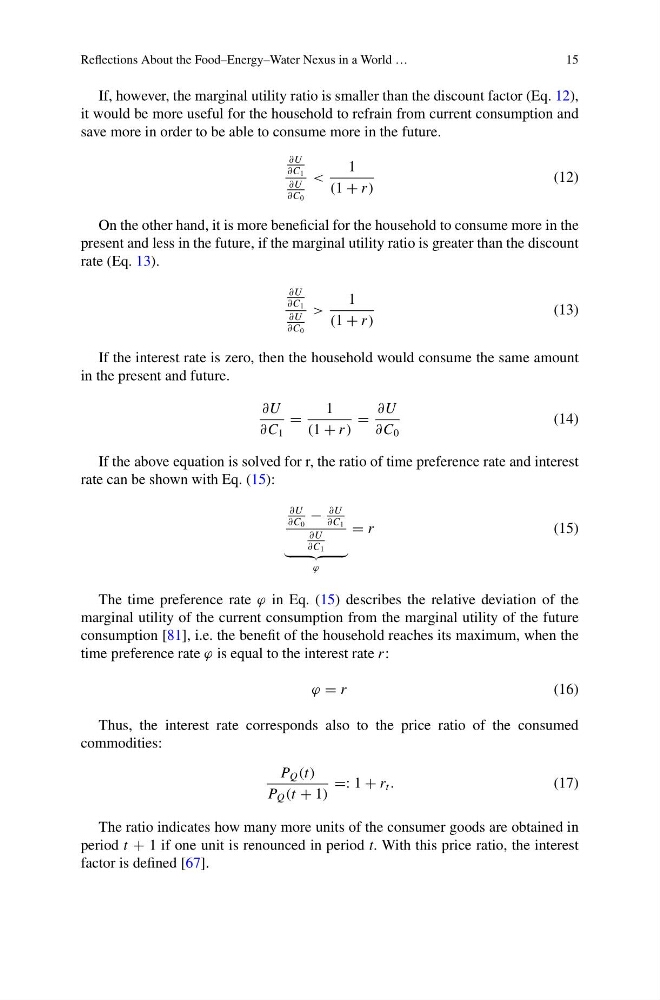
If, however, the marginal utility ratio is smaller than the discount factor (Eq. 12),
it would be more useful for the household to refrain from current consumption and
save more in order to be able to consume more in the future.
∂U
∂C 1
∂U
∂C 0
<
1
(1 + r )
(12)
On the other hand, it is more beneficial for the household to consume more in the
present and less in the future, if the marginal utility ratio is greater than the discount
rate (Eq. 13).
∂U
∂C 1
∂U
∂C 0
>
1
(1 + r )
(13)
If the interest rate is zero, then the household would consume the same amount
in the present and future.
∂U
∂C 1
=
1
(1 + r )
=
∂U
∂C 0
(14)
If the above equation is solved for r, the ratio of time preference rate and interest
rate can be shown with Eq. (15):
∂U
∂C 0
−
∂U
∂C 1
∂U
∂C 1
ϕ
= r
(15)
The time preference rate ϕ in Eq. (15) describes the relative deviation of the
marginal utility of the current consumption from the marginal utility of the future
consumption [81], i.e. the benefit of the household reaches its maximum, when the
time preference rate ϕ is equal to the interest rate r :
ϕ = r
(16)
Thus, the interest rate corresponds also to the price ratio of the consumed
commodities:
P Q (t)
P Q (t + 1)
=: 1 + r t .
(17)
The ratio indicates how many more units of the consumer goods are obtained in
period t + 1 if one unit is renounced in period t. With this price ratio, the interest
factor is defined [67].
15
If, however, the marginal utility ratio is smaller than the discount factor (Eq. 12),
it would be more useful for the household to refrain from current consumption and
save more in order to be able to consume more in the future.
∂U
∂C 1
∂U
∂C 0
<
1
(1 + r )
(12)
On the other hand, it is more beneficial for the household to consume more in the
present and less in the future, if the marginal utility ratio is greater than the discount
rate (Eq. 13).
∂U
∂C 1
∂U
∂C 0
>
1
(1 + r )
(13)
If the interest rate is zero, then the household would consume the same amount
in the present and future.
∂U
∂C 1
=
1
(1 + r )
=
∂U
∂C 0
(14)
If the above equation is solved for r, the ratio of time preference rate and interest
rate can be shown with Eq. (15):
∂U
∂C 0
−
∂U
∂C 1
∂U
∂C 1
ϕ
= r
(15)
The time preference rate ϕ in Eq. (15) describes the relative deviation of the
marginal utility of the current consumption from the marginal utility of the future
consumption [81], i.e. the benefit of the household reaches its maximum, when the
time preference rate ϕ is equal to the interest rate r :
ϕ = r
(16)
Thus, the interest rate corresponds also to the price ratio of the consumed
commodities:
P Q (t)
P Q (t + 1)
=: 1 + r t .
(17)
The ratio indicates how many more units of the consumer goods are obtained in
period t + 1 if one unit is renounced in period t. With this price ratio, the interest
factor is defined [67].