

202
S. Namany and T. Al-Ansari
and gains amongst sectors, the minimisation of uncooperative competitions, which
usually lead to collective losses and inefficiencies, in addition to the mitigation of the
internal factors that threaten interactions between sectors and the overall performance
of the nexus [61]. The improvement that modelling and analytical tools bring to the
EWF nexus and food systems has proven its effectiveness across the major pillars
of food security. For instance, enhancing the crop production [62] and storage of
agricultural products [63], in addition to reducing food waste in the food system
supply chain [64], have contributed to the enhancement of the food availability
pillar. This was achieved by means of optimisation models and analytical tools that
ensure the communication between the three resources systems. Similarly, models
targeting the adjustment of the dietary needs while considering the water and energy
consumption considering economic and environmental concerns have contributed to
the food utilisation component of the food security [65, 66]. As for food accessibility,
which accounts for household income and food prices; a holistic EWF nexus system
approach might support enhanced food affordability and grant a wider access to food
products at more affordable costs [67, 68].
In order to ensure the stability of the three pillars of food security, internal and
external risks and uncertainties must be factored into EWF nexus modelling and mitigated accordingly. In fact, internal risks associated with each sector’s operations,
and external risks inflicted by the surrounding environment should be considered
while making decisions and planning for sustainable, resilient, and long-lasting food
security. As such, the following section will highlight the tools and models, which
can be applied to understand risks and uncertainties in volatile environments, and
that can form the basis of control and mitigation to sustain the performance of the
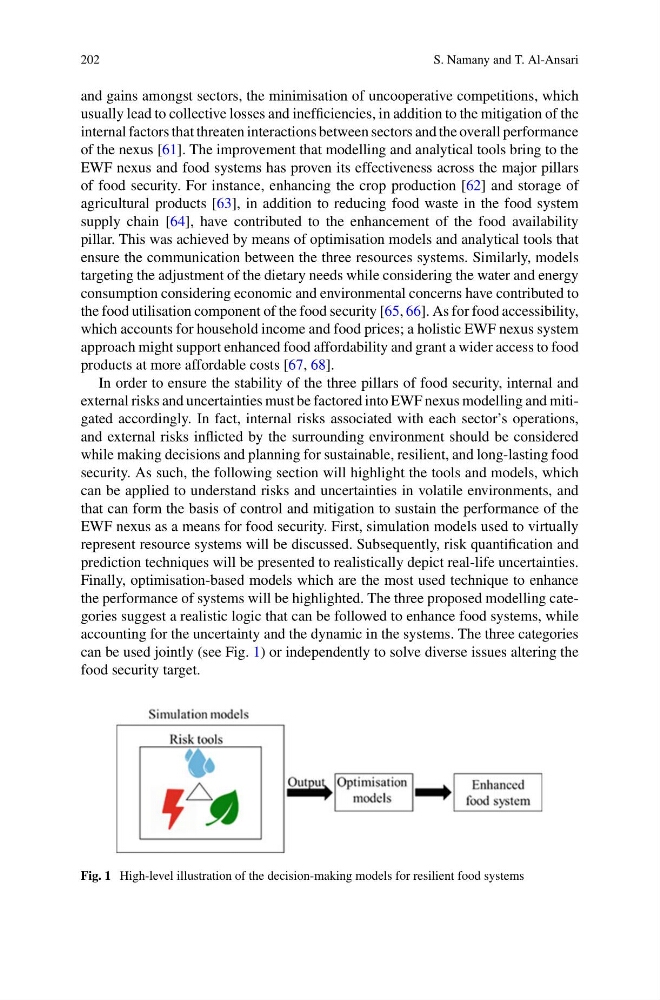
EWF nexus as a means for food security. First, simulation models used to virtually
represent resource systems will be discussed. Subsequently, risk quantification and
prediction techniques will be presented to realistically depict real-life uncertainties.
Finally, optimisation-based models which are the most used technique to enhance
the performance of systems will be highlighted. The three proposed modelling categories suggest a realistic logic that can be followed to enhance food systems, while
accounting for the uncertainty and the dynamic in the systems. The three categories
can be used jointly (see Fig. 1) or independently to solve diverse issues altering the
food security target.
Fig. 1 High-level illustration of the decision-making models for resilient food systems
S. Namany and T. Al-Ansari
and gains amongst sectors, the minimisation of uncooperative competitions, which
usually lead to collective losses and inefficiencies, in addition to the mitigation of the
internal factors that threaten interactions between sectors and the overall performance
of the nexus [61]. The improvement that modelling and analytical tools bring to the
EWF nexus and food systems has proven its effectiveness across the major pillars
of food security. For instance, enhancing the crop production [62] and storage of
agricultural products [63], in addition to reducing food waste in the food system
supply chain [64], have contributed to the enhancement of the food availability
pillar. This was achieved by means of optimisation models and analytical tools that
ensure the communication between the three resources systems. Similarly, models
targeting the adjustment of the dietary needs while considering the water and energy
consumption considering economic and environmental concerns have contributed to
the food utilisation component of the food security [65, 66]. As for food accessibility,
which accounts for household income and food prices; a holistic EWF nexus system
approach might support enhanced food affordability and grant a wider access to food
products at more affordable costs [67, 68].
In order to ensure the stability of the three pillars of food security, internal and
external risks and uncertainties must be factored into EWF nexus modelling and mitigated accordingly. In fact, internal risks associated with each sector’s operations,
and external risks inflicted by the surrounding environment should be considered
while making decisions and planning for sustainable, resilient, and long-lasting food
security. As such, the following section will highlight the tools and models, which
can be applied to understand risks and uncertainties in volatile environments, and
that can form the basis of control and mitigation to sustain the performance of the
EWF nexus as a means for food security. First, simulation models used to virtually
represent resource systems will be discussed. Subsequently, risk quantification and
prediction techniques will be presented to realistically depict real-life uncertainties.
Finally, optimisation-based models which are the most used technique to enhance
the performance of systems will be highlighted. The three proposed modelling categories suggest a realistic logic that can be followed to enhance food systems, while
accounting for the uncertainty and the dynamic in the systems. The three categories
can be used jointly (see Fig. 1) or independently to solve diverse issues altering the
food security target.
Fig. 1 High-level illustration of the decision-making models for resilient food systems