

36
properties, houses and built assets, as well as 700 hectares of native vegetation, wetlands, and heritage
and cultural assets are at risk to inundation and coastal recession (Roös & Jones, 2013; GORCC, 2012).
Continued development and population growth in Australia’s coastal areas will exacerbate risks
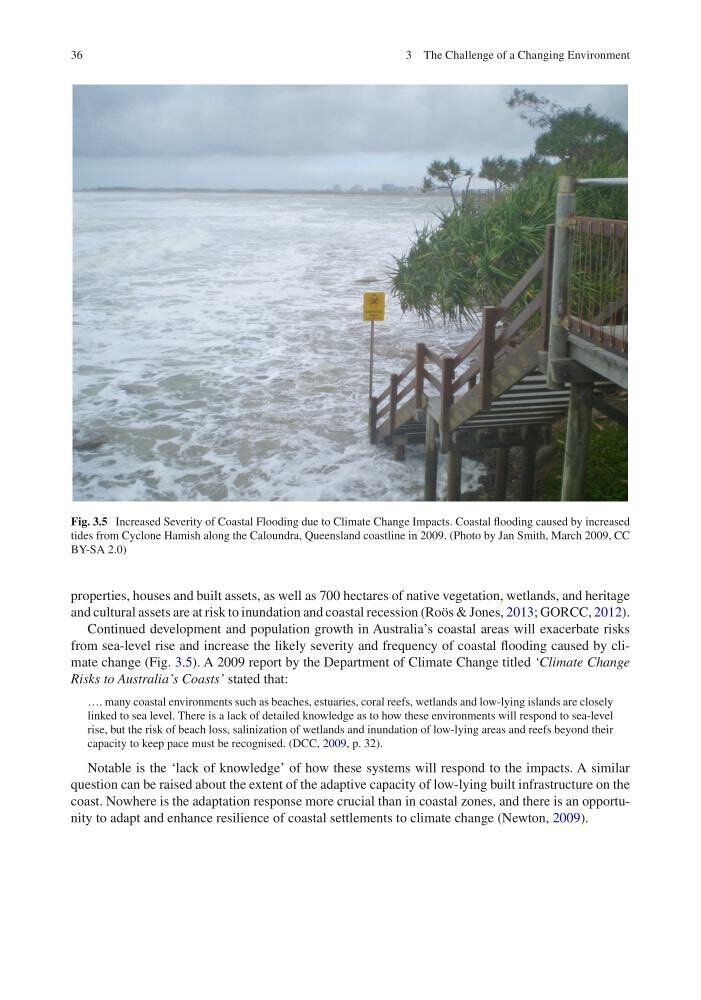
from sea-level rise and increase the likely severity and frequency of coastal flooding caused by climate change (Fig. 3.5). A 2009 report by the Department of Climate Change titled ‘Climate Change
Risks to Australia’s Coasts’ stated that:
…. many coastal environments such as beaches, estuaries, coral reefs, wetlands and low-lying islands are closely
linked to sea level. There is a lack of detailed knowledge as to how these environments will respond to sea-level
rise, but the risk of beach loss, salinization of wetlands and inundation of low-lying areas and reefs beyond their
capacity to keep pace must be recognised. (DCC, 2009, p. 32).
Notable is the ‘lack of knowledge’ of how these systems will respond to the impacts. A similar
question can be raised about the extent of the adaptive capacity of low-lying built infrastructure on the
coast. Nowhere is the adaptation response more crucial than in coastal zones, and there is an opportunity to adapt and enhance resilience of coastal settlements to climate change (Newton, 2009).
Fig. 3.5 Increased Severity of Coastal Flooding due to Climate Change Impacts. Coastal flooding caused by increased
tides from Cyclone Hamish along the Caloundra, Queensland coastline in 2009. (Photo by Jan Smith, March 2009, CC
BY-SA 2.0)
3 The Challenge of a Changing Environment
properties, houses and built assets, as well as 700 hectares of native vegetation, wetlands, and heritage
and cultural assets are at risk to inundation and coastal recession (Roös & Jones, 2013; GORCC, 2012).
Continued development and population growth in Australia’s coastal areas will exacerbate risks
from sea-level rise and increase the likely severity and frequency of coastal flooding caused by climate change (Fig. 3.5). A 2009 report by the Department of Climate Change titled ‘Climate Change
Risks to Australia’s Coasts’ stated that:
…. many coastal environments such as beaches, estuaries, coral reefs, wetlands and low-lying islands are closely
linked to sea level. There is a lack of detailed knowledge as to how these environments will respond to sea-level
rise, but the risk of beach loss, salinization of wetlands and inundation of low-lying areas and reefs beyond their
capacity to keep pace must be recognised. (DCC, 2009, p. 32).
Notable is the ‘lack of knowledge’ of how these systems will respond to the impacts. A similar
question can be raised about the extent of the adaptive capacity of low-lying built infrastructure on the
coast. Nowhere is the adaptation response more crucial than in coastal zones, and there is an opportunity to adapt and enhance resilience of coastal settlements to climate change (Newton, 2009).
Fig. 3.5 Increased Severity of Coastal Flooding due to Climate Change Impacts. Coastal flooding caused by increased
tides from Cyclone Hamish along the Caloundra, Queensland coastline in 2009. (Photo by Jan Smith, March 2009, CC
BY-SA 2.0)
3 The Challenge of a Changing Environment