

19
2.2 A Rapid Urbanised World
It is evident that the future environment of human habitation is urban. The trend is that human settlements of villages become towns, towns turn into cities, and cities become megacities. Further, compact towns along coastlines (and inland) built of brick and stone sprawl into large megacities made of
tarmac, concrete, steel and glass (Girardet, 2015, p. 3). Across many parts of the world large cities
have sprung up on locations that were previously small villages and towns, and these cities spread like
an invasive parasite along coastline and waterways. On the one hand these cities are an astonishing
human achievement, where millions of people live in compact environments with rich cultures and
advanced transport systems are built to move people around; moreover, the cities act as incubators for
many new innovative technologies. On the other hand, the aggregated environmental impacts from
these cities are a major concern, and the resources of Earth are depleted at a rapid rate to feed them.
In 2012 our global civilisation used more natural resources in 8 months than what the Earth can produce, and under current trends we will need more than two Earths to supply the needy human society
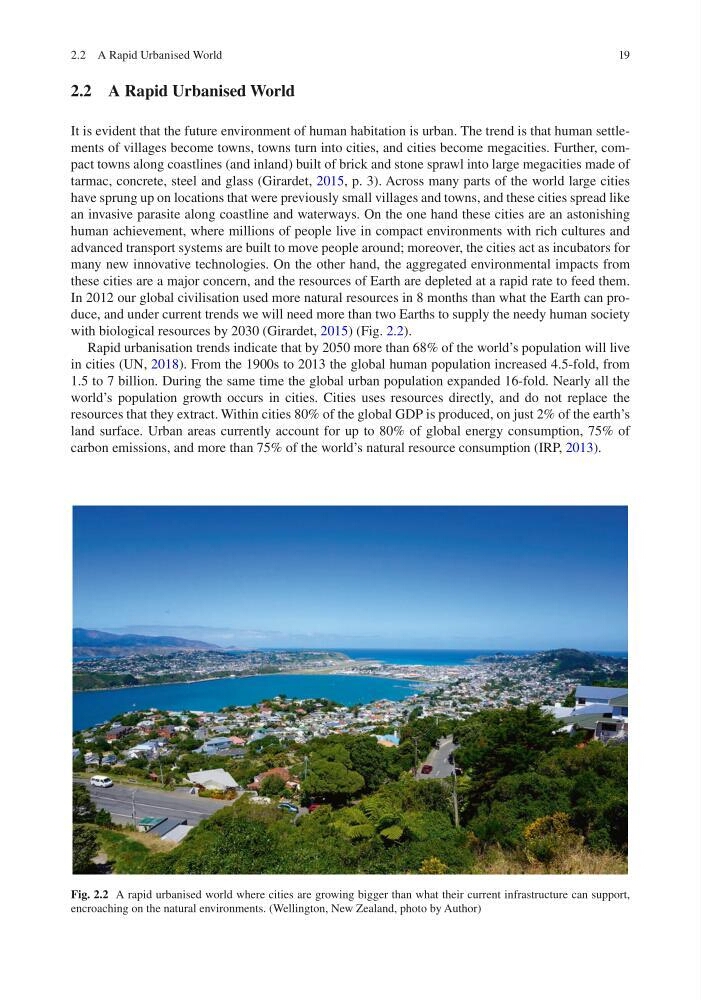
with biological resources by 2030 (Girardet, 2015) (Fig. 2.2).
Rapid urbanisation trends indicate that by 2050 more than 68% of the world’s population will live
in cities (UN, 2018). From the 1900s to 2013 the global human population increased 4.5- fold, from
1.5 to 7 billion. During the same time the global urban population expanded 16-fold. Nearly all the
world’s population growth occurs in cities. Cities uses resources directly, and do not replace the
resources that they extract. Within cities 80% of the global GDP is produced, on just 2% of the earth’s
land surface. Urban areas currently account for up to 80% of global energy consumption, 75% of
carbon emissions, and more than 75% of the world’s natural resource consumption (IRP, 2013).
Fig. 2.2 A rapid urbanised world where cities are growing bigger than what their current infrastructure can support,
encroaching on the natural environments. (Wellington, New Zealand, photo by Author)
2.2 A Rapid Urbanised World
2.2 A Rapid Urbanised World
It is evident that the future environment of human habitation is urban. The trend is that human settlements of villages become towns, towns turn into cities, and cities become megacities. Further, compact towns along coastlines (and inland) built of brick and stone sprawl into large megacities made of
tarmac, concrete, steel and glass (Girardet, 2015, p. 3). Across many parts of the world large cities
have sprung up on locations that were previously small villages and towns, and these cities spread like
an invasive parasite along coastline and waterways. On the one hand these cities are an astonishing
human achievement, where millions of people live in compact environments with rich cultures and
advanced transport systems are built to move people around; moreover, the cities act as incubators for
many new innovative technologies. On the other hand, the aggregated environmental impacts from
these cities are a major concern, and the resources of Earth are depleted at a rapid rate to feed them.
In 2012 our global civilisation used more natural resources in 8 months than what the Earth can produce, and under current trends we will need more than two Earths to supply the needy human society
with biological resources by 2030 (Girardet, 2015) (Fig. 2.2).
Rapid urbanisation trends indicate that by 2050 more than 68% of the world’s population will live
in cities (UN, 2018). From the 1900s to 2013 the global human population increased 4.5- fold, from
1.5 to 7 billion. During the same time the global urban population expanded 16-fold. Nearly all the
world’s population growth occurs in cities. Cities uses resources directly, and do not replace the
resources that they extract. Within cities 80% of the global GDP is produced, on just 2% of the earth’s
land surface. Urban areas currently account for up to 80% of global energy consumption, 75% of
carbon emissions, and more than 75% of the world’s natural resource consumption (IRP, 2013).
Fig. 2.2 A rapid urbanised world where cities are growing bigger than what their current infrastructure can support,
encroaching on the natural environments. (Wellington, New Zealand, photo by Author)
2.2 A Rapid Urbanised World