

18
(Sachs, 2015). However, the concept of sustainable development is challenged. Brown (2015) claims
that sustainable development is an oxymoron, stating that the population growth and economic development that continue to this day are a direct force against aspirations to achieve sustainability:
Unfortunately, “sustainable development,” as advocated by most natural, social, and environmental scientists, is
an oxymoron. Continual population growth and economic development on a finite Earth are biophysically
impossible. They violate the laws of physics, especially thermodynamics, and the fundamental principles of biology. Population growth requires the increased consumption of food, water, and other essentials for human life.
Economic development requires the increased use of energy and material resources to provide goods, services,
and information technology… The humans of the Anthropocene are changing the climate, decimating the biodiversity, and reducing the productivity of the biosphere (Brown, 2015, p. 1027).
From the perspective of considering the whole, and how we need to change our worldview that will
consider the human-nature interconnectedness as fundamental to future sustainability, we need to
further investigate the concept of sustainable development and its alignment with a more regenerativeadaptive future. Following from the previous one, this chapter raises the issues of the state of the
planet, investigates the United Nations’ 17 Sustainable Development Goals, and puts forward the
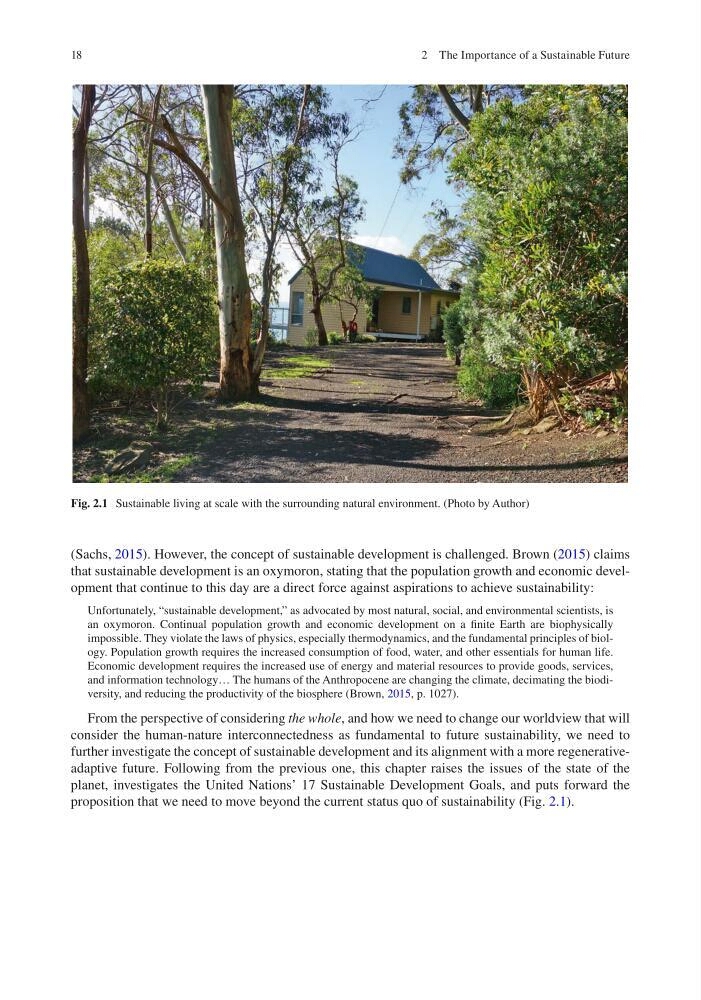
proposition that we need to move beyond the current status quo of sustainability (Fig. 2.1).
Fig. 2.1 Sustainable living at scale with the surrounding natural environment. (Photo by Author)
2 The Importance of a Sustainable Future
(Sachs, 2015). However, the concept of sustainable development is challenged. Brown (2015) claims
that sustainable development is an oxymoron, stating that the population growth and economic development that continue to this day are a direct force against aspirations to achieve sustainability:
Unfortunately, “sustainable development,” as advocated by most natural, social, and environmental scientists, is
an oxymoron. Continual population growth and economic development on a finite Earth are biophysically
impossible. They violate the laws of physics, especially thermodynamics, and the fundamental principles of biology. Population growth requires the increased consumption of food, water, and other essentials for human life.
Economic development requires the increased use of energy and material resources to provide goods, services,
and information technology… The humans of the Anthropocene are changing the climate, decimating the biodiversity, and reducing the productivity of the biosphere (Brown, 2015, p. 1027).
From the perspective of considering the whole, and how we need to change our worldview that will
consider the human-nature interconnectedness as fundamental to future sustainability, we need to
further investigate the concept of sustainable development and its alignment with a more regenerativeadaptive future. Following from the previous one, this chapter raises the issues of the state of the
planet, investigates the United Nations’ 17 Sustainable Development Goals, and puts forward the
proposition that we need to move beyond the current status quo of sustainability (Fig. 2.1).
Fig. 2.1 Sustainable living at scale with the surrounding natural environment. (Photo by Author)
2 The Importance of a Sustainable Future