

188
redevelopment and regeneration of the built and natural environments, in practical terms it remains
difficult to implement such diverse and large-scale solutions. However, I believe that we need to progress forward and test the theory as broadly as possible, as there is an urgent need to change the current
unsuccessful methods of sustainable planning, design and development in the face of a rapid changing
climate.
Recently, a small research team from the Live+Smart Research Laboratory at Deakin University
took on the challenge, investigating how regenerative-adaptive design and integral sustainable design
can collectively be applied to regenerate exhausted quarry and open cast mine sites. Working with
their industry partner Grimshaw Architects, the team investigated the application of the principles of
regenerative- adaptive design to conceptual and hypothetical propositions for the regeneration of the
recently closed down Alcoa open-cast coal mine in Anglesea.
The project – “Heal the Scar” – looked at how we can best regenerate exhausted quarry and mine
sites, and holistically (environmentally, economically, socially and culturally) enrich both the sites
and their surrounding community. The research methodology followed a process of inquiry, critical
literature and case study reviews, theory and model development, and a final pilot study of the open
cast coal mine in Anglesea. The findings informed visionary, hypothetical- scenario propositions for
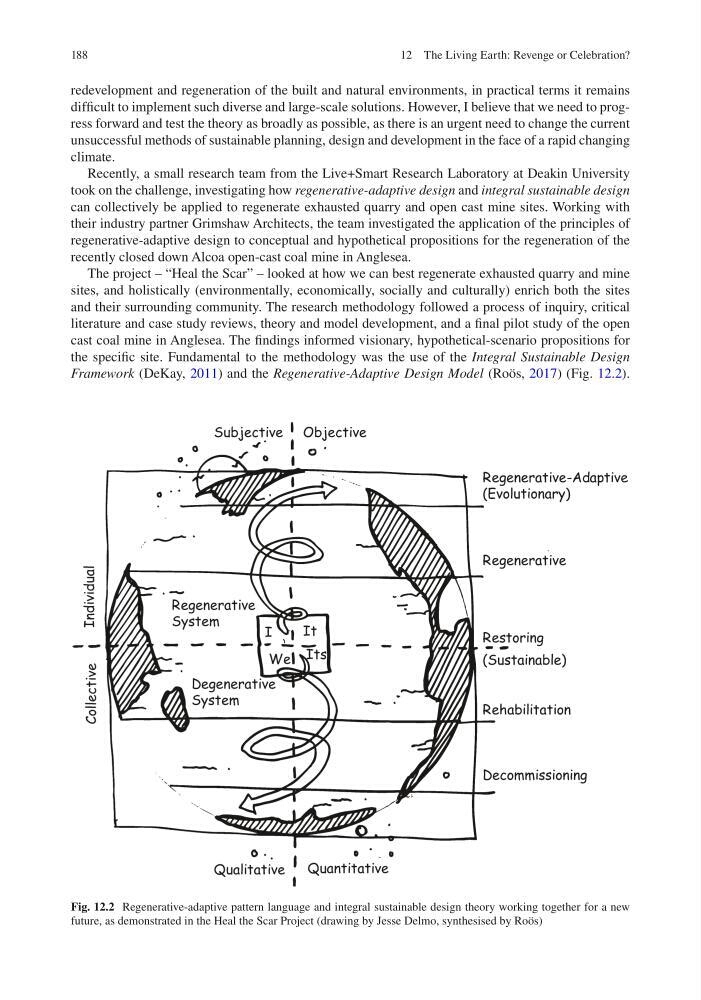
the specific site. Fundamental to the methodology was the use of the Integral Sustainable Design
Framework (DeKay, 2011) and the Regenerative-Adaptive Design Model (Roös, 2017) (Fig. 12.2).
Fig. 12.2 Regenerative-adaptive pattern language and integral sustainable design theory working together for a new
future, as demonstrated in the Heal the Scar Project (drawing by Jesse Delmo, synthesised by Roös)
12 The Living Earth: Revenge or Celebration?
redevelopment and regeneration of the built and natural environments, in practical terms it remains
difficult to implement such diverse and large-scale solutions. However, I believe that we need to progress forward and test the theory as broadly as possible, as there is an urgent need to change the current
unsuccessful methods of sustainable planning, design and development in the face of a rapid changing
climate.
Recently, a small research team from the Live+Smart Research Laboratory at Deakin University
took on the challenge, investigating how regenerative-adaptive design and integral sustainable design
can collectively be applied to regenerate exhausted quarry and open cast mine sites. Working with
their industry partner Grimshaw Architects, the team investigated the application of the principles of
regenerative- adaptive design to conceptual and hypothetical propositions for the regeneration of the
recently closed down Alcoa open-cast coal mine in Anglesea.
The project – “Heal the Scar” – looked at how we can best regenerate exhausted quarry and mine
sites, and holistically (environmentally, economically, socially and culturally) enrich both the sites
and their surrounding community. The research methodology followed a process of inquiry, critical
literature and case study reviews, theory and model development, and a final pilot study of the open
cast coal mine in Anglesea. The findings informed visionary, hypothetical- scenario propositions for
the specific site. Fundamental to the methodology was the use of the Integral Sustainable Design
Framework (DeKay, 2011) and the Regenerative-Adaptive Design Model (Roös, 2017) (Fig. 12.2).
Fig. 12.2 Regenerative-adaptive pattern language and integral sustainable design theory working together for a new
future, as demonstrated in the Heal the Scar Project (drawing by Jesse Delmo, synthesised by Roös)
12 The Living Earth: Revenge or Celebration?