

166
a unified pattern language for this area and its settlements with unique character. Living next to nature
is the attraction for communities along the Great Ocean Road coast, a traveller’s paradise with some of
Australia’s best surf beaches, bustling resort towns, spectacular scenery, and lush rainforests. Beyond
visual attributes, it is the ecological, social and economic values that boost a shift in Australian culture
from the bush and city. In Victoria, the migration to the coastal towns from the city of Melbourne
resulted in the emergence of the third culture in Australia, that of ‘the culture of the beach’ (Salt, 2003).
This is indeed the culture of communities along the Great Ocean Road coast. These communities survive today because of the high visual and natural attributes they have, which underpin their existence
and economic survival. It is these same attributes that make coastal towns attractive places to live,
which is now threatening their current existence (Roös & Jones, 2013). Change these landscape attributes and there is a dramatic effect upon their context, economic, social and environmental sustainability. The values that are important for residents and that make the Great Ocean Road coastal region
an attractive tourism destination are evident in its natural, built and social/recreational attributes.
For the purposes of this investigation, the Great Ocean Road coastal region stretches from Torquay
in the east to Peterborough in the west, just south of the town of Warrnambool. Six towns were
selected for sampling, and included Port Campbell, Apollo Bay, Wye River, Lorne, Anglesea, and
Torquay. The town of Anglesea was selected as a case study due to its unique character, as well its
representativeness of similar small towns along this coastline (Fig. 11.3).
11.4 Case Study Town: Anglesea
Coordinates: 38.24,29 S / 144.11,07 E.
Postcode: Victoria, 3230.
The town is located next to the Anglesea River inlet, with a wetland, hilly geomorphology, large
trees, bush and coastal scrub, and a limestone coastal cliff that butts against the sandy beach area. The
vegetation is predominantly heath woodland, lowland forest, and coastal headland scrub. With a unique
coastal village character (Fig. 11.4), and the setting of the town within the bush, river plain and the
coast makes Anglesea a major attraction for holidaymakers that visit the Great Ocean Road coast.
Nearby coastal settlements with similar characteristics are Lorne, Aireys Inlet, Bells Beach and Jan Juc.
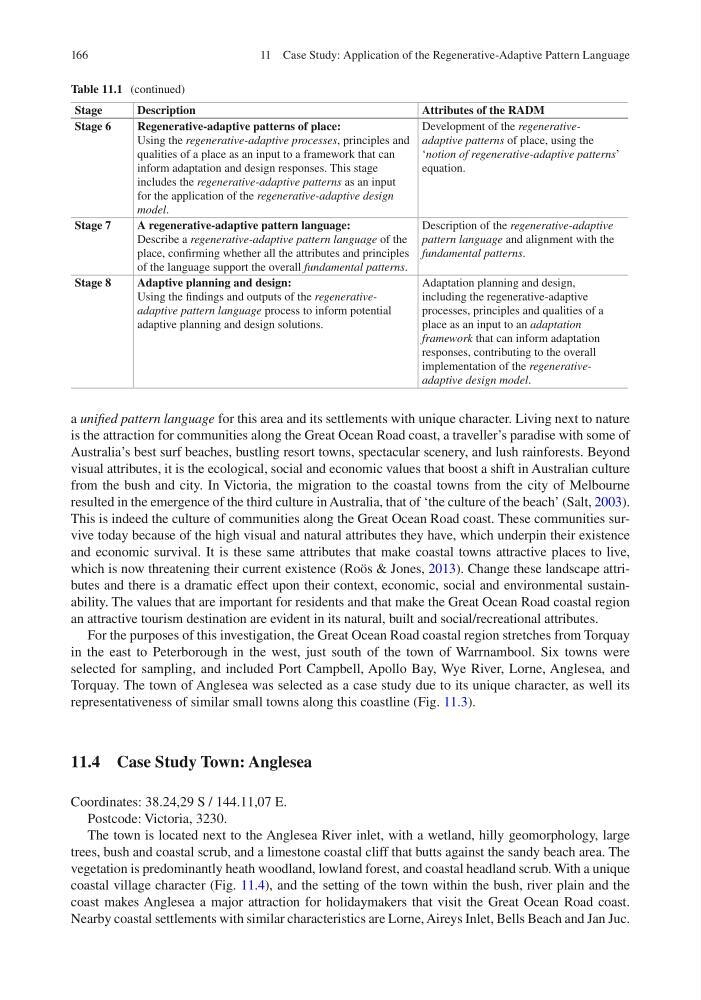
Table 11.1 (continued)
Stage
Description
Attributes of the RADM
Stage 6
Regenerative-adaptive patterns of place:
Using the regenerative-adaptive processes, principles and
qualities of a place as an input to a framework that can
inform adaptation and design responses. This stage
includes the regenerative-adaptive patterns as an input
for the application of the regenerative-adaptive design
model.
Development of the regenerativeadaptive patterns of place, using the
‘notion of regenerative-adaptive patterns’
equation.
Stage 7
A regenerative-adaptive pattern language:
Describe a regenerative-adaptive pattern language of the
place, confirming whether all the attributes and principles
of the language support the overall fundamental patterns.
Description of the regenerative-adaptive
pattern language and alignment with the
fundamental patterns.
Stage 8
Adaptive planning and design:
Using the findings and outputs of the regenerativeadaptive pattern language process to inform potential
adaptive planning and design solutions.
Adaptation planning and design,
including the regenerative-adaptive
processes, principles and qualities of a
place as an input to an adaptation
framework that can inform adaptation
responses, contributing to the overall
implementation of the regenerativeadaptive design model.
11 Case Study: Application of the Regenerative-Adaptive Pattern Language
a unified pattern language for this area and its settlements with unique character. Living next to nature
is the attraction for communities along the Great Ocean Road coast, a traveller’s paradise with some of
Australia’s best surf beaches, bustling resort towns, spectacular scenery, and lush rainforests. Beyond
visual attributes, it is the ecological, social and economic values that boost a shift in Australian culture
from the bush and city. In Victoria, the migration to the coastal towns from the city of Melbourne
resulted in the emergence of the third culture in Australia, that of ‘the culture of the beach’ (Salt, 2003).
This is indeed the culture of communities along the Great Ocean Road coast. These communities survive today because of the high visual and natural attributes they have, which underpin their existence
and economic survival. It is these same attributes that make coastal towns attractive places to live,
which is now threatening their current existence (Roös & Jones, 2013). Change these landscape attributes and there is a dramatic effect upon their context, economic, social and environmental sustainability. The values that are important for residents and that make the Great Ocean Road coastal region
an attractive tourism destination are evident in its natural, built and social/recreational attributes.
For the purposes of this investigation, the Great Ocean Road coastal region stretches from Torquay
in the east to Peterborough in the west, just south of the town of Warrnambool. Six towns were
selected for sampling, and included Port Campbell, Apollo Bay, Wye River, Lorne, Anglesea, and
Torquay. The town of Anglesea was selected as a case study due to its unique character, as well its
representativeness of similar small towns along this coastline (Fig. 11.3).
11.4 Case Study Town: Anglesea
Coordinates: 38.24,29 S / 144.11,07 E.
Postcode: Victoria, 3230.
The town is located next to the Anglesea River inlet, with a wetland, hilly geomorphology, large
trees, bush and coastal scrub, and a limestone coastal cliff that butts against the sandy beach area. The
vegetation is predominantly heath woodland, lowland forest, and coastal headland scrub. With a unique
coastal village character (Fig. 11.4), and the setting of the town within the bush, river plain and the
coast makes Anglesea a major attraction for holidaymakers that visit the Great Ocean Road coast.
Nearby coastal settlements with similar characteristics are Lorne, Aireys Inlet, Bells Beach and Jan Juc.
Table 11.1 (continued)
Stage
Description
Attributes of the RADM
Stage 6
Regenerative-adaptive patterns of place:
Using the regenerative-adaptive processes, principles and
qualities of a place as an input to a framework that can
inform adaptation and design responses. This stage
includes the regenerative-adaptive patterns as an input
for the application of the regenerative-adaptive design
model.
Development of the regenerativeadaptive patterns of place, using the
‘notion of regenerative-adaptive patterns’
equation.
Stage 7
A regenerative-adaptive pattern language:
Describe a regenerative-adaptive pattern language of the
place, confirming whether all the attributes and principles
of the language support the overall fundamental patterns.
Description of the regenerative-adaptive
pattern language and alignment with the
fundamental patterns.
Stage 8
Adaptive planning and design:
Using the findings and outputs of the regenerativeadaptive pattern language process to inform potential
adaptive planning and design solutions.
Adaptation planning and design,
including the regenerative-adaptive
processes, principles and qualities of a
place as an input to an adaptation
framework that can inform adaptation
responses, contributing to the overall
implementation of the regenerativeadaptive design model.
11 Case Study: Application of the Regenerative-Adaptive Pattern Language